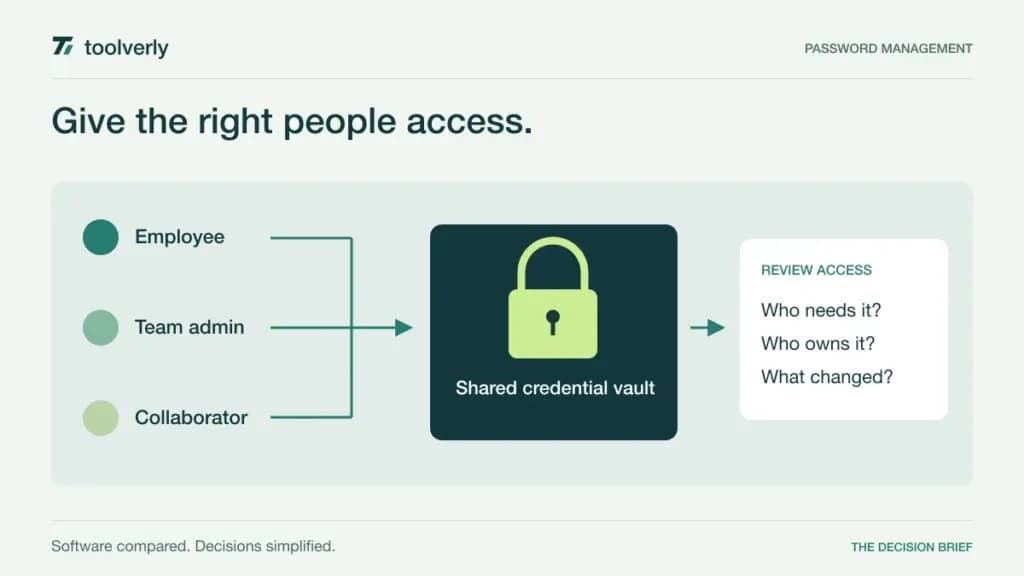
A business password manager should make shared access understandable: who owns a login, who can use it, and what happens when that person changes roles or leaves. Storing passwords is only the beginning. The buying decision also includes deployment, account recovery, reporting, and the everyday experience of finding the right credential.
This comparison covers 1Password, Bitwarden, Dashlane, Keeper, and NordPass for workforce password management. Official sources were checked on September 23, 2026. We assess documented capabilities and plan fit; this is not an independent security audit, penetration test, or claim that one product cannot be breached.
Separate employee access from infrastructure secrets
Start by identifying the records your employees actually need to share. A marketing account, a supplier portal, and an application used by contractors may need different owners and access rules. Machine credentials and automated service access can require a separate secrets-management workflow; do not assume the workforce password subscription covers every technical use case.
| Product | Best fit | Main strength | Tradeoff to examine |
|---|---|---|---|
| 1Password | Teams organizing access around shared vaults | Small-team package with a broader Business tier | Starter and Business have different commercial models |
| Bitwarden | Teams comparing clear business tiers | Sharing and provisioning with an Enterprise upgrade path | SSO and advanced policies require the right tier |
| Dashlane | Organizations separating vaults from risk detection | Distinct Password Management and Credential Protection packages | Older plan names can mislead comparisons |
| Keeper | Organizations needing delegated administration | Shared folders and progressively deeper controls | Advanced provisioning is an Enterprise consideration |
| NordPass | Small teams planning a structured rollout | Team package and more advanced business options | Minimum seats and contract term affect the bill |
1Password
1Password’s Teams Starter Pack is listed at $24.95 per month paid annually, including ten members. The current page also allows additional seats under separate per-member pricing. Business is $8.99 per user per month paid annually, with broader identity-provider integrations and business controls. Do not compare the Starter package price with a competitor’s single-user rate.
Shared vaults, access permissions, and Watchtower alerts are central to the documented offering. Our assessment is that 1Password merits a trial when a company wants an approachable way to organize credentials around teams and responsibilities. The first design task is deciding which vault owns each shared record and who can approve access.
The tradeoff is choosing the right level of administration rather than simply the cheapest entry package. Map your identity-provider and reporting requirements to Business before committing. In the trial, have a new employee find a shared login without asking the administrator to explain the folder structure. Then check the same workflow when that employee changes departments.
Bitwarden
Bitwarden’s business pricing makes the Teams and Enterprise distinction explicit. Teams is $4 per user per month billed annually and includes credential sharing, event logs, directory synchronization, and SCIM provisioning. Enterprise is $6 on the same billing basis, adding capabilities such as SSO, enterprise policies, granular access controls, and the option to self-host.
Our fit judgment favors Bitwarden when buyers want to compare a relatively clear business feature boundary and evaluate whether Enterprise controls are necessary. For a team using an identity provider, distinguish provisioning a user from authenticating that user: those are related but different requirements, and should be demonstrated separately.
The tradeoff is operational ownership. Self-hosting is an option, not a shortcut around maintenance, backups, or availability planning. A hosted deployment may better fit a team without an owner for those tasks. During evaluation, create a shared collection with a narrow purpose, grant access to the appropriate group, and inspect the resulting activity record. Confirm that the proposed tier supports the complete process.
Dashlane
Dashlane’s current professional packaging uses the Omnix name. Password Management covers the vault, credential sharing, administrative policies, and integrations. Credential Protection is a separate package for detecting and responding to credential risks. Omnix Enterprise combines the two, with packaging tailored to the organization.
This distinction is more useful than comparing obsolete plan names. Dashlane’s current support documentation says it no longer sells Starter, Team, or Standard plans to new customers. Its plan matrix places SSO and SCIM in Password Management, while broader credential-risk detection and AI phishing alerts appear in Credential Protection or Enterprise.
Our recommendation is to shortlist Dashlane when the company wants to make vault management and additional credential-risk coverage explicit purchasing decisions. The tradeoff is scope: ask which employees need each capability and how the package is licensed. The public pricing page presents annual per-user billing but did not expose a reliable numeric amount in our review; request or confirm the current offer. Avoid assuming every Omnix capability is included in the password-management subscription.
Keeper
Keeper’s Business Starter tier lists an encrypted vault, administrative console, sharing, and autofill for five to ten users. Business adds shared team folders and delegated administration. Enterprise adds advanced provisioning, including SCIM, directory and SSO connections, together with further role-based controls and developer interfaces.
Our assessment is that Keeper deserves attention when responsibility needs to be delegated across departments rather than concentrated in one administrator. Model that structure before evaluating the console: define what a department administrator should manage and what must remain under central control.
The public page describes annual per-user billing for the business tiers, with Enterprise available through a quote. Numeric amounts were not reliably exposed in our source capture, so confirm the current regional offer and any add-ons directly. The tradeoff is administrative scope. A larger set of controls is only helpful if the team can maintain it. Test an ordinary access request, a change of department, and a departing employee against the exact tier being considered.
NordPass
NordPass offers Teams, Business, and Enterprise options. The pricing page presents Teams as a ten-user pack, while Business and Enterprise carry minimum-seat requirements. Business adds group-based sharing, shared folders, and security-dashboard features to the core password-management offering. Enterprise extends the administrative and identity-provider options.
Our fit judgment is to evaluate NordPass when a small organization wants a defined team package and a path toward more structured administration. Begin with the number of people who need access today and the likely count after the next hiring cycle. A package designed for ten users has a different cost profile from a purely incremental seat model.
The page offers monthly, one-year, and two-year terms, with promotional savings and region-dependent checkout details. Because the numeric prices remained dynamic placeholders in our review, confirm both the initial total and renewal terms directly. The tradeoff is matching the exact plan to your identity provider and provisioning needs. Request a demonstration of the required integration rather than inferring it from the broad label “business.”
Evaluate the complete employee lifecycle
Build a pilot around three roles: a permanent employee, a department administrator, and a short-term collaborator. Create only test credentials for the exercise. Give each role the access it should have, then verify that an unrelated team record remains inaccessible. This reveals whether your intended structure is understandable before importing real business data.
Next, simulate someone losing access to their usual device. Ask the administrator to follow the documented recovery process and record which approvals are required. Recovery that nobody understands can create a business interruption, while a process that depends on one unavailable person is difficult to operate. Evaluate the process your organization will actually adopt.
Finally, simulate a departure. Review which records remain owned by the organization and which access paths must be removed. If someone knew a shared password outside the manager, revoking vault access alone does not erase that knowledge; the underlying service may need a password change or other access update. Write that responsibility into the exit checklist.
Check daily usability and administration together
Ask pilot participants to use their normal supported browsers and devices. Include a shared account with an unusual login flow and a record that must be handed to another team. Count requests for help and note where naming or ownership is unclear. These observations are more useful for adoption than a generic feature count.
Keep non-secret operating instructions in a shared handbook, with the sensitive values stored in the chosen vault. Our team wiki comparison covers the documentation side. Track rollout responsibilities and unresolved access questions using a suitable project management tool, without copying credentials into task descriptions.
- Confirm required sharing, recovery, reporting, SSO, and provisioning capabilities by tier.
- Calculate the actual package or minimum-seat cost for the full contract term.
- Inspect the distinction between employee, administrator, and external access.
- Review export options and the process for moving organization-owned records.
- Assign owners for onboarding, recovery, periodic access review, and departures.
Shortlist 1Password for vault-centered team organization, Bitwarden for a clear Teams-to-Enterprise comparison, Dashlane for separately scoped credential protection, Keeper for delegated administration, and NordPass for a packaged small-team rollout. Choose the product and tier that pass your employee lifecycle, then document the access rules before expanding beyond the pilot.
Official sources
Checked September 23, 2026: 1Password business plans, Bitwarden business plans, Dashlane pricing and current professional-plan matrix, Keeper business plans, and NordPass business plans. Dollar amounts are USD. Check taxes, renewal conditions, and current quoted terms before purchase.
Original illustration by Toolverly. Read about our publication or send a correction.