A new teammate asks how a customer handoff works. Three people send three different links, and none of the documents makes clear which instructions are current. The problem is not a lack of written information. It is a lack of a dependable place to find the version somebody still owns.
A team wiki should make useful knowledge easier to retrieve, maintain, and trust. Some businesses want documents beside project databases. Others need a structured company handbook or a focused system for reviewing old instructions. Those needs lead to different purchases even when every product offers an editor and search.
We compared Notion, Confluence, Slite, Nuclino, and Slab using official sources checked on September 22, 2026. Recommendations are our assessment of documented capabilities and workflow fit, not a hands-on search-quality benchmark. Plan boundaries and billing models matter, especially when most of the company reads information but only a few people maintain it.
Decide what belongs in the wiki
Start with information that should survive the project that created it: a repeatable process, a decision with long-term consequences, an onboarding guide, or a clear explanation of ownership. Meeting notes can support that information, but a pile of meeting notes is not automatically a usable handbook.
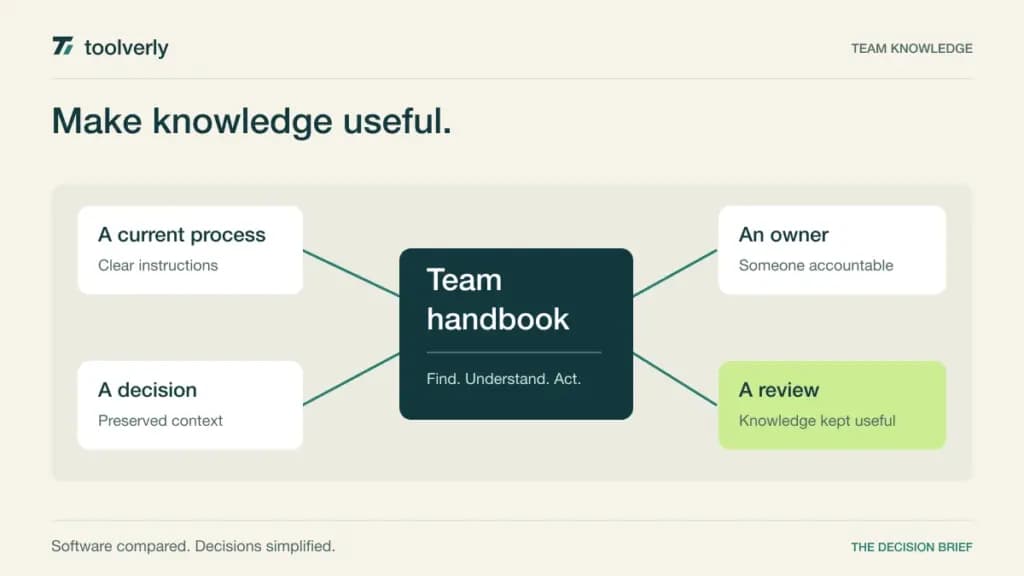
Give each important page an owner and a reason to be reviewed. A change in a product, policy, or customer process should trigger an update. Search becomes more helpful when it leads readers to material somebody is still responsible for, instead of merely locating every historical mention of a subject.
Five team wikis compared
| Product | Best fit | Main strength | Main tradeoff |
|---|---|---|---|
| Notion | Teams joining documentation and structured work | Pages, databases, and adaptable workspaces | Flexibility needs a shared information structure |
| Confluence | Organizations building structured team spaces | Pages, templates, and paid access controls | Free-plan permissions differ from paid editions |
| Slite | Teams prioritizing maintained knowledge | Document ownership and verification | AI, reader seats, and governance vary by plan |
| Nuclino | Small teams wanting connected documents | Collaborative items and several navigation views | All users, including readers and guests, count for billing |
| Slab | Teams organizing a focused internal handbook | Posts, topics, and unified search | Private topics and deeper controls depend on the tier |
Notion
Notion combines documents with databases and multiple ways to organize work. It is a plausible choice when a team wants a handbook to sit near project records, product information, or other structured material.
Our assessment is that the flexibility works best when somebody establishes a small set of page types and navigation rules. A customer-facing process, an internal decision, and a project note should be distinguishable without asking readers to understand how each author designed their workspace.
Plan boundaries deserve attention. Free collaboration is limited for teams, while Business includes features such as private teamspaces and page verification. More advanced administration and provisioning appear in Enterprise. Do not assume that a personal workspace demonstrates the controls a company deployment needs.
Pricing context: Paid plans are per member, with different annual and monthly terms. AI capabilities, guest access, history, and administration should be checked against the selected edition. Notion plans and feature comparison.
Confluence
Confluence organizes knowledge into spaces and pages, with templates for recurring documents and additional ways to connect work. It is worth evaluating for organizations that want a recognizable structure for departmental documentation, especially when Atlassian products already form part of the working environment.
Our recommendation is to build one space around an actual team process. Ask a reader to navigate from an overview to the current procedure and then to its supporting decision. The quality of that path matters more than the number of pages imported.
The Free edition is not an equivalent permissions trial. Atlassian documents restrictions on space and page permissions on Free; Standard adds more access controls and guest collaboration. Evaluate confidential and broadly shared material separately.
Pricing context: Free supports up to ten users. Paid pricing depends on users and billing terms; annual subscriptions use user tiers. Include any additional apps or identity requirements in the quote. Confluence pricing; Free-plan permission limits.
Slite
Slite emphasizes the maintenance of company knowledge alongside collaborative writing. Its current plans list document ownership, verification, and a knowledge-management panel, making it relevant when outdated instructions are the main reason people do not trust the wiki.
Our assessment is that it fits a team willing to assign owners and review documentation deliberately. A verified marker is useful only when someone has actually checked the information; the software supports the routine rather than replacing the judgment behind it.
The current packages distinguish Basic, Pro, and Enterprise. Search across connected tools and agent features are part of the higher-level proposition, while reader-only seats and more extensive governance appear in Enterprise. Test what the intended plan includes before evaluating company-wide cost.
Pricing context: Basic and Pro use per-member subscriptions; Enterprise has custom pricing. Compare AI allowances, identity controls, storage, and reader access alongside the editor. Slite pricing and knowledge-management features.
Nuclino
Nuclino provides collaborative documents with list, board, table, and graph views. It is a candidate for teams that want connected knowledge without beginning with a large intranet or a highly customized workspace.
Our view is that the evaluation should focus on writing and retrieval. Create a small group of related procedures, link them where context is needed, and see whether a new reader can find the next relevant explanation. Visual navigation is useful only if the relationships make sense.
Pricing deserves particular attention in a company with many occasional readers. Nuclino defines users to include guests and read-only members, and a paid upgrade covers the entire team. A modest author group does not necessarily mean a small paid-user count.
Pricing context: Free allows up to 50 items. Starter removes the item limit and includes 30-day history; Business adds controls including audit logs and SAML SSO. Compare the actual participant count. Nuclino plans and user definition.
Slab
Slab organizes a knowledge base around posts and topics, with collaboration, verification, and unified search. It is relevant when the team wants a focused internal handbook and a clearer route to information already held across connected tools.
Our assessment is that a handbook trial should include both navigation and a realistic search question. Ask a colleague who did not write the content to find the current answer, explain its scope, and identify the responsible person.
The commercial boundaries include private topics, history, integrations, and governance. Slab also explains that it does not have an inherently read-only user account; editing access follows how content is organized and shared. Validate those rules for the audience you intend to invite.
Pricing context: Free supports up to ten users. Startup is listed at US$6.67 per user per month billed annually, while Business is US$12.50 on that basis. Enterprise uses custom pricing. Slab pricing and access model.
Evaluate trust, not just search results
Prepare five documents: a current procedure, a superseded version, a decision explaining the change, a project note that mentions the procedure, and a confidential exception. Give each a realistic title. This small collection is enough to reveal whether the proposed structure helps readers distinguish evidence from instruction.
Ask somebody outside the original team to answer a practical question, such as how to hand a newly signed customer to delivery. Do not provide the exact document title. Observe which page they find and whether they can explain why it should be trusted.
If the product offers AI answers, ask the same question through that route. Open the supporting sources and check whether the answer preserves the conditions and exceptions in the original material. A fluent response should not become a substitute for verifying an operational instruction.
Test access using a role with the permissions a normal reader will have. An administrator’s successful search does not establish what an employee, contractor, or guest can see. Confirm both that restricted material stays restricted and that ordinary instructions remain discoverable.
Finally, export the sample. Check whether the result preserves enough structure, links, and attachments to remain understandable. This makes future migration a concrete consideration, rather than an assumption that every piece of information can be recovered later.
- Give important pages an owner and review trigger.
- Separate current instructions from archived project context.
- Keep the navigation understandable to a new employee.
- Budget for readers, guests, integrations, and governance requirements.
Choose the system that supports a maintenance habit
Our starting shortlist is Notion for flexible documents and structured work, Confluence for organized team spaces, Slite for knowledge maintenance, Nuclino for connected lightweight documentation, and Slab for a focused handbook. Choose the product that makes a current answer easy to find and easy for its owner to update. A smaller collection people trust is a stronger foundation than a large archive nobody is responsible for.
Original illustration by Toolverly. Read about our publication or send a correction.
Connect knowledge with the rest of your workflow
Use a wiki for durable instructions and decisions, and a project-management tool for owners, deadlines, and the next action. If an instruction describes an integration, our workflow automation comparison can help you evaluate who will maintain that process when a connection fails.