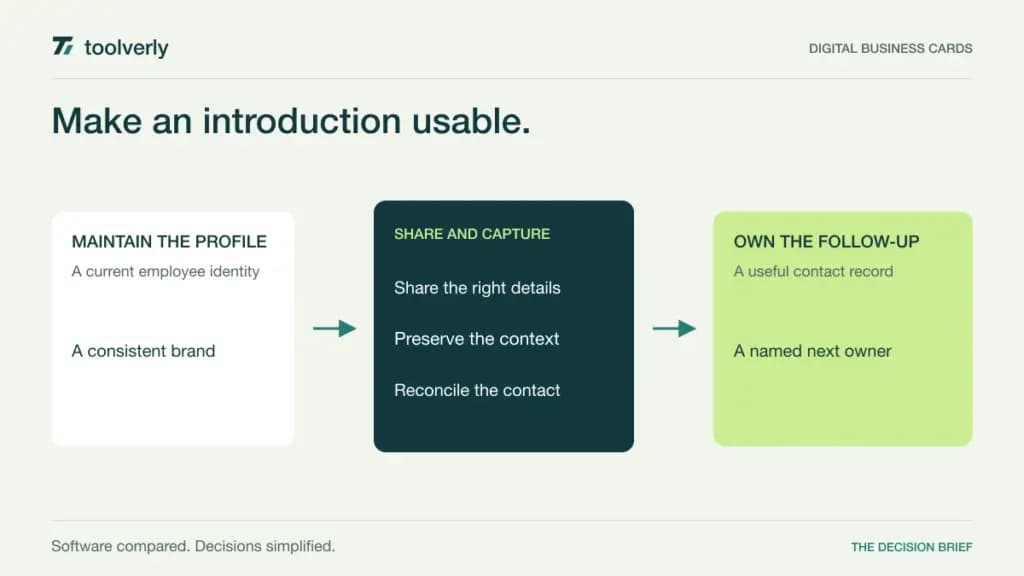
A business card exchange is a small workflow with several opportunities to fail. The employee’s title may be outdated, the recipient may never save the details, or a promising conversation may become a contact without an owner. Digital business card platforms maintain a shareable professional profile and increasingly connect that exchange to contact capture and CRM follow-up.
HiHello, Blinq, Popl, Mobilo, and Wave Connect serve different versions of this need. Some emphasize branded employee identity; others extend toward event lead capture or physical NFC cards. Choose around the exchange your team actually makes. Published features and commercial terms were checked on October 11, 2026; this article does not claim measured scanning accuracy or conversion results.
For the destination of captured contacts, compare small business CRM software. If you organize the event itself, our event registration comparison addresses ticketing and check-in, a separate decision from how employees introduce themselves.
Compare the five platforms
| Product | Best fit | Main strength | Meaningful tradeoff |
|---|---|---|---|
| HiHello | Consistent employee identity | Cards, email signatures, and team templates | Business purchase starts at five users |
| Blinq | Simple sharing with team capture | Digital profiles and centralized contact workflows | Individual and team entitlements differ |
| Popl | Teams attending many events | Card sharing connected with event lead capture | Team pricing needs a scoped quote |
| Mobilo | Physical tap-to-share deployment | NFC cards linked to maintained profiles | Hardware and ongoing software costs are separate |
| Wave Connect | Small branded teams | Profile control and contact handoff | AI capture uses a separate credit pool |
HiHello
HiHello combines digital cards with email signatures, virtual backgrounds, contact scanning, and branded templates. Its Business plan adds centralized team controls and directory-related capabilities. This is a coherent choice when the same employee identity should appear in several everyday business surfaces rather than only during a trade show.
The official page lists Professional at $6 per month, billed $72 yearly, for one user. Business is $5 per user per month, or $60 per user yearly, for five to one hundred users. Enterprise covers larger deployments with custom pricing. Scan allowances differ: Professional lists twenty card and badge scans monthly, while Business describes unlimited scanning and enrichment.
Best fit: companies that want a maintained brand presence across employee cards and signatures. Limitation: an individual’s paid plan is not the same purchase as a centrally administered team. Evaluate the five-user minimum against the size of the actual rollout.
Ask an administrator to change a department name and then have a representative share the updated profile. Test both the employee’s convenience and the recipient’s ability to save the contact. Consistency matters most after changes, so include a promotion, a transferred employee, and an offboarding scenario in the evaluation.
Blinq
Blinq’s free offering supports two digital cards, unlimited sharing and contact creation, QR and message-based sharing, and mobile wallet cards. Business adds team templates, automated provisioning, a corporate contact book, and lead capture linked to CRM workflows. These capabilities connect an approachable individual exchange to an administered business process.
The pricing page lists Premium at $9.99 monthly and Business at $6.99 per user monthly when billed monthly. Annual pricing is a separate selection. Premium includes additional cards, scanning, enrichment, and an AI notetaker; Business adds organization-oriented identity and capture features. Verify the exact integration and capture allowance for the selected subscription.
Strength: a clear path from personal sharing to team management. Limitation: additional capture features are useful only if the contact data and notes reach the correct destination. Best fit: teams that need low-friction employee sharing with controlled follow-up.
Use two representatives meeting the same person as a practical pilot. Inspect whether the resulting CRM record duplicates, how ownership is assigned, and whether a scanned title overwrites a verified one. A larger contact list is not automatically a better sales workflow; the record needs enough context for a respectful, relevant next conversation.
Popl
Popl’s current team offer emphasizes event lead capture, with digital business cards included. The pricing page describes badge scanning, contact and company enrichment, event campaigns, qualifying questions, CRM connections, and onboarding support. It also points individuals toward a simpler personal card app.
Team pricing is requested rather than presented as a stable public subscription amount. The published offer includes unlimited events and conferences, but that does not establish that every kind of scan, enrichment, integration, or service has no commercial boundary. Ask for the exact annual scope, capture allowances, support, and renewal terms.
Best fit: organizations whose card exchange is part of a repeated event acquisition program. Limitation: this broader workflow can be excessive for a team that only wants a branded profile link. Do not buy an event operations package simply because the physical card looks appealing.
Build the pilot around the end of an event day. Can a representative qualify a conversation, preserve a note, and send it to the right CRM campaign? Ask the receiving salesperson to review the record without speaking to the scanner operator. That exercise exposes missing context, unsuitable required fields, and confusing campaign ownership before hundreds of contacts enter the pipeline.
Mobilo
Mobilo offers physical NFC cards and QR codes tied to a digital profile. Its Team offer describes centralized management, locked or overridden profile fields, analytics, and CRM integrations. This makes the hardware part of an ongoing identity system rather than a fixed printed description.
The page separates card purchases from a Team software charge shown as an additional $4 per month. Hardware prices vary by material and design. It also displays multiple promotional amounts and expired-looking campaign dates, so this comparison does not present a promotional card price as a guaranteed current purchase. Confirm the recurring billing unit, commitment, shipping, taxes, replacement cards, and post-trial cost in writing.
Strength: a familiar physical exchange that can still point to updated information. Limitation: procurement includes both a device and software service. Best fit: employees who regularly meet people in person and prefer carrying a card.
Try the tap and QR paths with different recipient phones and without installing the vendor’s app on the recipient device. Include the fallback for somebody who declines NFC or has poor connectivity. Also decide who replaces a lost card and how its old destination is disabled. These details determine whether the hardware remains practical after launch week.
Wave Connect
Wave Connect provides digital cards, wallet sharing, signatures, saved contacts, and lead capture. Its Teams package adds an administrative workspace, bulk profile editing, templates, locked content, CRM synchronization, and a shared lead dashboard. Wave Connect is a networking product, unrelated to the accounting software called Wave.
Pro lists $7 per month billed annually. Teams lists $5 per user per month billed annually with a three-user minimum. Enterprise is custom. AI badge and business-card capture and enrichment are credit-based: free trial credits do not imply unlimited ongoing scanning, and teams share a credit pool.
Best fit: smaller teams that need brand control and contact handoff without a large initial seat purchase. Limitation: a predictable seat price still requires budgeting for capture credits. Separate ordinary profile sharing from the AI operations the team expects to use.
Have a manager edit a locked field while an employee edits an allowed field, then review what recipients see. Test the CRM path with a contact already in the database. The most important outcome is a reliable professional identity and usable follow-up context, not the number of enrichment fields filled by automation.
Make the contact exchange the selection unit
Define the primary scenario first. A consultant sharing details after a meeting, a distributed team maintaining signatures, and a booth team capturing hundreds of leads have different requirements. Choose one dominant scenario and identify what must happen from introduction to saved contact to follow-up.
Separate outbound identity from inbound data. Employees should know which public fields they can edit and which are centrally maintained. Captured contacts need ownership, duplication rules, and an agreed destination. A card platform should not silently become an unmanaged parallel customer database.
Use a short evaluation checklist: share by link and QR; save on a recipient phone; update an employee profile; capture a contact with context; reconcile an existing CRM record; remove an employee; and export the company’s legitimate records. Treat consent, permitted enrichment, and appropriate follow-up as operational decisions for the company.
Compare total cost for the actual team, including minimum seats, annual commitments, scanning credits, CRM scope, onboarding, and physical replacements. A one-time card price is not a complete estimate for managed team software. Likewise, a free individual card can be sufficient when centralized control has no business value.
Shortlist HiHello for identity across cards and signatures, Blinq for approachable sharing and team handoff, Popl for event capture operations, Mobilo for physical tap-to-share deployment, and Wave Connect for smaller administered teams. The right choice is the one employees will use consistently and the receiving team can maintain after the exchange.
Official sources
Checked October 11, 2026: HiHello plans; Blinq pricing; Popl team offer; Mobilo hardware and plans; Wave Connect pricing. Confirm regional charges and final entitlements before purchase.
Original illustration by Toolverly. Read about our publication or send a correction.