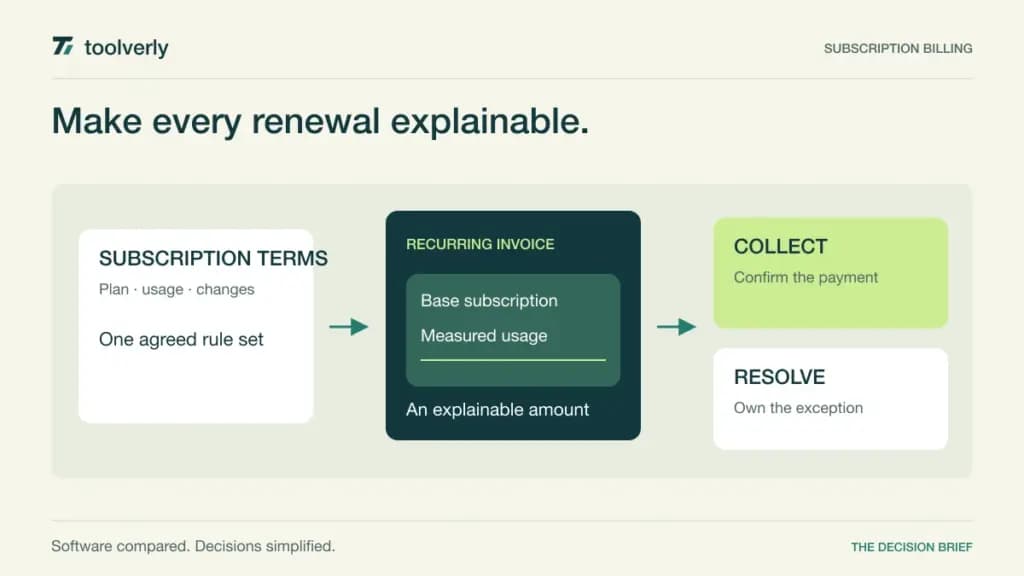
Subscription billing becomes difficult at the edges: a customer changes plans halfway through a period, a usage event arrives late, a payment fails, or finance cannot reconcile the invoice with the agreement. A useful billing system makes those events explainable. A checkout that accepts the first payment is only the start of the process.
Stripe Billing, Chargebee, Recurly, Paddle, and Maxio cover different combinations of recurring billing, collection, payment responsibility, and financial reporting. Start with your commercial model and the teams that own it. Comparing only the percentage fee can hide substantial differences in what the vendor does and what your organization still operates.
Research checked October 2, 2026. We reviewed official pricing and product sources, without conducting a hands-on billing migration or performance test. Rates below are current reference offers, not a complete cost estimate. Confirm the fee base, payment charges, regional eligibility, optional modules, taxes, and contract terms for your business.
Five subscription billing systems compared
| Product | Best fit | Main strength | Price reference | Meaningful tradeoff |
|---|---|---|---|---|
| Stripe Billing | Teams building recurring workflows around Stripe | Subscriptions, customer portal, and payment recovery | Pay as you go: 0.7% of Billing volume | Payment processing is a separate charge |
| Chargebee | Teams coordinating hybrid billing and multiple gateways | Usage ingestion, invoicing, and business-system connections | Flow calculator: $0 + 0.80% or $99 + 0.65% | Monthly invoicing volume and add-ons affect cost |
| Recurly | Subscription businesses managing plans and collection | Recurring billing with payment and retention tools | Starter: US$249/month plus volume fee | 0.9% applies above the included US$40,000 monthly billings |
| Paddle | Eligible software businesses wanting a merchant-of-record service | Billing bundled with payment and transaction administration | 5% + US$0.50 per Checkout transaction | A different commercial responsibility from billing software alone |
| Maxio | B2B teams joining billing and financial operations | Recurring and usage billing with finance reporting | Grow: US$599/month, up to US$100,000 monthly billings | Higher volume and advanced requirements need a quote |
Stripe Billing
Stripe Billing provides subscription management, a customer portal, automatic reminders, and Smart Retries alongside Stripe’s payment ecosystem. Its official Billing pricing page lists pay-as-you-go pricing at 0.7% of Billing volume. The charge covers Billing transactions on and off Stripe and excludes one-off invoices from that fee base. Payment processing remains separately priced. A subscription pricing option also exists, so the percentage model is not the only commercial route.
Strength: this is a practical starting point when the engineering team already owns a Stripe-based customer journey. Evaluate the whole lifecycle: creation, upgrade, cancellation, payment failure, and reactivation. For each event, check the customer’s view and the record your support team sees. Those two views should tell the same story.
Limitation: a familiar payment provider does not remove the work of defining billing behavior. Decide when a plan change takes effect and who resolves an incorrect invoice. Stripe Billing fits teams comfortable integrating and maintaining their commercial rules. Keep the processing fee and billing fee on different budget lines, and confirm whether additional metering or other services are required for your particular usage model.
Chargebee
Chargebee’s current Flow package combines price books and invoicing, usage ingestion and billing, usage alerts, analytics, and CRM or ERP connections. Its official calculator displays monthly invoicing volume with formulas of US$0 plus 0.80%, or US$99 plus 0.65%. Flow includes 100 million usage events per month. Enterprise adds requirements such as multiple business entities and account hierarchies; higher usage limits and some enterprise controls are paid add-ons.
Strength: Chargebee is worth evaluating when a business needs billing to coordinate with several operational systems or payment gateways. Map which application owns customer identity, contract terms, usage, and invoice status. Then follow one changed agreement through that map. A successful demonstration should reveal how conflicting updates are handled, not merely show that two systems connect.
Limitation: the calculator’s volume and formula must match the proposal you actually purchase. Request the selected fee basis, optional modules, and processing charges in writing. Chargebee fits teams with hybrid or evolving commercial models and a named owner for integration behavior. Avoid estimating its cost from an older plan name or treating every feature displayed in the comparison grid as part of Flow.
Recurly
Recurly manages subscription plans, billing, and collection alongside a wider product portfolio. The current pricing page lists Starter at US$249 per month plus 0.9% of billing volume, with the first US$40,000 of monthly billings included without that volume charge. Starter includes one dunning campaign and connections to more than 20 payment gateways. Higher-volume offers require scoped terms. The product overview describes additional subscription and revenue tools; confirm which products the proposal includes.
Strength: a subscription business can evaluate billing and payment recovery as one operational journey. In your trial, intentionally fail a payment and ask the service owner to explain the next customer message, retry, and account action. This exposes whether the team’s policy is understandable before real customers encounter it.
Limitation: one included campaign may not cover every segment or recovery strategy. Volume-dependent fees also change with growth, so price a typical month and a higher-volume scenario. Recurly fits teams that want a structured subscription lifecycle and can specify the required billing and recovery configuration. Keep other portfolio products separate until their scope and charges appear in the commercial offer.
Paddle
Paddle takes a different role: its merchant-of-record service bundles checkout, payments, subscription billing, and vendor-described transaction administration. The published Checkout rate is 5% plus US$0.50 per transaction, without a monthly fee on that offer. The package includes services such as tax administration, fraud and chargeback handling, buyer billing support, and reporting. Custom pricing is available for particular volume or low-value requirements.
Strength: eligible software sellers can evaluate a bundled operating model instead of assembling every transaction function themselves. Ask who handles each customer interaction: a refund request, an invoice question, a failed renewal, and a disputed payment. This makes the division of responsibility visible to product, finance, and support before a migration.
Limitation: the merchant-of-record arrangement is a commercial decision as well as a software choice. Confirm eligibility, agreement terms, payout behavior, and the parts of your business that remain your responsibility. Paddle fits teams that want this defined service model. Its percentage should be compared with the combined costs and responsibilities of alternatives, rather than with a billing-only percentage that excludes processing and administration.
Maxio
Maxio joins recurring and usage billing with financial reporting and collections. Its current pricing page lists Grow at US$599 per month for up to US$100,000 in monthly billings, with Scale quoted above that level. The page includes subscription and usage billing, collections, and more than 20 gateway connections. It distinguishes standard and advanced financial capabilities across packages; request the specific reporting and integration scope needed by your finance team.
Strength: Maxio deserves a shortlist place when billing data must support a repeatable finance handoff. Give the evaluation a sample agreement, an amendment, and a credit. Ask both the billing administrator and finance reviewer to explain how those records appear in their work. The point is traceability across the handoff, not a promise that software eliminates review.
Limitation: contract, implementation, and advanced reporting needs can change the effective commitment. A threshold alone is not a complete configuration. Maxio fits B2B teams that want billing and financial operations to share a clearer record. Bring the finance owner into selection early and request a migration plan that accounts for historical balances and existing customer agreements.
Evaluate the invoice lifecycle
Write a short scenario pack before asking for demonstrations. Include a new customer, a mid-period upgrade, a late usage adjustment, a failed payment, a cancellation, and a correction. Define the expected amount and customer communication for each scenario. If colleagues disagree, resolve the policy first; otherwise vendors will demonstrate different assumptions and the comparison will be misleading.
Next identify where billing events travel. A customer-facing team may need context from your customer success platform. Application messages may use a separate transactional email service. Check the event owner, duplicate handling, and failure visibility at those boundaries. An invoice sent successfully does not prove every dependent record is current.
- Separate platform, volume, payment, implementation, and optional-module fees.
- Ask how credits, reversals, and failed payments affect the fee base.
- Reconcile one sample invoice to its agreement and customer-facing explanation.
- Assign ownership for exceptions and document the correction process.
- Check how you export records and migrate away if requirements change.
Stripe Billing suits an integrated Stripe workflow, Chargebee a coordinated hybrid model, Recurly a structured subscription lifecycle, Paddle a merchant-of-record arrangement, and Maxio a billing-to-finance handoff. Choose the system whose behavior your team can explain when the transaction is no longer straightforward.
Original illustration by Toolverly. Read about our publication or send a correction.