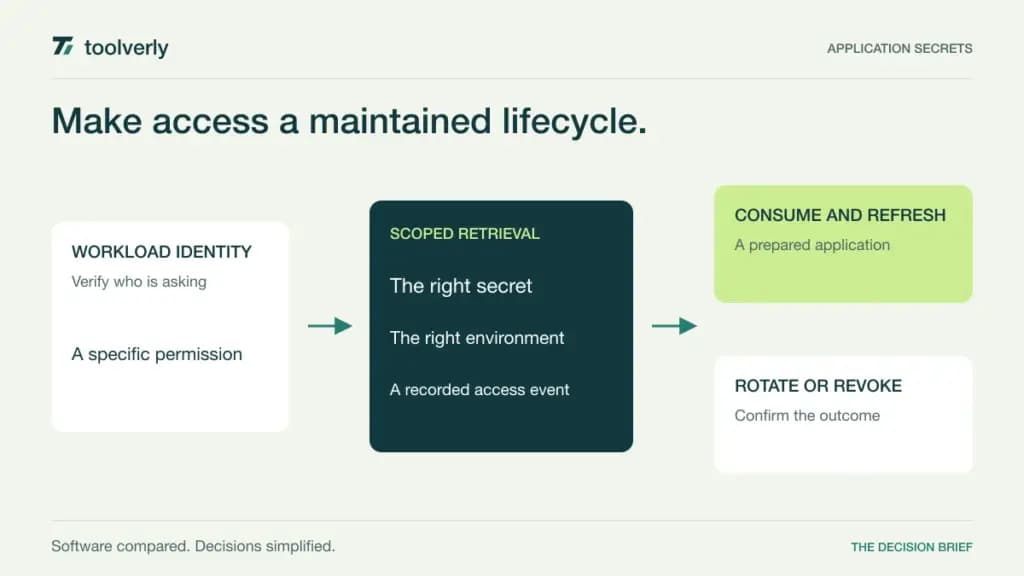
An application credential has a lifecycle that extends beyond storing its value. A workload needs to prove its identity, receive only the secret it should use, notice a rotation, and stop working with a revoked credential. The team also needs evidence of access and an agreed behavior when the secret service is unavailable.
HashiCorp Vault, Doppler, Infisical, AWS Secrets Manager, and Akeyless organize that work differently. Some emphasize an extensible credential service, some a developer configuration workflow, and some a cloud-native or managed hybrid operating model. The strongest choice is the one whose identity and operating assumptions match your workloads.
Official product, documentation, and price references were checked on October 7, 2026. This is a comparison of documented capabilities and buying decisions, not a penetration test or proof that a deployment is secure. The evaluation exercises below use disposable credentials and a non-production environment.
Five application secret operating models
| Product | Best fit | Main strength | Meaningful tradeoff | Price context |
|---|---|---|---|---|
| HashiCorp Vault | Platform teams needing programmable secret lifecycles | Identity-based access and dynamic credential workflows | Deployment and client charges require careful scoping | HCP cluster-hour plus production client charges |
| Doppler | Teams standardizing application configurations | Developer CLI, environments, and configuration syncs | Governance, log retention, and syncs vary by tier | Developer free for three users; Team $21/user/month |
| Infisical | Teams needing human and machine access in one model | Projects, integrations, and tiered lifecycle controls | Machine identities are part of the billing unit | Pro $20/identity/month, billed annually |
| AWS Secrets Manager | Applications already organized around AWS identity | Managed retrieval, rotation, and IAM access policies | API use and supporting architecture affect cost | Stored-secret and API-call billing |
| Akeyless | Organizations considering SaaS or gateway-based operation | Managed service with hybrid deployment choices | Client definitions and annual true-ups need review | Free limits; enterprise client-based quote |
HashiCorp Vault
Vault provides identity-based access to secrets with programmable creation, distribution, expiration, rotation, and revocation. Its documentation separates secret engines, authentication, and policy concepts. That structure is useful when a platform team wants a reusable service rather than a different credential-handling convention in every application.
The strength is lifecycle depth. Ask how a supported dynamic credential is issued to a workload and what happens when its lease expires. A stored static password and a short-lived generated credential solve different problems, so compare the actual backend and application integration.
Current IBM HCP Vault Dedicated pricing shows Development from USD0.62 per cluster-hour for a limited environment. Essentials starts at USD1.58 per cluster-hour and Standard at USD1.85, with a stated USD73 monthly charge per Vault client for those production offerings. Self-managed Enterprise pricing is custom. These are different deployment scopes, and the development price is not a complete production estimate.
The limitation is operational responsibility and commercial complexity. Vault fits a platform team prepared to own policy design, integration, and a scoped availability plan. Include client counting, cluster hours, and support in the estimate instead of comparing only an hourly infrastructure headline.
Doppler
Doppler centers on application secrets and configurations, with a CLI, service tokens, secret references, and configuration syncs. The Developer tier includes five syncs and three days of activity logs. Team adds controls such as change requests, SAML SSO, role-based access, service accounts, automatic rotation, and longer log retention.
Its strength is creating one understandable path from local development to deployed configuration. Demonstrate a developer changing a non-production value, a reviewer approving the change where applicable, and the receiving platform seeing the updated configuration. Decide whether a sync or runtime retrieval is the appropriate integration for each workload.
Developer is free for three users, with additional users at $8 per month; Team is displayed at $21 per user per month. Enterprise is quoted, and some Team additions carry separate per-seat charges. The pricing page explicitly describes non-human identities as not adding agent fees.
The limitation is assuming every governance feature and sync allowance is included at entry level. Doppler suits application teams seeking a maintained configuration workflow. Review log retention, allowed projects and environments, sync counts, and rotation compatibility before treating the subscription as the whole solution.
Infisical
Infisical’s secrets management offering uses projects and environments, integrations, secret references, overrides, and tiered access and lifecycle capabilities. Free includes five identities. Pro adds access controls, rotation, SAML SSO, versioning, recovery, and 30-day audit retention; Advanced adds dynamic secrets, temporary access, and expanded control and retention.
Its strength is making the workload identity part of the access discussion. A pipeline, service, and person may each need a different permission boundary. Evaluate those identities separately even when they share a project, and ask how decommissioning a pipeline removes its access.
The annual billing selection shows Pro at $20 per identity per month and Advanced at $40. An identity is defined as a human or machine authenticating to Infisical, so developer headcount alone is not the billable population. Enterprise is custom and includes further deployment and governance options.
The limitation is the gap between a convenient free setup and an organization-wide identity estate. Infisical fits teams that want explicit human and machine permissions, provided the budget counts both. Keep certificate management and privileged access pricing separate from the secrets product, and verify the exact tier needed for approvals, audit export, and deployment requirements.
AWS Secrets Manager
AWS Secrets Manager stores and retrieves application credentials and API keys, uses IAM policies to govern access, and supports rotation, replication, and integration with AWS monitoring. Its operating model is a managed service rather than a team-administered secret server.
The strength is fitting into an existing AWS workload identity design. Evaluate a specific workload role retrieving one secret, with a different role denied that access. Review the application’s rotation behavior as well as the retrieval call; successfully changing a stored value does not establish that every consumer has refreshed its connection.
Billing depends on stored secrets and API calls, without an upfront commitment. The official examples use $0.40 per secret per month and $0.05 per 10,000 calls. Those examples are a reference, not a universal regional estimate. Confirm the chosen region and supporting services in a scoped calculation.
The limitation is overlooking the rest of the architecture. Replication, encryption configuration, rotation execution, caching, and network access require their own design and potential costs. AWS Secrets Manager fits an organization already comfortable with IAM and AWS operations. Estimate the request pattern your application will produce, rather than assuming the number of human users determines the bill.
Akeyless
Akeyless presents Pure SaaS and Hybrid SaaS deployment choices, with gateways in the hybrid model. Its pricing page describes static, dynamic, and rotated secret capabilities and a free tier with limited clients and resources. Enterprise scope is configured through a proposal.
The strength is choosing where integration and operational control should sit. In a hybrid evaluation, ask what the gateway must reach, what it stores or caches, and which team owns its availability. A managed control plane does not remove every customer-operated dependency.
Akeyless defines clients as human users, applications, or servers initiating remote sessions. Its current rules say multiple instances of the same application count as one client, and describe monthly distinct-client tracking with annual quota true-ups. The free secrets tier lists five clients, 500 static secrets, and smaller dynamic and rotated-secret allowances.
The limitation is comparing that client unit directly with another vendor’s seat or identity unit. Request the billable population and the applicable 12-month contract conditions in writing. Akeyless suits teams evaluating a managed or hybrid credential service, especially when the gateway boundary is part of the decision. Demonstrate a failed retrieval and recovery path before relying on the integration for a critical workload.
Evaluate access, rotation, and failure together
Use a disposable service account and a sample application. Verify the allowed retrieval, a denied retrieval, rotation, consumer refresh, and revocation. Record which events appear in the audit trail and whether the team can explain them without exposing secret values in logs or screenshots.
Define how the application behaves during an outage and when a cached value expires. Assign ownership for every integration, including external destination credentials. A rotation button is useful only when the consumer and destination can complete the same lifecycle.
- Count human users, workload identities, clients, and API calls separately.
- Confirm production availability, log retention, and support scope.
- Use temporary credentials for evaluation and review cleanup.
- Document how the application receives changes and loses access.
Our business password manager comparison addresses employee credential use. Our application hosting guide addresses the runtime around the application. Choose secrets management for the identity, retrieval, rotation, and revocation lifecycle connecting those workloads to their dependencies.
Official sources and verification date
Product and pricing information checked October 7, 2026. These official references support the documented capabilities and commercial boundaries above; the evaluation advice is Toolverly editorial analysis.
- Vault product overview
- IBM HashiCorp pricing — select Vault
- Vault documentation
- Doppler pricing and allowances
- Infisical secrets management pricing
- AWS Secrets Manager usage pricing
- AWS Secrets Manager product
- Akeyless pricing units and deployment
Original illustration by Toolverly. Read about our publication or send a correction.