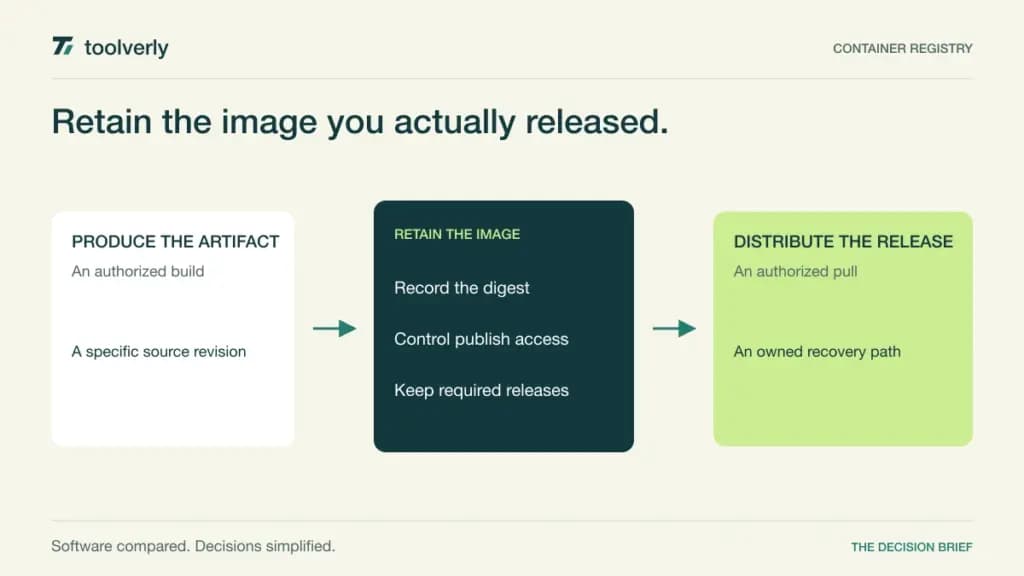
Your build finishes successfully, but production still needs a dependable place to obtain the image. That registry becomes part of the release path: it stores the artifact, controls who can publish or pull it, and determines whether an older version remains available when deployment needs to be reversed. Choosing it only by the price of storage misses most of the operating decision.
Docker Hub, GitHub Container Registry, GitLab Container Registry, Amazon ECR, and Harbor represent different tradeoffs between platform integration, managed distribution, and self-operated control. Compare the complete route from build identity to deployment pull, including a restart that happens after an old tag has been cleaned up.
Research checked October 13, 2026. This comparison uses current official pricing and documentation. We have not benchmarked pull speed, availability, scanning effectiveness, or security. A registry stores and distributes artifacts; your deployment and release policies still need separate ownership.
Compare artifact ownership and distribution
| Registry | Best fit | Main strength | Meaningful tradeoff |
|---|---|---|---|
| Docker Hub | Teams using Docker’s distribution ecosystem | Hosted public and private image repositories | Subscription and usage limits need separate review |
| GitHub Container Registry | Organizations building through GitHub | Images linked to repositories with granular permissions | Package and workflow access must be configured explicitly |
| GitLab Container Registry | Teams standardizing build and release in GitLab | Registry storage integrated with each project | Project paths and hosting model shape operation |
| Amazon ECR | AWS-centered deployment environments | Managed repositories with usage-based billing | Cross-region and internet transfer can change costs |
| Harbor | Organizations operating their own artifact service | Policy, role controls, scanning, and replication tools | The organization owns infrastructure and reliability |
Docker Hub
Docker Hub provides image repositories within Docker’s broader subscription ecosystem. The current pricing page lists Personal, Pro, Team, and Business. Team is displayed at $15 per user per month on the annual plan or $16 monthly, with role-based repository access, private repositories, and organization access tokens. Business adds administrative controls such as SSO and provisioning. These are subscription prices, not a pure per-gigabyte registry quote.
Capacity depends on access identity. The usage documentation distinguishes authenticated paid subscriptions, authenticated Personal users, and anonymous pulls. It also describes a separate abuse limit and fair-use controls. The pricing page and usage document show different Personal pull windows, so confirm the current limit for your actual accounts before relying on a free allowance.
Strength: managed image distribution with familiar Docker tooling. Limitation: unlimited paid pull rates remain subject to fair use and abuse protection. Docker Hub fits teams wanting a hosted repository with organization controls. Evaluate how CI publishes and how multiple deployment machines authenticate. A shared outbound address can change the experience of anonymous pulls, so rehearse a scale-out event instead of assuming one successful developer pull proves sufficient capacity.
GitHub Container Registry
GitHub Container Registry stores Docker and OCI images under a personal or organization namespace. The official registry documentation supports repository-linked permissions or granular package permissions, anonymous access to public images, and publication through GitHub Actions. A package pushed from a command line is not automatically linked to a repository just because its name resembles the project.
The billing documentation makes an important exception: container image storage and bandwidth are currently free, with at least one month’s notice promised before a policy change. General GitHub Packages private-package quotas should not be presented as current GHCR image charges. Actions compute and other services remain separate commercial questions.
Strength: connecting build workflows, source, and image ownership in an existing GitHub organization. Limitation: package access and workflow access can differ, particularly across repositories. GHCR fits teams prepared to configure those permissions deliberately. Demonstrate a producer repository, a separate deployment repository, and an external runtime pulling the image. Verify which identity authorizes each action and what remains available if an individual maintainer leaves the organization.
GitLab Container Registry
GitLab’s container registry documentation describes image storage integrated with each project across Free, Premium, and Ultimate tiers. The interface exposes tags, storage information, and manifest digests. Private image pulls require authentication. Image paths follow the namespace and project, which gives teams a familiar ownership model but creates considerations when projects move or are renamed.
The pricing comparison distinguishes GitLab.com, Self-Managed, and Dedicated. Premium lists $29 per user per month, billed annually, while Ultimate requests a custom quote. Those are platform plans, not mandatory standalone registry fees. Registry availability in Free does not establish unlimited hosted storage or eliminate the infrastructure bill for a self-managed installation. Ask which storage limits and controls apply to the selected offering.
Strength: keeping project code, CI, and images in the same operating environment. Limitation: project location and hosting responsibilities shape artifact access and maintenance. GitLab fits teams already managing delivery through its projects. In evaluation, retain a deployed digest while cleaning old build tags. Then rehearse a project transfer and confirm that deployment references, credentials, and retained artifacts still behave as the team expects.
Amazon ECR
Amazon Elastic Container Registry offers managed public and private repositories. Its pricing page charges for stored data and relevant transfer, with no upfront commitment. AWS’s worked private-repository example uses $0.10 per GB for storage: forty GB costs $4 per month before other charges. Treat that as a documented example and verify the rate for the intended region and configuration.
Transfers from a private registry to AWS services in the same region are free in the documented examples. Cross-region movement and internet distribution can add costs, and replication creates another transfer path to price. Public repository storage and download allowances follow a different model from private repositories. New-account credits also have eligibility and expiry conditions; they are not a durable operating budget.
Strength: a managed repository close to AWS deployment infrastructure. Limitation: placement and download patterns can outweigh a small storage bill. ECR fits AWS-centered teams with a clear account and regional layout. Estimate retained releases, shared layers, replication, and machine replacement during a busy period. Verify which account pays for private distribution and distinguish registry storage from scanning, encryption, or other separately scoped services.
Harbor
Harbor is an open-source registry designed for managing cloud-native artifacts. Its official project site describes policy and role-based access, scanning, content signing and validation, replication, identity integration, and a web interface. It can run in Kubernetes or on a Docker-capable system. This makes it relevant when a company needs to operate the artifact authority in an environment it controls.
There is no managed-service subscription price established by the project page. Budget compute, storage, network transfer, upgrades, monitoring, and the people handling incidents. A commercial hosting or support provider may add its own charges. Scanning and signing capabilities are tools for a configured release process, not proof that every stored image is safe or that a deployment will enforce the resulting policy.
Strength: substantial control over repository operation and artifact policies. Limitation: the business becomes responsible for service continuity and maintenance. Harbor fits organizations with an explicit platform operations owner. Before adopting it, rehearse a registry outage, a capacity warning, and an upgrade. Check whether deployments can still obtain required artifacts, how replication is monitored, and who can approve deleting a release that an environment still references.
Choose the release contract before the registry
Define what deployment consumes: a mutable tag, a retained digest, or an approved release reference. A digest identifies specific content, while a tag can change. Decide how the organization records the connection between source revision, built image, approval, and deployed environment. That record should remain understandable when the build system changes.
Next, specify retention around real deployment behavior. A cleanup rule that removes an apparently old image may break a later restart or a return to an earlier release. Count active environments and supported release versions before setting expiration rules. Keep publishing rights separate from routine pull access.
Use this evaluation checklist:
- Trace CI publication and runtime pulls with distinct identities.
- Verify private, internal, and public visibility.
- Demonstrate digest retrieval after routine cleanup.
- Price retained storage, repeated pulls, replication, and regional transfer.
- Assign scanning, policy exceptions, service maintenance, and incident ownership.
- Rehearse an outage and a release recovery without assuming unavailable artifacts can be rebuilt identically.
Our application hosting platforms comparison covers where software runs. Our secrets management guide covers controlled credentials. The registry supplies the retained artifact between those responsibilities.
Shortlist Docker Hub for hosted Docker distribution, GHCR for GitHub-connected builds, GitLab for project-integrated delivery, ECR for AWS proximity, and Harbor for self-operated control. Choose the one whose permissions, costs, and retention behavior your team can explain during a release problem.
Original illustration by Toolverly. Read about our publication or send a correction.