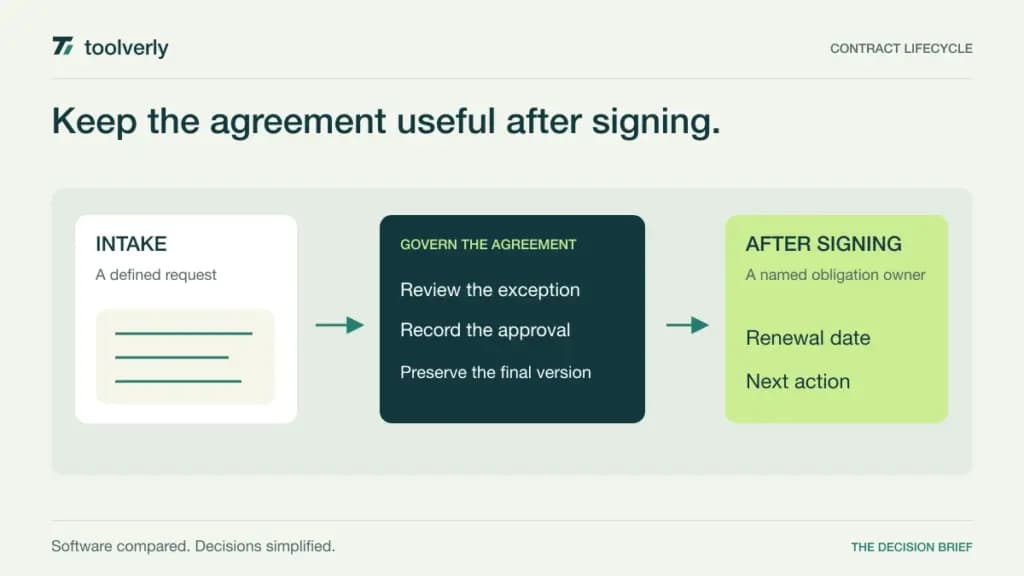
A signed agreement is only one milestone in a business relationship. Someone still has to find the approved template, negotiate changes, collect the right approvals, preserve the final version, and remember what happens at renewal. Contract lifecycle management software connects those steps so the agreement remains useful after the signing email disappears.
This comparison covers Ironclad, Juro, Contractbook, SpotDraft, and Agiloft. The decision is how your organization manages the entire contract process: intake, review, execution, storage, and ongoing responsibilities. A sales team generating attractive proposals or a department collecting occasional signatures may have a narrower requirement. Start with our guides to electronic signature software and procurement workflows when defining those neighboring handoffs.
Research basis: Official product and pricing pages checked on October 3, 2026. This is a document-based comparison; we have not conducted hands-on tests. All five vendors use configured quotes for the options discussed here. We distinguish published allowances from costs that require a written proposal.
Compare the contract operating model
| Product | Likely fit | Published commercial basis | Boundary to examine |
|---|---|---|---|
| Ironclad | Legal-led workflows and structured contract data | Configured quote; products and implementation options vary | Integration, API, and deployment scope |
| Juro | Broad business participation in controlled workflows | Quote based on contract volume and integration complexity | Premium integrations and implementation scope |
| Contractbook | Teams wanting explicit users and annual contract allowances | Quoted plans; Centralize lists 5 users and 350 signed contracts/year | Automation, API, and CRM packaging |
| SpotDraft | Teams seeking vendor-supported rollout | Quote by users or contract volume; implementation advertised as included | Actual migration and integration deliverables |
| Agiloft | Organizations with complex rules and data models | Configured CLM quote, including Astra in the listed CLM option | Configuration ownership and ongoing administration |
Ironclad
Ironclad connects contract workflows with a repository and structured contract information. Its pricing page separates CLM, its AI assistant, and electronic signature offerings, while listing different implementation approaches. That makes the purchasing discussion about the operating system your legal team needs, rather than a single per-seat subscription.
Strengths: The combination of workflow and searchable contract data is relevant when legal staff must explain both where a request is stuck and what the executed document says. A buyer can evaluate the handoff from a business request to review, then into the repository, instead of maintaining disconnected folders for each stage.
Limitations: There is no fixed public price for that configured deployment. APIs, integrations, additional instances, and success arrangements need explicit scope. Even a capable repository depends on consistent fields and a migration process that distinguishes current agreements from obsolete copies.
Best fit: A legal operations team prepared to own templates, structured data, and workflow changes. During evaluation, bring one ordinary agreement and one exception involving a nonstandard clause. Ask who can change the routing, what history remains visible, and how the final contract links back to the original request. See Ironclad’s commercial options.
Juro
Juro publishes a contract-volume and integration-complexity pricing model, with unlimited users, workflows, and templates on its plans. Its core connections include tools such as Slack and Google Drive; deeper connections to Salesforce, HubSpot, or Workday are described as extra-cost integrations. Implementation is tailored to workflow complexity.
Strengths: Unlimited participation is useful when many business colleagues initiate contracts but relatively few negotiate them. The buyer can focus on controlled templates and approved paths instead of deciding whether every occasional requester deserves a paid seat. This favors processes where business teams can handle standard requests within boundaries maintained by legal.
Limitations: Unlimited users do not mean unlimited contract volume or every integration at the same price. Ask how amendments, renewals, canceled requests, and imported agreements affect the quoted volume. A CRM handoff should be included in the proposal if it is essential to the process.
Best fit: Teams seeking wide participation with legal control over standard agreements. In a demo, have a requester choose an approved template, alter a field that should require review, and return to the task after an approver asks for clarification. That sequence exposes the practical boundary between self-service and escalation. Review Juro’s pricing explanation.
Contractbook
Contractbook’s published tiers make capacity relatively explicit. Centralize lists five users, 350 signed contracts per year, and 15 templates. Accelerate lists ten users and 500 signed contracts per year, alongside additional automation and organizational controls. The page offers a trial, followed by a limited free option; the business plans discussed here require a quote.
Strengths: Defined allowances help a smaller team frame a realistic buying conversation. The repository, uploaded-document data extraction, and export options support a move away from scattered agreement files. The tier distinctions also give the buyer a concrete way to discuss when a centralized archive should become a more automated process.
Limitations: API access is an add-on for Centralize and Accelerate. Automation and CRM connections have their own packaging boundaries. Do not equate an allowance for signatures with the annual count of signed contracts, or assume that a higher tier includes every external connection.
Best fit: Organizations that can forecast agreement volume and prefer an explicit capacity discussion. Request a quote using actual annual contracts, required administrators, and the desired CRM connection. Then import a sample with an unusual renewal condition and check whether its extracted fields can be corrected and exported. Consult Contractbook’s plan details.
SpotDraft
SpotDraft describes custom pricing based on users or contract volume. Its pricing page advertises implementation by its in-house team as included, covering workflows, integrations, and legacy data. Templates, approvals, signing, and a searchable repository sit within the broader contract process.
Strengths: Included implementation is a meaningful starting point for a department that lacks spare technical capacity for rollout. The practical opportunity is to agree one joined-up process: what the requester enters, which approval follows, where execution happens, and what information survives into the repository.
Limitations: The word “included” still needs a statement of work. Record the migration volume, source file quality assumptions, named integrations, acceptance criteria, and responsibilities for later changes. A standard agreement should not be the only example used to judge a workflow with many exceptions.
Best fit: Legal teams that value a vendor-led implementation and can dedicate an internal process owner. Ask the implementation team to explain a failed import, a reassigned approver, and a partially signed agreement. Those examples clarify operational responsibilities more effectively than a polished happy-path demonstration. Read SpotDraft’s pricing and rollout description.
Agiloft
Agiloft emphasizes configurable contract workflows and data models, with approval routing, document generation, comparison, repository functions, and obligation tracking. Its current pricing form lists a CLM option that includes Astra, as well as a separate Astra selection. Pricing is configured through the vendor rather than a published monthly amount.
Strengths: Configuration flexibility matters when agreements cross business units with different fields, approval rules, and reporting needs. A team can evaluate whether the system represents its process accurately instead of reshaping every exception into the same narrow template.
Limitations: Flexible systems require governance of their configuration. Define who owns field changes, tests revised rules, and resolves competing requests from departments. The amount of available configuration should not become a reason to reproduce every inconsistency in an old spreadsheet.
Best fit: Organizations with complex contract operations and a named administrator or implementation partner. Bring a change request to the demo: add a new approver condition, preserve existing records, and show the impact on reporting. Ask which work can be performed internally and which requires additional services. Compare the proposed scope with Agiloft’s current pricing form.
How to choose and validate a contract platform
Map your contract lifecycle before comparing feature lists. Write down the requester, document owner, approver, signing parties, repository administrator, and person responsible for the next renewal. Every transfer between them is a place to examine permissions, missing information, and delayed decisions.
Use three real, sanitized examples: an unchanged standard agreement, a negotiated version with an approval exception, and an existing signed agreement with a future obligation. Ask each vendor to carry those examples through the proposed package. Record whether a business user can see progress without obtaining access to unrelated confidential agreements.
For commercial comparison, normalize annual contract volume, occasional participants, named integrations, imported records, implementation services, and ongoing support. Quotes become useful only when they cover the same workload. Also request an export example containing documents and structured fields; a downloadable PDF alone may leave behind information that your team needs.
A useful shortlist follows your process: Ironclad for legal-led workflow and contract data, Juro for broad participation, Contractbook for explicit capacity tiers, SpotDraft for a supported rollout, and Agiloft for configurable operations. The deciding evidence should be a demonstrated handoff and a written scope that your team can maintain.
Original illustration by Toolverly. Read about our publication or send a correction.