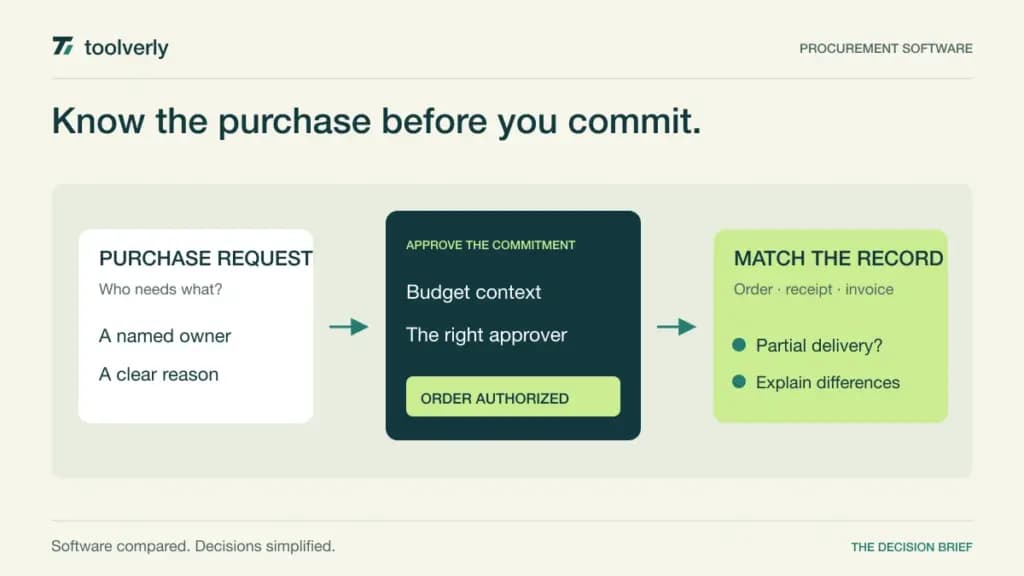
Procurement software should make a purchase understandable before money is committed. Who requested it? Which budget pays for it? Who approved the amount? Did the supplier deliver what was ordered? A good workflow keeps those answers connected through the purchase order, receiving record, and invoice handoff.
Procurify, Precoro, Tradogram, PLANERGY, and Spendwise offer different entry points into that process. Compare the stages your team needs, not simply the lowest subscription rate. A plan that creates purchase orders may still leave requisitions, custom approvals, or invoice matching in a higher package or separate product.
Research checked October 2, 2026. This comparison uses current official features and pricing, without hands-on implementation tests or savings claims. Listed USD rates are reference offers with the stated terms. Request the user allowances, required modules, integrations, implementation services, and contract conditions for your organization before treating a rate as the full cost.
Five procurement platforms compared
| Product | Best fit | Main strength | Price reference | Meaningful tradeoff |
|---|---|---|---|---|
| Procurify | Teams formalizing purchase requests and budgets | Purchasing base with modular expansion | Configured quote | AP and other products change the scope |
| Precoro | Teams needing an explicit purchasing-to-invoice workflow | Core requests, orders, receiving, and matching | Core from US$499/month, billed annually | Automation and advanced requirements raise the tier |
| Tradogram | Businesses starting with orders and supplier records | Entry purchasing package with broader workflow options | Essentials: US$99/month; additional-user fees apply | Requisitions and custom approvals appear in Premium |
| PLANERGY | Teams joining purchasing and accounts payable | Connected procure-to-pay platform | Tailored quote | Implementation and integration scope need definition |
| Spendwise | Smaller teams needing defined approval and budget controls | Per-user Pro package with purchasing and receiving | Pro: US$19/user/month, minimum five users | Accounting connections and implementation are optional add-ons |
Procurify
Procurify’s pricing page describes Purchasing as the base product, including requests, catalogs, purchase orders, approvals, budgets, and reporting. Accounts Payable and Expense and Card Management are additional product choices. Guided Intake and Contracts are among the add-ons. The commercial model considers products, integrations, and Pro users; Basic requester and receiver users are unlimited. Pricing requires a configured proposal.
Strength: separating the purchasing base from additional functions helps a buyer define the first operational boundary. Start with a request that exceeds a department budget and ask the vendor to show the approval path. Then have the requester, budget owner, and receiver each explain their part. The process should be understandable from all three perspectives.
Limitation: a purchasing quote is not automatically an accounts-payable quote. Specify where invoice handling starts and which system receives the final record. Procurify fits teams prepared to formalize requests and ownership before expanding into more functions. Count the roles that need Pro access and confirm any integration costs; an unlimited requester allowance does not establish the complete operating price.
Precoro
Precoro’s current plans list Core from US$499 per month billed annually. Core includes purchase requisitions, purchase orders, receipts, invoices, approval workflows, and two- or three-way matching, with QuickBooks and Xero connections. Automation starts from US$999 per month billed annually and adds capabilities such as automated invoice processing, supplier workflows, and API or SSO access. Enterprise uses a custom annual proposal.
Strength: the Core scope provides a concrete sequence to evaluate from request to invoice comparison. Use one partial delivery and one invoice with a different quantity from the order. Ask the receiver to document what arrived and finance to identify the discrepancy. This tests whether your staff can operate the handoff, rather than assuming matching alone resolves every exception.
Limitation: advanced intake, supplier, or integration needs may belong above Core. The annual commitment also deserves attention before comparing monthly-equivalent rates. Precoro fits teams whose purchasing process benefits from a connected document trail and whose required plan can be specified clearly. Request exact user allowances and implementation work for the proposed configuration instead of estimating them from the starting price.
Tradogram
Tradogram’s current pricing page lists Essentials at US$99 per month, with additional-user fees. It includes purchase orders, supplier management, and accounts-payable invoices. Premium is quoted and adds functions such as requisitions, receiving, budget tracking, contracts, and custom approvals. Scale is also quoted and addresses larger requirements. The annual Essentials offer is US$950.40 per year; that is a different commitment from paying monthly.
Strength: a buyer can distinguish a lightweight order-and-supplier workflow from a fuller purchasing process. In an evaluation, begin with the documents you already create and identify which stage is currently missing. If the problem is request approval rather than order creation, demonstrate the higher package that addresses it before using the entry rate in a budget.
Limitation: core purchasing does not mean every pre-purchase or receiving function is included in Essentials. Tradogram fits businesses that want an explicit progression and can name the workflow stage they are buying. Obtain the required users, modules, and renewal terms in one proposal. That prevents the later discovery that a seemingly simple requirement actually depends on a different tier or additional-user commitment.
PLANERGY
PLANERGY connects purchase requests, approvals, orders, receiving, budgets, and accounts-payable processes. Its current platform overview describes access to the full core procure-to-pay platform with pricing tailored to the business. The same source presents accounting connections, supplier management, and invoice matching. There is no fixed subscription figure on that page, so use a scoped quote rather than an amount inferred from third-party directories.
Strength: a connected purchasing and AP approach can help departments work from the same evidence. Ask a budget owner to find a commitment before the supplier invoice arrives, then ask finance to trace that invoice back to the order and receipt. Both views should remain understandable when delivery is partial or the original requester is unavailable.
Limitation: broad core access does not explain the effort of configuring your organization or connecting its accounting system. PLANERGY fits teams that want to evaluate the entire procure-to-pay handoff and can assign implementation owners. Request the included integrations, approval setup, training, and ongoing service terms explicitly. The vendor’s general value claims are not evidence of savings for your particular business.
Spendwise
Spendwise’s plans page lists Basic at US$9 per user per month, with a one-user minimum, up to five users, and ten monthly transactions. Pro is US$19 per user per month with a five-user minimum and adds unlimited transactions, approval limits and workflows, custom roles, and budgets. Accounting-system integrations, inventory, and implementation are optional add-ons. Enterprise uses a quote.
Strength: explicit user and transaction limits make the entry decision tangible. For a small purchasing team, Pro’s minimum creates a US$95 monthly subscription reference before optional services. Evaluate whether the requester can submit a purchase, the approver can see the right budget context, and the receiving person can find the order without assistance.
Limitation: the smallest rate does not include Pro’s control features, and required connections can add cost. Spendwise fits smaller teams whose process aligns with its defined packages. Count everyone who needs operational access and confirm the proposed billing commitment. A transaction cap that looks generous during setup can become restrictive when a team begins recording its real purchasing activity consistently.
Choose around the purchasing handoff
Map a routine purchase and two exceptions before scheduling demonstrations. A useful exception is a supplier who delivers only part of the order. Another is an urgent request submitted while the usual approver is away. Name the person responsible at each stage and define what record should survive. If the approval policy is unclear, a vendor will demonstrate its default assumptions rather than your intended process.
Separate approval before commitment from reimbursement afterward. Our employee expense comparison covers claims and evidence for purchases employees have made. Our inventory comparison covers stock availability and movement. Those workflows may connect to procurement, but their primary records and responsibilities are different. Decide which application owns each record and who corrects a mismatch.
For pricing, count the required stages, roles, integrations, and implementation work. Compare the whole configuration over the proposed term. Ask for an export of orders, approvals, receipts, and invoices so the finance owner can review the audit trail and the operations owner can assess portability.
- Demonstrate a budget exception and a temporary approval delegate.
- Follow a partial delivery through receiving and invoice review.
- Confirm which users, modules, and connections the quote includes.
- Assign owners for supplier records and accounting synchronization failures.
- Check how historical documents remain available after staff changes.
Procurify offers modular purchasing expansion, Precoro an explicit matching workflow, Tradogram a staged purchasing package, PLANERGY a connected platform proposal, and Spendwise defined smaller-team controls. Choose the system that makes a purchase explainable from request through payment handoff.
Original illustration by Toolverly. Read about our publication or send a correction.