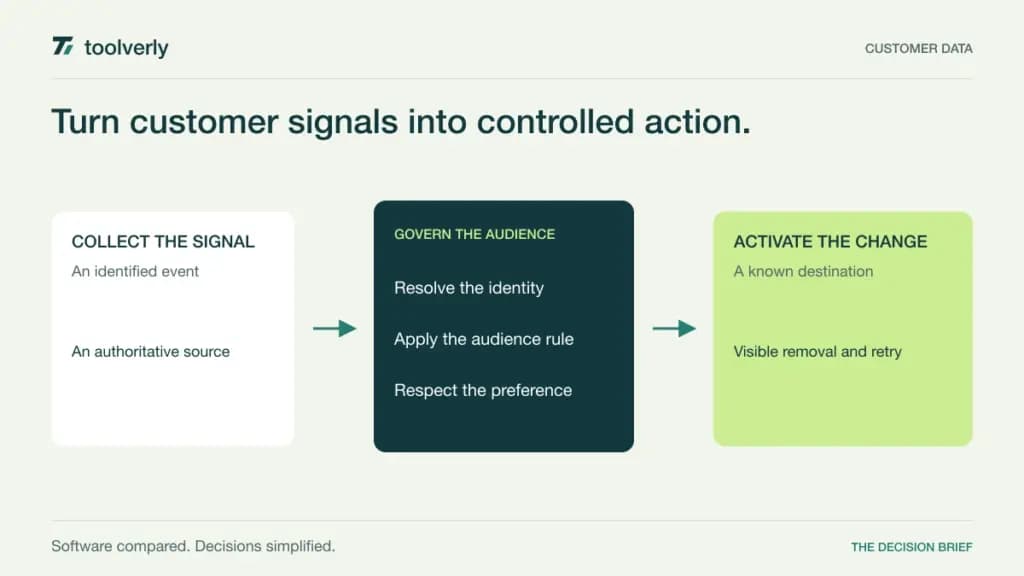
Your warehouse knows that a customer bought last week, your website sees a new visit, and your email platform still treats that person as a prospect. A customer data platform should turn those disconnected signals into maintained identities and usable audiences. The value lies in the action downstream: suppressing the wrong message, updating a customer attribute, or placing the right person in a reviewed lifecycle journey.
Twilio Segment, RudderStack, mParticle, Tealium, and Hightouch approach that job from different architectural starting points. Event collection, identity resolution, audience construction, and activation can be bundled or purchased separately. A cheap pipeline is not automatically a complete CDP, and a warehouse-centered design still needs someone to maintain the customer model.
Research checked October 13, 2026. This is an official-source buying comparison, not a latency benchmark or a claim that any platform guarantees perfect identity matching. Request a scoped quote for your data volumes and activation requirements.
Compare the customer-data operating model
| Platform | Best fit | Main strength | Meaningful tradeoff |
|---|---|---|---|
| Twilio Segment | Teams combining collection with unified profiles and journeys | Connections, Unify, and Engage in a full CDP offering | Pipeline pricing cannot stand in for full CDP pricing |
| RudderStack | Engineering-led customer data infrastructure | Events, warehouse delivery, and reverse ETL | Profile capabilities need separate enterprise scoping |
| mParticle | Consumer brands combining live and warehouse signals | Hybrid architecture with identity and audience tools | Commercial scope and operating responsibilities need a quote |
| Tealium | Organizations connecting real-time profiles and consent-aware activation | Packaged and composable customer-data workflows | Activation-only entry pricing excludes the full CDP scope |
| Hightouch | Teams activating an owned warehouse customer model | Composable product choices and downstream syncing | Free reverse ETL is much narrower than the complete platform |
Twilio Segment
Twilio Segment distinguishes its Customer Data Pipeline from its Customer Data Platform. The current pricing page, now served on Twilio’s site, describes Connections as the collection and routing layer. The CDP bundles Connections with Unify and Engage, adding resolved profiles, audiences, and journey orchestration. This is a useful distinction when one team needs clean event delivery and another needs customer-facing activation.
Full CDP pricing is custom and based on monthly tracked users, rather than a simple seat fee. Obtain the definition of a tracked user for your anonymous and known activity, volume commitments, throughput, and required add-ons. The page includes AI audience capabilities in the CDP while listing some corresponding pipeline features as add-ons. Confirm data-governance entitlements explicitly instead of reading an entry pipeline price as a complete offer.
Strength: a path from collected events to maintained profiles and journeys. Limitation: choosing the right bundle requires agreement about what the business will activate. Segment fits teams that need that combined workflow. In a demonstration, trace an anonymous visitor becoming known, an updated purchase attribute, and an audience removal. Ask what evidence explains each transition and how the downstream system receives it.
RudderStack
RudderStack starts with customer-data infrastructure that engineering can connect to SDKs, cloud tools, and warehouse destinations. Its current plan page lists a free allowance of 250,000 events per month. Growth displays $265 per month at the one-million-event selection, with a separately advertised annual-billing discount. Enterprise pricing is custom. An event meter can behave very differently from a unique-user meter when an application generates frequent activity.
Growth lists tracking plans, two workspaces, thirty-minute warehouse sync, and 25 reverse ETL connections. Enterprise lists access to Profiles and Data Apps, alongside deeper governance and support. The low-volume collection plan therefore should not be treated as the price of every identity and audience capability. The FAQ also retains a reference to a Starter plan while the main cards say Growth; confirm applicable overage rules in writing.
Strength: an engineering-oriented route to collection and warehouse activation. Limitation: the team still needs a governed data model, and advanced profile capabilities require commercial scoping. RudderStack fits organizations that can own instrumentation and transformations. Evaluate a changed event schema and a duplicate message. Ask how operators detect the issue, repair downstream data, and avoid activating a mistaken customer attribute.
mParticle
mParticle’s current platform overview describes a hybrid CDP that combines real-time pipelines with warehouse-native activation. Its tools include IDSync, profile and event APIs, real-time and composable audiences, data plans, and consent management. The audience interface can use live behavior, modeled warehouse data, or both. This is relevant when a consumer brand needs immediate session context alongside historical purchasing attributes.
The platform also describes audience and prediction agents. Treat assisted audience creation as a proposed rule requiring review: a business goal is not enough to define exclusions, identity keys, or a correct suppression policy. The pricing route leads to a contact process rather than verified numeric rates. Request a quote that specifies architecture, event and profile volumes, chosen modules, support, and implementation.
Strength: combining live and warehouse customer signals within one operating model. Limitation: hybrid flexibility introduces choices about where identity and audience truth are maintained. mParticle fits consumer organizations prepared to assign that ownership. Demonstrate an identifier correction and a profile assembled from conflicting sources. Require the operator to show the reasoning and controls behind the final audience, then follow the removal path when its qualification changes.
Tealium
Tealium’s CDP overview describes real-time profiles, identity resolution, warehouse-based audience activation, and governance from collection through delivery. It supports a packaged profile approach, a composable warehouse approach, or a combination. The relevant choice is whether a customer decision must happen during a session or can wait for a scheduled update.
The pricing page displays Data Cloud Activation at $1,000 per month, billed annually. That is an activation offering with reverse ETL and related capabilities. Data Collection and the full CDP require pricing quotes; the full CDP adds profiles and identity. Tealium describes consumption-based pricing, with the CDP overview referring to inbound events. Ask exactly which events count and how the selected package handles peak traffic.
Strength: connecting live customer context and warehouse activation with consent-aware data flows. Limitation: the published activation entry price is not a complete CDP price, and consent behavior depends on configuration and inputs. Tealium fits teams needing both real-time and scheduled pathways. Demonstrate a customer changing preferences while an audience sync is in progress. Examine which destination sees the change, what is blocked, and how the operator investigates a failed delivery.
Hightouch
Hightouch’s current offer separates its composable CDP from its agentic marketing platform and a free basic reverse ETL tier. The CDP product selection includes reverse ETL, events, Customer Studio, real-time personalization, identity resolution, and Match Booster. Teams can choose the components that support their existing data architecture rather than assuming every product must be bought together.
The free tier allows up to two active syncs and lists unlimited destinations and users. It is an entry activation workflow, not an unlimited full CDP. Paid CDP pricing is usage-based and sales-scoped; the page says it does not impose monthly-tracked-user limits or source, destination, and seat caps. A quote still needs to identify the actual metered operations and selected products. Warehouse compute and data-model maintenance also belong in the budget.
Strength: activating an owned warehouse model through composable tools. Limitation: a flexible sync layer cannot repair an undefined customer model by itself. Hightouch fits teams with dependable warehouse data and clear model ownership. Demonstrate an audience addition, an exclusion, and a failed destination write. Check whether the team can see what was attempted, correct the underlying row, and verify the eventual destination state.
Define the activation before buying the platform
Start with one business rule: for example, remove recent purchasers from an acquisition audience and place qualifying customers in a reviewed onboarding journey. Specify the person identifier, source of the purchase, consent requirement, destination, and acceptable delay. This makes architectural differences tangible without assuming every use case needs real-time processing.
Then identify competing truths. The CRM may own an account relationship, commerce may own orders, and the warehouse may calculate customer value. Decide which source wins when records disagree. An identity merge that looks convenient for reporting may be inappropriate for an operational message, so inspect shared devices and changed addresses as well as the easy match.
Use a focused implementation checklist:
- Define authoritative identifiers and source precedence.
- Separate collection, profiles, audiences, and destination activation.
- Demonstrate additions, removals, preference changes, and failed syncs.
- Price normal traffic and seasonal peaks using the actual meter.
- Assign owners for instrumentation, models, audience approval, and delivery.
- Include warehouse costs, implementation, and support in the total.
Our data integration platforms comparison covers moving data into operational and analytical systems. Our product analytics guide covers understanding behavior. A CDP purchase should explain how maintained customer data becomes a controlled action, rather than merely another reporting destination.
Shortlist Segment for a bundled collection-to-journey path, RudderStack for engineering-led infrastructure, mParticle for hybrid consumer activation, Tealium for live and composable workflows, and Hightouch for warehouse-centered activation. Choose the platform whose operators can explain why a person entered an audience and prove when that person left it.
Original illustration by Toolverly. Read about our publication or send a correction.