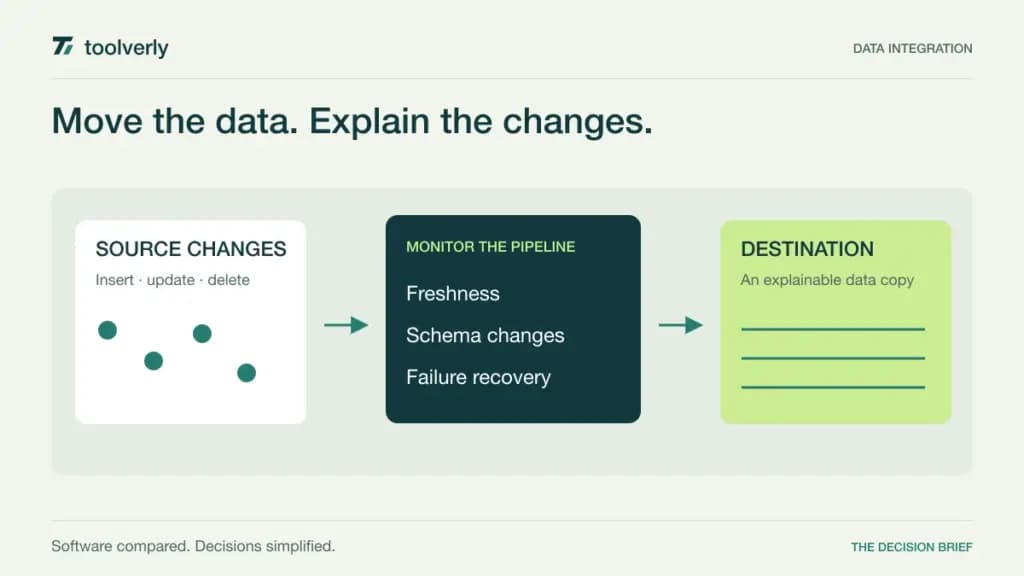
A warehouse can only answer a business question if the underlying data arrives reliably. Copying customer records once is straightforward; maintaining an accurate copy as rows change, tables evolve, and connections fail is an ongoing operating task. Data integration platforms provide connectors and controls for that recurring movement.
This guide compares Fivetran, Airbyte, Hevo, Matillion, and Stitch for teams moving operational data into an analytical destination. The buying decision concerns ingestion, change handling, transformations, and pipeline ownership. Once those records arrive, our guides to business intelligence software and database client tools cover the tools people use to explore them.
Research basis: Official pricing and feature pages checked on October 3, 2026. We have not run performance benchmarks or hands-on trials. Amounts below refer to the published packages and selected allowances; warehouse compute, storage, and other destination costs need their own budget. Usage units differ substantially between vendors.
Compare the workload and billing unit
| Platform | Likely fit | Verified pricing reference | Important boundary |
|---|---|---|---|
| Fivetran | Managed replication with row-based pricing | Free connections allowance up to 500,000 monthly active rows; paid usage pricing | Connection-level usage and sync frequency |
| Airbyte | Teams comparing managed and self-hosted approaches | Standard US$20/month with 5 credits; extra credits US$5 each | Credit consumption and operating responsibility |
| Hevo | Managed pipelines with event allowances | Starter US$299/month, or US$265/month equivalent billed annually, at the displayed 5-million-event allowance | Chargeable events and extra usage |
| Matillion | Teams combining movement with transformation development | Credit-based configured quote; no fixed amount on the checked page | Developer capacity and execution consumption |
| Stitch | Focused ingestion into a limited set of destinations | US Standard starts at US$100/month | Rows, sources, destinations, and billing selection |
Fivetran
Fivetran prices paid connections around monthly active rows, abbreviated MAR, and offers a Free connections allowance up to 500,000 MAR. Its Standard package lists fully managed connectors, unlimited users, and 15-minute syncs; Enterprise adds a different frequency and control profile. The pricing estimator is more useful than treating the service as a flat monthly subscription.
Strengths: Managed connectors suit a team that wants to spend less effort maintaining ingestion code. The buyer can focus on connection coverage, freshness, and the quality of the destination tables. A row-based commercial model also gives the team a specific unit to investigate when a source’s behavior changes.
Limitations: Stored database size is not a substitute for monthly active row usage. Estimate the actual connections and their update patterns. Confirm the chosen plan’s treatment of connection-level charges, initial loads, and transformations instead of assuming the free allowance applies to every paid arrangement.
Best fit: Analytics teams prioritizing managed replication and prepared to monitor its usage. Bring a frequently updated table and a largely append-only source to the evaluation. Ask for separate estimates and show how the destination recovers after an interrupted sync. Review Fivetran’s pricing and estimator.
Airbyte
Airbyte currently lists managed Standard at US$20 per month including five credits, with additional credits at US$5 each. Plus lists US$189 per month including 40 credits and a different feature and sync-frequency profile. Pro and Enterprise Flex use configured capacity discussions. The open-source, self-hosted Core option is a separate operating choice.
Strengths: The range makes Airbyte relevant when a team wants to compare a hosted service with infrastructure it operates itself. The important advantage is choice of responsibility: the organization can evaluate connector coverage alongside where the system runs and who maintains it.
Limitations: A small base fee does not represent the total managed bill. Credit consumption depends on the workload, and additional usage matters. Self-hosted software also needs infrastructure, upgrades, monitoring, and someone accountable for recovery; an open-source license does not remove those tasks.
Best fit: Teams that want flexibility and can make an explicit hosted-versus-operated decision. Price a full month of representative sources, then test a schema change and connector failure in the intended package. If considering Core, name the person who will handle an upgrade while a critical pipeline is delayed. Consult Airbyte’s current editions and allowances.
Hevo
Hevo’s pipeline pricing page shows Starter at US$299 on monthly billing for the displayed five-million-event allowance, or US$265 per month equivalent on annual billing. It defines an event as a record inserted, updated, or deleted in the destination. Starter lists ten users, a broader connector selection than Free, and features such as dbt integration.
Strengths: Event allowances make a useful starting point for a team that can estimate the number of changing records. The managed pipeline approach is relevant when analysts need dependable source-to-destination movement without taking full ownership of a connector service.
Limitations: Updates and deletes matter to the event count, not just newly created records. Additional on-demand events can affect the bill. Check connector eligibility and required administration features against the selected tier, especially if a free pilot will later become a shared production workflow.
Best fit: Teams seeking a managed pipeline with a clearly budgeted event allowance. Use a sample month containing a bulk correction or backfill, not only ordinary daily growth. Ask how those changes affect the estimate and how an operator identifies a stalled source. See Hevo’s pipeline plans and event definition.
Matillion
Matillion’s current pricing page describes a credit-based Data Productivity Cloud offering, including its Maia capabilities. Developer lists one developer, while Teams lists five; the packages combine connectors with low-code development, SQL or Python work, and Git-related workflows. Pricing requires a configured discussion rather than a visible fixed subscription amount.
Strengths: Matillion is relevant when moving data and developing transformations are part of the same team’s responsibility. Evaluate the path from ingestion to a reviewed transformation and a repeatable run, rather than judging the platform only by the number of source logos.
Limitations: Developer capacity and execution consumption are separate dimensions. Unlimited administrators do not mean unlimited developers. Ask how credits are consumed by the jobs you plan to run, which controls belong to the proposed tier, and which compute costs remain with your data platform.
Best fit: A data engineering team that needs a development workflow as well as ingestion. Bring a transformation with dependencies and an intentionally incorrect input. Have the vendor demonstrate review, execution, diagnosis, and correction. Request the credit estimate for that workload and clarify who owns the resulting logic. Read Matillion’s current package comparison.
Stitch
Stitch’s US pricing page lists Standard starting at US$100 per month. Its displayed base configuration includes a five-million-row allowance, one destination, ten Standard sources, five users, and seven days of extraction history. Advanced and Premium increase capacity and destinations, with published monthly equivalents that require annual billing.
Strengths: A focused ingestion package can be easier to evaluate when a team knows its sources and destination. The visible limits help a buyer identify whether a straightforward setup remains within the entry configuration or needs a higher tier.
Limitations: Verify the exact source types, row allowance, billing cycle, and retention needed for your workload. The page identifies its amounts as US pricing; international buyers are directed to contact the vendor. A low starting amount becomes less relevant if the organization needs more destinations or a longer troubleshooting history.
Best fit: Teams seeking a constrained, understandable ingestion setup. Demonstrate a row update and a failed extraction, then inspect the information available to diagnose it. Check that the desired connector is available in the quoted tier instead of assuming every integration has identical packaging. Compare Stitch’s current US plan details.
Choose for change handling, not just the first successful load
Build a workload sheet with sources, destinations, normal update volume, largest tables, freshness requirements, and the person responsible for failures. Add expected backfills and bulk corrections. A pipeline that looks inexpensive during a quiet sample week may behave differently when a business process rewrites historical records.
Use a controlled evaluation containing an initial load, an incremental update, a deleted record, a new column, and a temporary connection failure. Inspect the destination after each step. Decide what counts as recovery: an operator should be able to explain which data is current and what still needs attention.
Normalize cost over a realistic month, while keeping each vendor’s unit distinct. MAR, credits, events, and replicated rows cannot be compared by their numbers alone. Request examples of usage reporting and alerts, and budget warehouse execution separately. Transformation work may move costs between services rather than eliminate them.
Choose Fivetran for a managed replication discussion, Airbyte when hosting responsibility is a key choice, Hevo for event-budgeted pipelines, Matillion when development and transformation are central, or Stitch for a focused ingestion footprint. The strongest evidence is an understandable failure and recovery process at a cost your team can explain.
Original illustration by Toolverly. Read about our publication or send a correction.