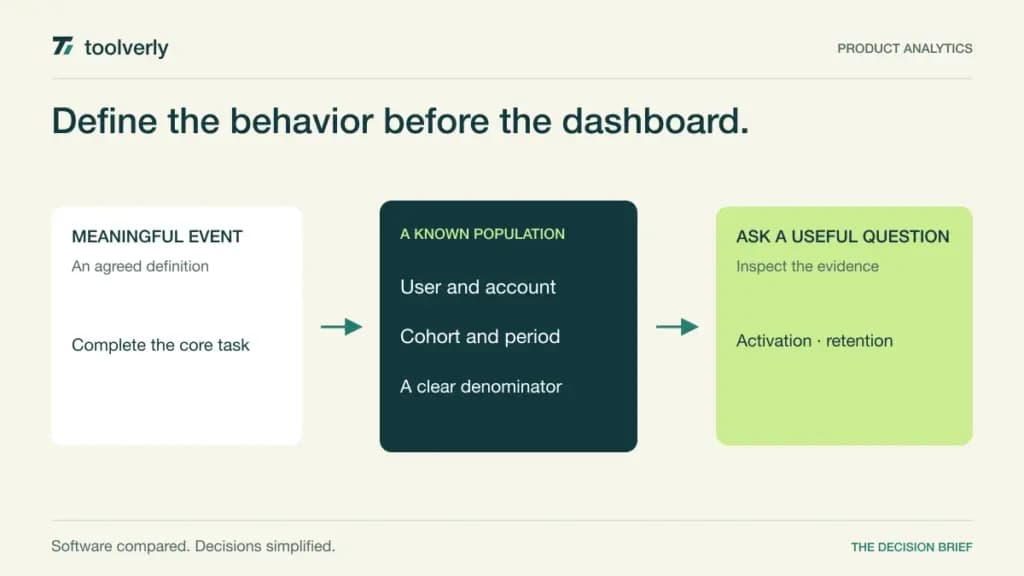
A sign-up count tells a product team that people arrived. It does not explain whether those people completed setup, used the core workflow again, or abandoned a specific step. Product analytics connects events to users, accounts, and time so a team can investigate activation, feature adoption, and retention. The difficult part is agreeing on what those events mean before a dashboard becomes the basis for a decision.
This comparison covers Mixpanel, Amplitude, PostHog, Heap, and Pendo. The focus is behavior inside a product, distinct from traffic acquisition in our website analytics comparison. Analytics can reveal where a journey breaks; usability testing can help investigate the reason without treating correlation as a causal explanation.
Official pricing and product materials were checked on October 6, 2026. We did not run an SDK benchmark or measure any conversion lift. Current billing units include events, sessions, and monthly active users. Compare an expected workload in each vendor’s unit rather than assuming a free allowance represents equivalent coverage.
Five approaches to product behavior analytics
| Product | Best fit | Main strength | Meaningful tradeoff | Pricing reference |
|---|---|---|---|---|
| Mixpanel | Teams organizing event-based analysis | Funnels, retention, flows, and cohorts | Events and adjacent products have different limits | Free to 1M events/month; paid volume pricing |
| Amplitude | Broader product intelligence programs | Behavioral analysis with governed expansion paths | Advanced analysis and access controls depend on tier | Free 2M events/month; event-based paid plans |
| PostHog | Engineering-led product teams | Usage-based tools with per-product billing limits | Unpaid over-quota events are dropped | 1M analytics events/month free; usage beyond |
| Heap | Teams prioritizing autocapture and event labeling | Captured interaction data with definition management | Session volume and add-ons shape the contract | Free to 10K sessions/month; configured paid pricing |
| Pendo | Teams linking adoption insight to product operations | Analytics beside guidance and higher-tier replay | Broader bundle may exceed analytics-only needs | Custom MAU volumes and quoted pricing |
Mixpanel
Mixpanel’s current plans include funnels and retention analysis, with flows, metrics, and behavioral cohorts in its wider feature comparison. This supports questions such as which onboarding step loses users or whether people who complete a particular action return later. The practical unit is a defined event, not simply a page visit.
Its strength is giving a team a common place to compare event sequences and groups of users. It suits a product organization prepared to name events, maintain properties, and explain the difference between performing an action once and establishing a recurring habit. A funnel report is only useful when duplicate events and changes in identity handling are understood.
The Free plan currently allows up to one million events per month and unlimited seats, with limited saved reports. Growth starts at $0 with higher limits and a volume calculator; Enterprise is quoted. Session replay, experiment usage, and feature flag limits appear separately. The pricing matrix marks group analytics as an add-on, which matters for business software where an account is the decision-making unit. Build an event-volume estimate before selecting a tier, and price account analysis explicitly.
Amplitude
Amplitude combines product analytics with replay and other product intelligence capabilities. Its current page gives all plans unlimited seats, but separates advanced behavioral exploration, custom calculations, cohorts, project permissions, and access controls across tiers. This is a useful reminder that analyst access and analytical capability are different purchasing questions.
The advantage is a clear expansion route from initial event analysis to a broader program. It suits teams that expect several functions to use the same evidence and need to govern how that evidence is defined and accessed. During evaluation, ask two analysts to explain the same activation metric and identify where its filters, event definitions, and time window live.
Current Free pricing includes two million events per month. Plus starts at $0 with the first two million events free and requires a card to scale; Growth and Enterprise use custom event-based pricing. This differs from older active-user price assumptions, so do not reuse them. Replay allowances and retention terms are separately specified. Confirm the projected event bill, group-analysis scope, and governance tier instead of treating the headline free allowance as the complete platform specification.
PostHog
PostHog offers analytics alongside replay, feature flags, surveys, and other tools, with separate usage allowances. Its product analytics documentation covers event-based exploration such as funnels and retention. The platform is relevant when engineers want behavior evidence close to the product changes they maintain rather than purchasing a reporting tool entirely apart from the delivery workflow.
The strength is a visible usage model and per-product billing limits. A team can evaluate analytics while deciding independently how much replay or flag activity it needs. That flexibility is useful only if someone owns the limits: stopping collection and stopping spend are related but different choices, particularly during an unexpected usage spike.
The current free allowance is one million analytics events per month, resetting monthly, with unlimited team members. The no-card free tier lists one project and one-year retention; pay-as-you-go lists more projects and longer retention. Usage above free allowances is billed per product, while platform governance packages add another scope. The FAQ states that additional events on the unpaid free plan are permanently dropped. Include that behavior in your monitoring plan before relying on a free dataset for long-running retention analysis.
Heap
Heap’s pricing matrix includes autocapture, visual event labeling, definition history, funnels, journeys, and retention. This approach is attractive when teams want to define useful interaction events from captured data rather than manually instrument every initial question. Capturing interactions, however, does not automatically produce a correct business definition for activation or a durable account identity.
Its strength is supporting exploration while keeping event definitions visible. It suits teams that repeatedly discover new questions after a release and can maintain a labeling convention. Review how a changed interface affects an existing definition and how engineers validate that a captured interaction still corresponds to the intended product action.
The Free plan lists up to 10,000 monthly sessions and six months of data history. Growth has an installation-based estimate; Pro and Premier use custom session pricing. Replay and experience analysis are paid add-on considerations, and warehouse integration scope also needs confirmation. Heap is part of the Contentsquare group, so this comparison gives it one position rather than presenting the parent as an independent competitor. Its tradeoff is coordinating capture, definitions, retention, and contract scope as the dataset grows.
Pendo
Pendo combines Product Analytics with in-app guidance in its Base plan; Core adds Session Replay, while Ultimate expands into sentiment and other adoption operations. Its current materials describe retroactive analytics and a shared platform for understanding and acting on usage. For this comparison, the reason to shortlist it is measuring behavior, not simply publishing an onboarding tooltip.
The strength is a direct organizational connection between adoption evidence and the team responsible for the product experience. It suits a company whose product operations group wants to inspect feature use and coordinate responses in the same platform. Evaluate whether analysts can distinguish a completed business task from a click on a guide or an incidental interface element.
Base, Core, and Ultimate use custom monthly-active-user volumes and request-pricing routes. The page also offers Novus free during open beta with no MAU limit during that beta; this should not be treated as a permanent equivalent of a contracted Pendo package. Ask for the precise MAU definition, application scope, replay allocation, export requirements, and contracted tier. The limitation for analytics-only teams is paying for a wider operating bundle than their current questions require.
Make the first questions answerable
Before comparing demonstrations, write three questions: who completed the first useful task, where a meaningful sequence stopped, and which accounts repeated the core workflow within an appropriate period. Define the denominator, time zone, identity rules, and excluded internal users. These choices determine whether two apparently similar reports actually describe the same population.
Run a small authorized implementation around one journey. Inspect raw events, duplicate handling, anonymous-to-known identity transitions, missing properties, and deletions. Assign owners to event definitions and changes. Autocapture can broaden exploration, while explicit instrumentation can clarify intent; both approaches still require review when the product changes.
Shortlist Mixpanel for a focused event-analysis workflow, Amplitude for broader governed intelligence, PostHog for engineering-led usage controls, Heap for capture and later definition, and Pendo for adoption operations. Require a cost estimate for normal and peak usage. Choose the platform whose evidence the team can explain and maintain, then expand only after those first questions have reliable answers.
Official sources
- Mixpanel plans and limits
- Amplitude current event-based plans
- PostHog usage and quota rules and product analytics documentation
- Heap packages and Contentsquare relationship
- Pendo plans and Novus beta scope
Original illustration by Toolverly. Read about our publication or send a correction.