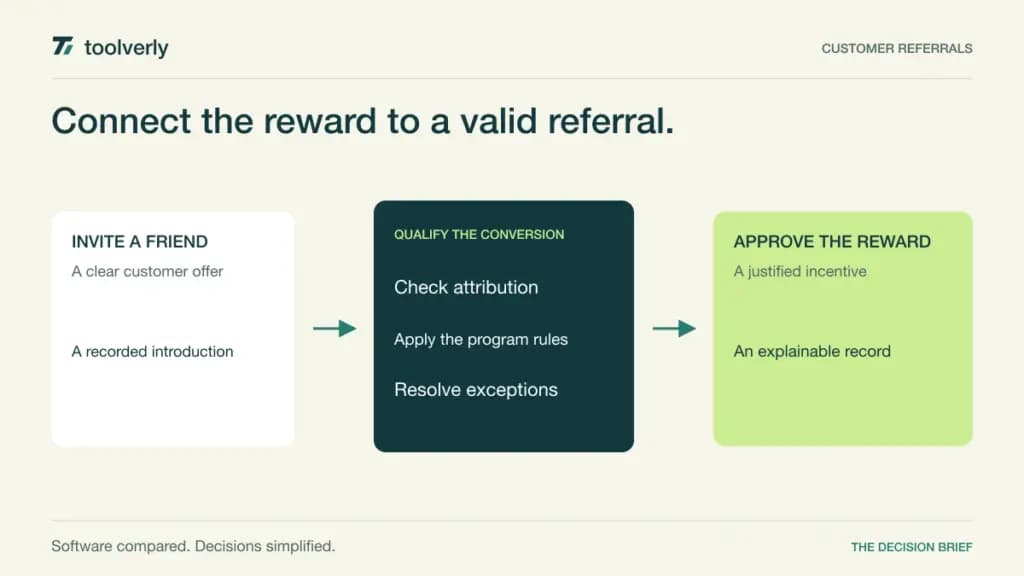
A happy customer can introduce a new one, but an operational referral program needs more than a share button. The business must connect the introduction to a qualifying action, avoid duplicate or abusive rewards, handle cancellations, and explain the outcome to both people. Customer referral software maintains that chain from invitation to justified incentive.
ReferralCandy, Friendbuy, Referral Rock, Mention Me, and Talkable cover different program sizes and commercial models. This comparison focuses on customer refer-a-friend programs rather than employee sales commissions or public review requests. Official product and pricing information was checked on October 11, 2026; vendor case-study results are not presented as outcomes a buyer should expect.
Your ecommerce platform supplies the purchase events a referral program may need. If the real goal is collecting public feedback, see customer review management software. A rewarded introduction and a public review require different rules and records.
Compare the program models
| Product | Best fit | Main strength | Meaningful tradeoff |
|---|---|---|---|
| ReferralCandy | Ecommerce referral rollout | Campaigns and incentives with published fee tiers | Success fees add to the fixed subscription |
| Friendbuy | Brands coordinating acquisition and retention | Referral incentives and optimization capabilities | Commercial scope requires a vendor discussion |
| Referral Rock | Service and relationship-driven businesses | Hosted program and frontline recruitment | Member intake and integrations have defined boundaries |
| Mention Me | Brands exploring broader advocacy | Referral programs including name-based sharing | Attribution rules and pricing need a scoped review |
| Talkable | Teams wanting managed program support | Referral tooling with differentiated operating services | Implementation and annual commitments affect cost |
ReferralCandy
ReferralCandy offers referral and affiliate campaigns, coupon codes, cash or store-credit payouts, integrations, and API access. Its current pricing page says the plans share the feature set and differ in fixed fees and variable success fees. That makes expected qualifying volume part of the buying decision.
Basic lists $9 monthly plus a 10.5% success fee; Grow is $79 plus 3.5%; Scale is $249 plus 1.5%; Enterprise is $799 plus 0.25%. These are software charges, not the rewards themselves. Confirm the precise fee base, qualification rules, refunds, and treatment of existing customers before calculating program economics.
Best fit: ecommerce teams wanting an accessible launch with an explicit fixed-plus-variable model. Limitation: the lowest subscription is not necessarily the lowest total cost. Model several volumes using the same agreed success-fee definition.
In a pilot, trace a customer’s invitation through a friend’s completed order and a later refund. Ask who can see why a reward is approved or withheld. The essential outcome is an understandable event chain; a program that launches quickly still needs an owner for exceptions and customer questions.
Friendbuy
Friendbuy’s current platform spans referral, loyalty, and influencer programs. For customer referral, it describes advocate activation, incentives, testing and optimization, fraud prevention, and product sharing. Its broader analytics and support positioning suits brands that want referrals connected with an ongoing acquisition and retention program.
The current public offer routes buyers toward a demonstration rather than a stable numerical subscription. Treat pricing as quote-based. Ask the vendor to distinguish referral software, optional loyalty or influencer capabilities, implementation, support, reward costs, and any usage charges. An older internet price does not establish today’s package.
Strength: referral work can sit within a broader customer-growth system. Limitation: that breadth can create unnecessary scope for a small standalone program. Best fit: brands with a dedicated owner for incentive design and continuous optimization.
Write the qualifying event before the demonstration. For a subscription business, the event might need to account for a trial, a paid activation, or a later cancellation. Ask the vendor to show your chosen rule and its reversal path. That is more informative than a polished campaign screen because it exposes how the program handles normal commercial exceptions.
Referral Rock
Referral Rock’s Operator plan provides a hosted member portal, referral landing pages, sharing links and codes, automated messaging, and an advisor who helps set up the program. It includes a recruiter workflow for frontline staff, which can be valuable for service businesses whose introductions arise in actual customer conversations.
Operator lists $250 month to month, with ten percent savings for annual billing. It includes ten thousand base members, up to ten administrators and ten recruiters, unlimited referrals, and one thousand new rolling members per month from automated sources. Additional members, programs, and seats are paid expansions. Rewards are separate, and advanced integrations need scoping with the advisor.
Best fit: relationship-driven businesses that want a maintained referral workflow with launch assistance. Limitation: unlimited referrals does not mean unlimited member intake or every integration configuration.
Ask a frontline employee to enroll a customer after a completed service interaction. Then have the program owner inspect attribution, qualification, and the next message. The process should be short enough to use during real work while preserving a record the office can explain later. Decide whether employee recruitment credit affects any internal reporting before launching it broadly.
Mention Me
Mention Me emphasizes referral marketing and identifying customer advocacy beyond tracked links. Its current website describes Name Share and analysis of referral networks alongside managed program optimization. That can be relevant when people recommend a brand in conversation and the company wants an appropriate way to recognize the introduction.
The current public product site did not provide a stable numerical tariff. Obtain a scoped quote covering markets, implementation, operating support, attribution capabilities, and integrations. The company’s advertised customer results describe selected programs, not a guaranteed outcome for a new buyer.
Best fit: brands interested in a broader advocacy program with active optimization. Limitation: attribution and identity matching need clear rules; a name or network relationship alone is not proof of an incremental sale.
During the pilot, include common names, an existing customer, and a referral that happens without clicking a link. Ask how ambiguous cases are resolved and what evidence the administrator can inspect. Decide how the business communicates eligibility to customers so that a useful referral feature does not become a recurring dispute about who introduced whom.
Talkable
Talkable’s current pricing describes a flat monthly fee without CPA pricing or revenue share. Its tiers differentiate implementation and managed operating support, from a lighter platform-led launch to more frequent strategy work and services. The platform includes campaign tooling, fraud settings, reporting, and A/B testing capabilities.
Prices are quoted around program size and scope. The official terms describe an implementation charge typically equal to the monthly plan price, unless custom work changes the scope, and generally twelve-month agreements. Rewards, taxes, and integrations still need explicit treatment in the offer.
Strength: the commercial model can separate software fees from the value of attributed sales. Limitation: a flat fee still varies with services and implementation requirements. Best fit: organizations seeking a referral program with ongoing vendor support.
Ask for a month-by-month description of who does the campaign work. Clarify who edits an offer, checks a placement, analyzes an experiment, and responds to a reward dispute. A services-rich package is valuable when it fills a real operating gap; otherwise the team may pay for a cadence it cannot use or approve.
Design qualification before buying software
Start with the behavior you want to encourage and the event that earns a reward. Define who counts as a new customer, whether an order or activation must remain valid for a period, and how cancelled or refunded transactions affect eligibility. Document the difference between an invitation, an attributed conversion, and an approved incentive.
Next, design the advocate and friend experiences together. Explain the offer, expiry, qualifying conditions, and expected delivery clearly. Decide who answers questions and how the company resolves an ambiguous attribution. A program’s reputation depends partly on whether ordinary customers understand the rules.
Inspect the technical event chain. Confirm how the storefront or CRM supplies conversions, how retries avoid duplicate rewards, and how corrections propagate. Use a realistic cancellation and a repeated event in the pilot. Have the vendor demonstrate investigation tools rather than simply promising automated fraud prevention.
Compare full costs over twelve months: software subscription, success or usage fees, implementation, managed services, rewards, payment fulfillment, and staff effort. Model a busy month and a weak month. Evaluate incremental customer value separately from attributed revenue; a tracked sale may have happened without the incentive.
Shortlist ReferralCandy for a published variable-fee ecommerce model, Friendbuy for broader brand growth coordination, Referral Rock for service-led recruitment, Mention Me for advocacy and name-based sharing, and Talkable for managed support with flat-fee pricing. Select the program your business can explain, operate, and reconcile when the happy path fails.
Official sources
Checked October 11, 2026: ReferralCandy current fees; Friendbuy platform; Referral Rock Operator plan; Mention Me capabilities; Talkable pricing model and terms. Confirm contract details and fee definitions before committing.
Original illustration by Toolverly. Read about our publication or send a correction.