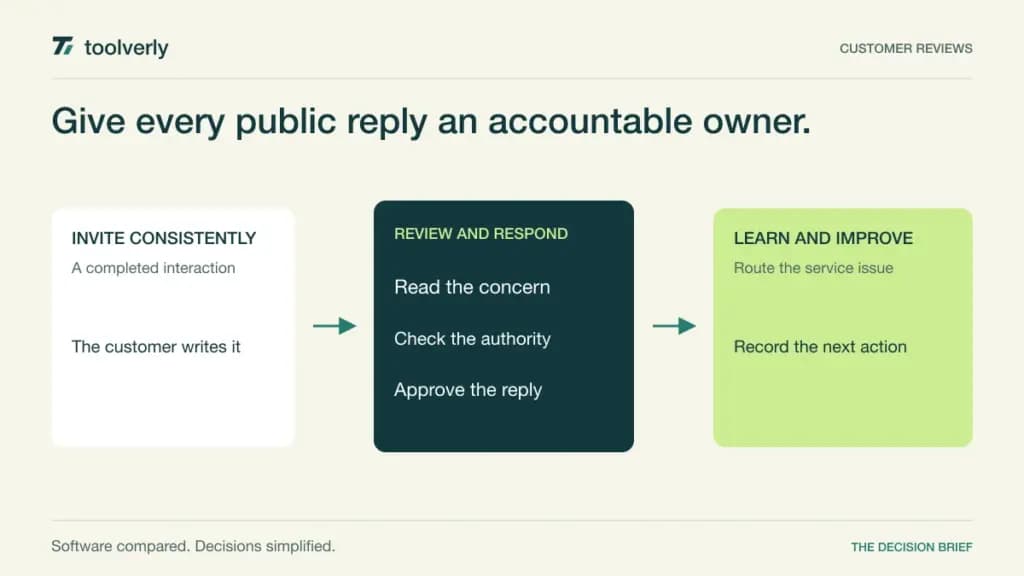
Public reviews create an operational queue, even when marketing owns the software budget. A completed service needs an appropriate invitation, a new review needs a responsible reader, and a difficult complaint may require a private service follow-up before anyone writes a public response. A tool that only increases invitation volume leaves much of that work unresolved.
Birdeye, Podium, NiceJob, GatherUp, and ReviewTrackers offer different balances of review requests, customer communication, reply support, location reporting, and broader reputation operations. The right fit depends on whether you manage one business, many locations, or client accounts for an agency.
We checked official product and pricing information on October 7, 2026. This comparison does not claim measured review growth or improved search rankings. Vendor outcome statistics are not our test results. Recommendations below are editorial judgments about workflows and package boundaries, with any numerical prices tied to their stated scope.
Five review management choices
| Product | Best fit | Main strength | Meaningful tradeoff | Price context |
|---|---|---|---|---|
| Birdeye | Brands coordinating many locations | Review generation, reply control, and wider reputation workflows | Broad deployed scope requires a configured contract | Custom location and product quote |
| Podium | Local teams using text-led customer communication | Review invites alongside a shared customer inbox | Messaging allowances and AI additions need review | Displayed Core $399/month; scope confirmation |
| NiceJob | Businesses wanting a focused invitation habit | SMS/email requests and social proof widgets | Expanded follow-up and website services cost more | Starter USD75/month; Pro USD125/month |
| GatherUp | Businesses and agencies combining feedback with reviews | Requests, monitoring, reporting, and reply tools | Message credits and location count affect scope | Single location $99/month on monthly selection |
| ReviewTrackers | Teams prioritizing location-level monitoring and analysis | Dashboards, responses, and experience insights | Analysis and adjacent services vary by package | Location-based quote |
Birdeye
Birdeye’s current Reviews product describes review generation, response, marketing, and centralized management across locations. Its response workflow can post automatically or hold a reply for approval. The wider platform connects reputation work with other marketing and customer experience capabilities.
The strength is coordinating many local teams under a shared operating model. Use a demonstration to inspect a regional manager’s view, a local responder’s permissions, and the escalation path for a sensitive complaint. An attractive central dashboard matters less if the local owner cannot recognize which issue needs attention.
Its limitation is commercial and operational breadth. The pricing page requests a configured proposal and emphasizes the products deployed at locations rather than a simple seat rate. Specify the locations, review sources, invitation channels, response controls, and additional modules before comparing a contract.
Birdeye suits a brand that needs consistent review handling across a distributed estate. Start with approval for high-risk replies and decide which ordinary responses, if any, can run automatically. Ask how a customer service correction reaches the responder; an AI draft should not invent a refund, appointment, or remedy that the business has not agreed to provide.
Podium
Podium combines textable review invitations, reminders, customer profiles, reporting, and an inbox for multiple customer interactions. Its current reviews page also describes AI assistance for invitations and responses. This makes it relevant when the staff who communicate with customers also own the review follow-up.
The strength is connecting an invitation to the existing service conversation. Ask how staff select the completed customer interaction, avoid duplicate reminders, and move a substantive complaint into a private conversation. The public reply should acknowledge the experience without disclosing details from the customer’s record.
Fresh browser review of the pricing page showed Core at $399 per month, Pro at $599, and custom Signature pricing. The page directs buyers to sales and describes AI Employee as an add-on. Those displayed figures do not establish contract length, message credits, or the full AI configuration; request those conditions in the proposal.
The limitation is paying for a larger communication platform when a narrow review tool would suffice. Podium belongs on the shortlist when the inbox and text-led workflow are useful independently of review volume. Evaluate the actual message allowance and ownership rules, with the staff who will use them every day.
NiceJob
NiceJob’s current Starter plan includes SMS and email review requests and website review widgets. Pro adds broader repeat-customer and referral campaigns and additional analysis and reply capabilities. The pricing page distinguishes its core reputation product from the separate managed website service.
Its strength is a straightforward review-request routine for an owner or small team. During evaluation, follow an eligible completed job into an invitation and then into a visible response. Check whether the team can understand and pause the reminder sequence without relying on a vendor representative for every change.
Starter is USD75 per month and Pro USD125 per month on the reviewed page, with no contract and cancellation available. Sites is separately listed at USD99 per month plus a USD199 setup fee. Enterprise and multi-location needs are directed to custom pricing.
The limitation is scope expansion. A business buying invitations should not automatically budget for website management or assume advanced repeat-customer campaigns are in Starter. NiceJob fits a company that wants a focused review collection and display process. Confirm the connection to your job or customer system, the applicable messaging scope, and the person responsible for reviewing replies before comparing it with a wider local-business platform.
GatherUp
GatherUp combines email and SMS requests, feedback options, review monitoring, reporting, widgets, and AI-crafted replies. Its plans also include QR codes, custom feedback links, integrations, API access, and webhooks. The product presents first-party customer feedback and public review activity together, which can be useful when the business needs both.
Its strength is giving a customer experience owner several ways to listen and follow up. Keep the distinction between feedback collected by the business and a review hosted by another platform clear. Each has different visibility, response, and publication expectations.
The monthly pricing selection shows $99 per month for one location and $60 per location for 2–10 locations. Annual billing is an alternative. Plans list up to 300 SMS and 3,000 email credits per location per month; agency pricing is quoted. Listings Hub and Review Defense are separate additions rather than assumed base features.
The limitation is managing channels and allowances as the location estate grows. Model invitation volume per location, not just total customers across the company. GatherUp suits businesses or agencies that want connected feedback and review operations. Ask how reply approvals, client access, credits, and account ownership behave when a location closes or an agency relationship ends.
ReviewTrackers
ReviewTrackers uses location-based pricing and separates Data Only, Starter, and Essential offerings. Starter describes alerts, dashboards, feedback and review requests, responding, and unlimited users. Essential adds experience analysis and competitor insights. Data Only is intended for teams that want review data in another analytical environment.
The strength is organizing reputation evidence across locations without treating every additional reader as another operator seat by default. In a demo, inspect whether location owners can find their unresolved reviews and whether central teams can compare recurring themes without losing the original context.
No numerical subscription rate was established on the current plans page; obtain a location-specific quote. Listings, local search rank, managed services, white labeling, and specialized monitoring packages are listed separately. That boundary is important when a broad feature list appears beside a starter package.
The limitation is assuming all analysis belongs in the entry product. ReviewTrackers fits organizations that prioritize monitoring, reporting, and customer experience patterns. Request a sample workflow for a repeated complaint across three locations and ask how it becomes a service improvement. A competitor dashboard is useful only if the team knows what decision the comparison will support.
Build a responsible invitation and response routine
Define the eligible interaction before automating invitations. Apply the same service-based rule consistently rather than selecting customers because you expect a favorable rating. Check each destination platform’s current request policy separately, and let customers describe their experience in their own words.
Set response ownership by location and issue type. A public reply should acknowledge the concern, offer an appropriate private route when needed, and avoid exposing personal details. Treat automatically generated replies as drafts until the team has reviewed the language, authority, and exception process.
- Verify the review sites and integrations your business actually uses.
- Inspect reminder timing, duplication controls, and message allowances.
- Test permissions for local responders and central reviewers.
- Separate software scope from managed services and extra modules.
Our helpdesk comparison covers private service resolution. Our social media management guide covers publishing and engagement on business accounts. Choose review management for the public invitation, monitoring, reply, and learning cycle that those adjacent systems do not fully own.
Official sources and verification date
Product and pricing information checked October 7, 2026. These official references support the documented capabilities and commercial boundaries above; the evaluation advice is Toolverly editorial analysis.
- Birdeye pricing
- Birdeye Reviews product
- Podium pricing
- Podium Reviews product
- NiceJob pricing
- ReviewTrackers plans
- GatherUp pricing and message credits
- GatherUp feedback and reply workflows
Original illustration by Toolverly. Read about our publication or send a correction.