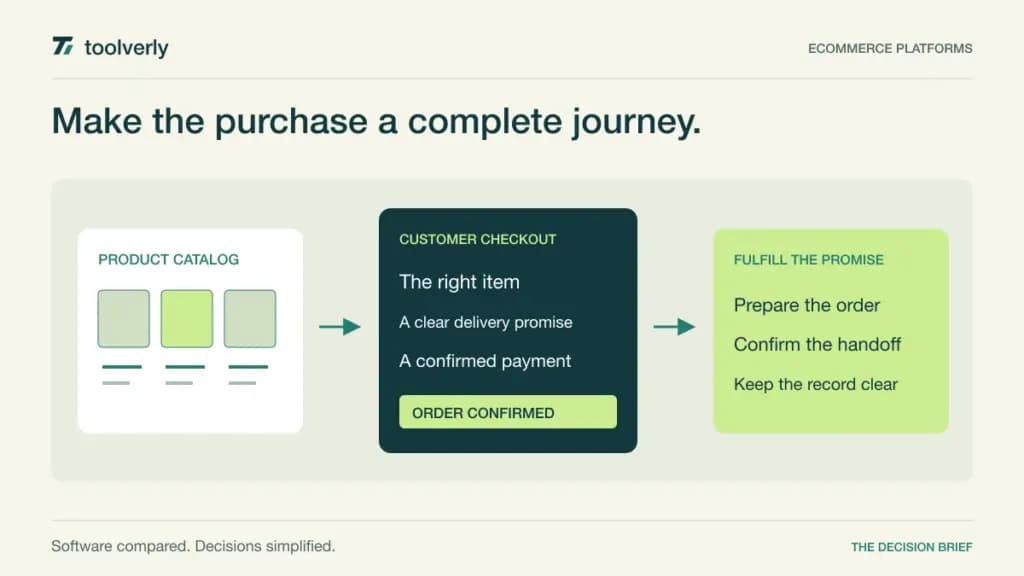
An ecommerce platform has to support a complete purchase, not just an attractive product page. Customers need to find the right variant, understand delivery, pay successfully, and receive a usable order confirmation. Your team then needs to fulfill the promise and handle the exceptions without maintaining conflicting versions of the order.
Shopify, BigCommerce, Wix, Ecwid, and Square Online provide different routes to that outcome. The best choice depends on whether you are building a new store, extending an existing website, or connecting online selling with a physical operation. Catalog size, staff access, payment choices, and growth rules can matter more than the cheapest advertised subscription.
Research checked October 1, 2026. This is a documentation-based comparison, not a hands-on checkout or conversion test. Reference prices use the vendors’ USD or US pricing views and stated billing terms. Regional availability, taxes, payment processing, apps, domains, and optional services can change the total.
Five ecommerce platforms compared
| Product | Best fit | Main strength | Price reference | Meaningful tradeoff |
|---|---|---|---|---|
| Shopify | A dedicated online store with a growing catalog | Storefront, checkout, and order operations together | Basic: US$29/month, billed yearly | Staff access and payment-provider fees need attention |
| BigCommerce | Merchants comfortable planning around sales-based tiers | Commerce tools with defined growth thresholds | Core: US$29/month, billed annually | Core has a US$30,000 trailing-12-month GMV threshold |
| Wix | A content-led business website that also sells | Website building alongside basic commerce | Core: US$29/month, yearly subscription paid upfront | Storage, collaborators, and commerce scope vary by tier |
| Ecwid | Adding a store to an established website | Embedded selling with a reusable catalog | Venture: US$35/month, monthly billing | Product limits and staff accounts shape the plan |
| Square Online | Businesses combining online and location-based sales | Online ordering within Square’s broader setup | Free: US$0; Plus: US$49/month per location | Location charges and processing fees affect the total |
Shopify
Shopify Basic provides a full online store, unlimited products, hosting, and checkout. Its US pricing page lists Basic at US$29 per month billed yearly or US$39 on monthly billing. Basic does not include additional staff accounts; Grow includes five. The displayed Basic US online standard card rate is 2.9% plus US$0.30, and the page separately lists a 2% third-party transaction fee where applicable. A temporary introductory promotion is not the continuing subscription price.
Strength: Shopify is a practical candidate when selling is the website’s primary job. Test the journey from product creation to a paid order, then inspect how staff find delivery details and customer correspondence. A platform should make the next operational step obvious without relying on the person who originally built the store.
Limitation: staff requirements, apps, and payment-provider choices can move the cost above Basic. Shopify fits a dedicated store that values a coherent commerce workspace. Price the configuration that your fulfillment and customer-service roles need, including any separate subscriptions required to complete the workflow.
BigCommerce
BigCommerce’s current pricing page uses Core, Growth, Scale, and Performance packages. Core is US$29 per month billed annually or US$39 monthly, with a US$30,000 trailing-12-month GMV threshold before automatic movement to Growth. Growth is US$79 per month billed annually. The page distinguishes embedded payment providers from other providers when describing platform fees, so a blanket assumption of zero fees would be misleading.
Strength: the published growth thresholds allow a merchant to model when the subscription may change. Build a simple forecast using the vendor’s own GMV definition, then compare the subscription at today’s volume and at the next threshold. Include the payment provider you actually intend to use in that exercise.
Limitation: growth can change the required plan even if your feature needs stay the same. BigCommerce fits a buyer who is comfortable treating that rule as part of operating cost. Confirm how adjustments and unusual orders affect the calculation, and request clarity on provider fees before treating two platforms’ base prices as equivalent.
Wix
Wix combines website creation with ecommerce features in eligible plans. The plan page displayed Core at US$29 per month for a yearly subscription paid upfront, with payment acceptance, basic ecommerce, 50 GB storage, and five collaborators. Business was US$39 on the same billing basis, with 100 GB storage, ten collaborators, and a broader commerce package. Wix notes that prices depend on location and that applicable taxes are additional.
Strength: Wix is worth evaluating when a company website contains substantial editorial, service, or brand content alongside its store. Ask the person responsible for routine updates to change a page and a product without assistance. The ability to maintain both comfortably matters after the launch project ends.
Limitation: a website plan is not automatically a selling plan, and higher storage or commerce requirements can change the tier. Wix fits a content-led business whose selling requirements match its package. Use real product options and delivery rules in the evaluation instead of assuming a simple demo product represents your catalog.
Ecwid
Ecwid can add a store to an existing website or provide its own Instant Site. Its monthly pricing view lists Venture at US$35 per month for up to 100 products and Business at US$65 for up to 2,500 products. Business adds two staff accounts, subscriptions, and abandoned-cart recovery. Annual offers differ. Ecwid lists no Ecwid transaction fee, but that does not remove charges from a payment processor.
Strength: Ecwid deserves a close look when the current website already serves the business well and the missing component is a store. Test the complete purchase inside that existing site. Navigation, checkout, order notifications, and support information should feel like one customer journey rather than an attached experiment.
Limitation: product counts and staff access can determine the tier sooner than expected. Count the catalog you intend to sell and confirm how the vendor treats its structure. Ecwid fits a business extending an established web presence, especially when preserving the current content workflow matters as much as adding checkout.
Square Online
Square Online is offered through Square’s current unified plans. The US online-store comparison lists Free at US$0, Plus at US$49 per month per location, and Premium at US$149 per month per location. Free includes a website builder and pickup, delivery, and shipping options. Plus adds further customization and commerce capabilities. Displayed US online processing is 3.3% plus US$0.30 on Free and 2.9% plus US$0.30 on Plus.
Strength: Square Online is a relevant candidate for a business that needs online orders to fit a location-based operation. Evaluate an order for pickup alongside a shipped order. Have the employee doing the work find the promised time, payment status, and customer details without referring back to the storefront administrator.
Limitation: a per-location subscription and processing charges can produce a different cost pattern from a single store fee. Check geographic availability and the exact plan needed for your delivery and customization requirements. Square Online fits merchants whose online and physical workflows can share the proposed Square setup.
Compare the order journey and the operating cost
Build the same small catalog in each serious candidate: a simple product, a product with options, an unavailable item, and an item with unusual delivery requirements. Follow a normal order and an exception. The exception could be an address correction, partial fulfillment, or a customer requesting a change before dispatch. Record where staff need to intervene.
Decide where stock truth will live. A storefront may show availability, but a business with purchasing, multiple channels, or warehouse processes may need a dedicated inventory management system. Verify the synchronization direction and how the team resolves a mismatch. Two editable quantities without a clear owner can create promises the business cannot fulfill.
Keep customer acquisition and checkout evaluation connected but distinct. Your email marketing platform may manage campaigns and segments, while the store manages the purchase. Check how consent, customer identity, and order data travel between them, and use an actual repeat-customer scenario when assessing the handoff.
- Count products, staff roles, locations, and supported sales regions.
- Verify delivery methods and required payment providers.
- Model subscription costs at current and expected sales volumes.
- Separate processing charges from platform transaction fees.
- Include apps, domains, themes, and required integrations in the estimate.
- Have everyday staff complete an order exception before committing.
Shopify is a useful starting point for a dedicated store, BigCommerce for buyers who plan around its growth rules, and Wix for a content-led site with commerce. Ecwid suits an existing website that needs selling capabilities, while Square Online fits compatible location-based operations. Let the completed customer order determine the shortlist.
Original illustration by Toolverly. Read about our publication or send a correction.