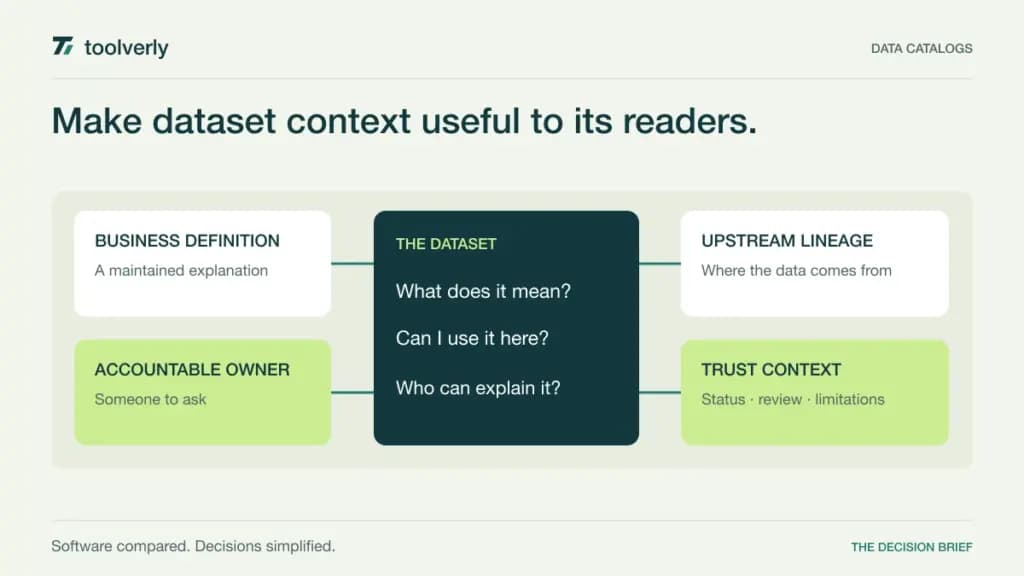
Two datasets can have similar names and still describe different business events. A useful data catalog helps a colleague understand what a dataset means, who maintains it, where it comes from, and whether it is suitable for the intended decision. Search alone cannot resolve those questions if definitions and ownership are missing.
Atlan, Collibra, Alation, DataHub Cloud, and OpenMetadata provide different paths to that context. Some buyers need a managed platform connected to an existing governance program. Others want an open-source system their engineering team can operate. The choice starts with the metadata you can collect and the people willing to keep business context current.
How this comparison was prepared
We reviewed official product materials and available pricing routes on October 5, 2026. This is desk research, not a hands-on benchmark of search accuracy, connector quality, or deployment speed. We compare discovery, definitions, ownership, lineage, curation responsibilities, and operating model. Published feature breadth should be treated as a shortlist input; buyers still need to verify support for their actual warehouse, transformation, and reporting systems.
| Product | Best fit | Main strength | Meaningful tradeoff | Pricing reference |
|---|---|---|---|---|
| Atlan | Connected data teams | Search with shared business context | Curation needs accountable owners | Sales quote |
| Collibra | Established governance programs | Catalog and governance context | Adjacent products need scoping | Scoped quote |
| Alation | Analyst discovery and reuse | Usage and collaboration signals | Popularity does not prove suitability | Sales discussion |
| DataHub Cloud | Managed metadata operations | Discovery with dependency context | Cloud differs from open source | Scoped quote |
| OpenMetadata | Teams able to operate a catalog | Open-source metadata platform | Hosting and maintenance cost time | Apache 2.0 software license |
Atlan
Atlan’s documentation describes searchable metadata, lineage, glossary context, ownership, certification, and curation across connected data systems. Its public pricing route leads to a sales contact form rather than a fixed amount. Scope the required connections and commercial package directly with the vendor.
Best fit: Data teams that want technical metadata and business explanations in a shared working context. Strength: The published model connects asset discovery with information about meaning and responsibility. Limitation: A catalog cannot supply an accountable business definition merely by connecting a warehouse.
For an evaluation, choose a report whose metric is disputed by two departments. Ask how the underlying assets, the accepted definition, the reviewer, and the last change would appear together. Include an asset with a missing owner so the evaluation exposes the work needed after ingestion. Judge whether a new analyst could identify the right next person to ask, rather than only whether a search finds a familiar table name.
Collibra
Collibra Data Catalog presents asset metadata, classification and profiling, glossary context, ownership, and lineage information. The current product page invites a demo and does not publish a fixed catalog price. Data quality, observability, and marketplace offerings should be specified separately in a proposal instead of presumed to be included.
Best fit: Organizations aligning catalog use with an established governance process. Strength: Business terms and stewardship can sit alongside technical asset information. Limitation: A broad product portfolio requires careful package and implementation boundaries.
Bring one governed metric and one less formal operational dataset. Ask which workflow is needed to publish a definition, which roles can revise it, and how a consumer sees its status. The useful buying question is whether those procedures are proportionate to your organization. A process that satisfies a governance team but discourages routine analyst participation may leave important context outside the catalog. Budget for stewardship and adoption alongside the subscription.
Alation
Alation’s catalog describes asset discovery informed by usage, descriptions and glossary terms, lineage, and trust signals such as endorsements and collaboration. The product page directs buyers to a demo and pricing discussion. Broader Alation offerings should be identified in the contract rather than assumed to accompany the catalog.
Best fit: Analysts who need to discover useful existing data and understand how colleagues work with it. Strength: Usage and collaboration context can provide starting points for a search. Limitation: A widely used dataset can still be wrong for a different population, time period, or business definition.
Evaluate a frequently used table alongside a newly certified replacement. Ask how a consumer would see the relationship, understand the reason for the change, and avoid an obsolete dependency. This checks whether popularity and trust are distinguishable in your intended workflow. Ask who will maintain descriptions and how users can report uncertainty without silently editing a business definition. Include those responsibilities in the adoption plan.
DataHub Cloud
DataHub Cloud’s product materials cover discovery, lineage, metadata quality and certification, governance context, and documentation workflows. Its public product page requires a commercial conversation rather than listing a fixed cloud subscription amount. The managed Cloud offering is different from the open-source DataHub project.
Best fit: Teams seeking managed metadata operations with a strong interest in dependencies. Strength: Discovery is connected to upstream and downstream context. Limitation: An open-source project name does not establish the price, support, or feature scope of a hosted service.
Choose a schema change that would affect a transformation and a business report. Request a demonstration of the relevant connection paths and ask which parts are automatically collected, manually annotated, or outside the connector’s scope. A lineage picture is useful only when its gaps are understood. Have the proposal distinguish managed operation, connector maintenance, support expectations, and any migration work from an existing metadata system.
OpenMetadata
OpenMetadata is an open-source metadata platform covering discovery, schemas, ownership, glossary information, classifications, lineage, and ingestion connections. The project’s license is Apache 2.0. The software license does not create a subscription charge, but hosting, upgrades, security operations, and support still require a budget. Managed commercial offerings are a separate purchasing decision.
Best fit: A technical team prepared to own the catalog’s operation. Strength: The open-source model offers a route to operate and inspect the platform yourself. Limitation: Avoid treating the absence of a software license fee as the absence of operating responsibility.
Before choosing this route, name the person responsible for upgrades and connector failures. Define how metadata credentials are stored, how permissions are reviewed, and how service interruptions are handled. Include an ingestion source that changes regularly in the evaluation. The catalog should remain useful when your engineering team is busy with other priorities, so compare the ongoing maintenance workload with the cost and scope of a managed alternative.
Decide what trustworthy context means
Choose one business question and trace it through a report, a transformation, and a source dataset. Record the definition, accountable owner, refresh expectation, and known limitations at each step. This is a better evaluation scenario than importing a large inventory and counting the resulting assets. It exposes whether the catalog explains why a consumer should use something.
Keep the surrounding tools in view. A catalog records context around data; a pipeline moves or transforms it. Our data integration comparison addresses that pipeline decision. Consumers may ultimately use a business intelligence platform to answer a question, but a polished dashboard still needs a clear definition and lineage.
Measure curation work honestly. Automatic descriptions can be a starting point, yet someone must resolve business disagreement and validate sensitive classifications. Decide who can certify an asset, who can revise a term, and when a previously trusted asset needs review. A smaller maintained catalog is often a more realistic starting goal than comprehensive metadata without an owner.
A practical buying checklist
- Use an evaluation sample containing a report, transformation, source dataset, and disputed business term.
- Verify the exact connector versions and the depth of lineage required for that sample.
- Ask how missing owners, incomplete lineage, and stale descriptions become visible to consumers.
- Define certification, review, and correction responsibilities before importing the wider estate.
- Include private or sensitive assets in the permission design without exposing them to all users.
- Compare subscription scope with implementation, stewardship, hosting, and connector maintenance costs.
- Confirm that business context and lineage records can be exported in a usable form.
Choose the platform that makes your most important data understandable to the people who use it. The sustainable result is a maintained explanation of meaning, responsibility, and dependencies, supported by an operating model your team can actually fund and own.
Sources and verification date
Official product information checked October 5, 2026. Prices are published reference points, not binding offers; confirm tax, currency, region, contract term, and package scope before buying.
- Atlan product documentation
- Atlan sales contact
- Collibra Data Catalog
- Alation Data Catalog
- DataHub Cloud products
- OpenMetadata project
- OpenMetadata Apache license
Original illustration by Toolverly. Read about our publication or send a correction.