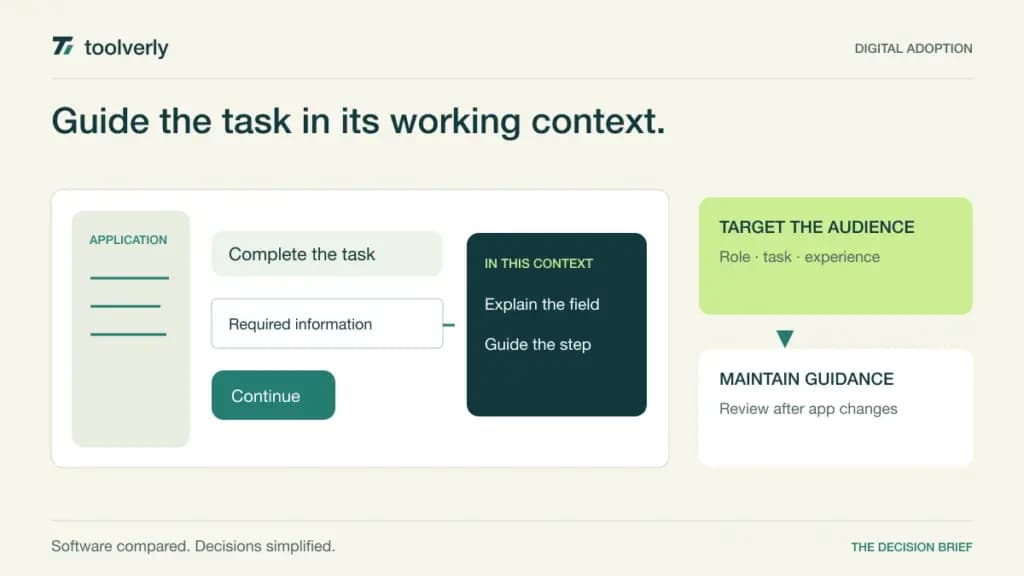
Employees and customers can know what a system is supposed to do and still struggle to complete a task inside it. A digital adoption platform adds guidance at the moment of work: a next step, an explanation, a relevant help resource, or a reminder tied to a particular user and context. The purchasing decision is whether that guidance will remain useful as the application changes.
This guide compares WalkMe, Whatfix, Userlane, Pendo, and Appcues. It focuses on assistance inside existing software, rather than a separate course catalog. Our comparison of employee learning management systems covers formal learning, while usability testing platforms help investigate why users struggle. An overlay can support an important workflow, but recurring guidance should also prompt a discussion about whether the underlying interface needs improvement.
We checked official sources on October 4, 2026. This comparison uses published capabilities and pricing, not hands-on test results. Current packaging differs substantially from older plan names and prices, so the table preserves the actual licensing units and quote requirements.
Compare the applications and users you need to support
| Product | Useful starting point | Pricing reference | Scope to confirm |
|---|---|---|---|
| WalkMe | Guidance across enterprise software workflows | Custom quote | Applications, audiences, and purchased capabilities |
| Whatfix | In-app guidance and contextual self-help | Configured application fee plus user licensing | DAP, Product Analytics, and Mirror scope |
| Userlane | Application-specific employee guidance | Annual per-application or consumption-based model; quoted amount | Application scope versus interaction usage |
| Pendo | In-app guides connected to usage analysis | Free up to 500 monthly active users; paid plans quoted | MAU count and selected modules |
| Appcues | Targeted experiences inside a software product | Configured Start, Grow, and Enterprise plans | MAUs, installations, and published experiences |
WalkMe
WalkMe’s pricing page separates employee and customer use cases and provides a custom quote. Its digital adoption capabilities include in-app guidance, tooltips, notifications, personalized onboarding, audience targeting, and analytics. Content authoring and localization are part of the platform’s broader scope. Confirm which applications and capabilities are included in the proposed package; the public page does not establish a universal per-user starting price.
Strength: it is a candidate for an enterprise adoption program that spans important software processes. The useful demonstration is a user completing a real task while guidance responds to context, rather than a tour of a static welcome screen.
Limitation: buying a broad platform does not remove the work of authoring, approving, and maintaining instructions. An implementation needs owners in the teams whose workflows are being explained.
Best fit: organizations prepared to manage adoption across several enterprise applications. Ask how guidance is targeted, reviewed, and updated when a supported application changes its screens or terminology.
Whatfix
Whatfix’s Digital Adoption Platform provides step-by-step guidance, contextual Self Help, no-code authoring, in-app surveys, and workflow engagement insights. The vendor describes pricing as an application fee plus user license fees, configured to deployment scope. Its product overview publishes illustrative starting amounts, but these are not a scoped offer. DAP, Product Analytics, and Mirror application simulations are distinct products; specify which are included instead of assuming a guidance quote covers the full suite.
Strength: it connects several forms of contextual support, which makes it relevant when users need more than a single introductory tour. Examine whether a short field explanation, a guided task, and a help article can serve different needs without competing on screen.
Limitation: application coverage and adjacent products complicate comparison with a simple per-user subscription. Obtain a quote for the exact deployment.
Best fit: teams implementing support within important operational workflows. Include content governance and application-change maintenance in the demonstration, not just the initial authoring experience.
Userlane
Userlane offers Application, Department, and Organization scopes. The Application offering combines interactive guidance, an assistant, announcements, validation, and usage insights for one application. Wider scopes cover more of the application portfolio. Pricing can use a fixed annual fee per application with unlimited users, or a consumption model with a user base and interaction-based usage. The vendor provides a configured amount rather than a public universal rate.
Strength: an application-based model is useful to examine when a defined internal system has many users. It makes the supported application an explicit part of both the adoption plan and commercial discussion.
Limitation: the two models answer different budgeting questions. A quoted annual application fee cannot be compared fairly with a consumption estimate without projecting the same scope and usage.
Best fit: an organization choosing guidance for known employee applications. Ask which interactions count, how expansion into another system is priced, and who will use the resulting adoption insights to improve instructions.
Pendo
Pendo combines product usage analysis with in-app guides. Its core Free offering supports up to 500 monthly active users. Paid packages use a configured MAU-based quote, with selected modules affecting scope; session replay and other capabilities sit in broader packaging. The vendor defines MAUs through unique active visitors over a 30-calendar-day period. Do not substitute an account’s total registered users or assume every product module is included in Free.
Strength: connecting guides with usage analysis lets a product team evaluate where assistance is needed and what happens after it appears. Frame that evaluation around task completion and repeated help requests.
Limitation: an MAU allowance needs a reliable identity and audience definition. Misunderstanding how visitors are counted can make a growing deployment difficult to budget.
Best fit: product teams that want to manage guidance alongside evidence of how their application is used. Ask to inspect one target audience, one guide, and the corresponding usage report within the exact proposed package.
Appcues
Appcues currently packages its platform as Start, Grow, and Enterprise with configured pricing. Cost depends on monthly active users, installations, and published experiences. Start begins at 3,000 MAUs and allows ten published experiences with 12 months of reporting; Grow expands the experience allowance to 25. The page advertises broad capability access, but that does not make the number of published experiences unlimited. Do not budget using an obsolete fixed-price entry plan.
Strength: the experience model fits a product team deciding which contextual messages and guides should be live for different audiences. It encourages a discussion about a manageable publishing portfolio.
Limitation: the experience allowance and installation count can matter independently of MAU growth. Several product environments or localized variants should be explained before signing.
Best fit: teams focused on customer-facing product guidance and activation. Map the experiences you expect to publish, clarify how each is counted, and ask how retired or revised experiences affect the allowance.
Evaluate a task, then its maintenance
Choose one recurring task that users find difficult: submitting a correct expense, configuring a new account, or completing a multi-step administrative action. Describe the intended audience, prerequisite knowledge, successful outcome, and common error. Ask every vendor to demonstrate guidance for that same task. Avoid selecting around a welcome tour when the real problem is a complicated task performed months after onboarding.
Then change the scenario. Rename a field, move a button, or add a required step. Ask how an author notices the change, updates the guide, tests it, and releases the revision. Check who approves content and how a mistaken instruction is withdrawn. A guide is another maintained part of the application experience, so its owner needs a reliable way to hear about product changes.
Keep the measurement plan narrow. Decide whether the guide should reduce a particular error, help a user reach a necessary step, or make a support answer easier to find. Do not treat a guide impression as proof that a person understood the task. Compare the intended audience with people who received the guidance, and examine repeated dismissals or requests for help as signals to investigate.
- List supported applications, environments, audiences, and languages before requesting a quote.
- Translate users, interactions, installations, and published experiences into a common deployment scenario.
- Review targeting so experienced users are not repeatedly interrupted.
- Assign content ownership and a release review process.
- Test whether the underlying workflow should be simplified alongside its guidance.
WalkMe and Whatfix deserve attention for a broader enterprise adoption program. Userlane makes an application-focused deployment and its pricing models explicit. Pendo is useful to examine when guides and product usage analysis share an owner, while Appcues centers the conversation on a managed set of targeted experiences. Select the platform around a maintainable workflow and an observable user need.
Official sources and verification date
Checked October 4, 2026: WalkMe pricing, Whatfix pricing, Whatfix DAP overview, Userlane pricing, Pendo pricing, and Appcues pricing. Request a current quote for the full application and audience scope.
Original illustration by Toolverly. Read about our publication or send a correction.