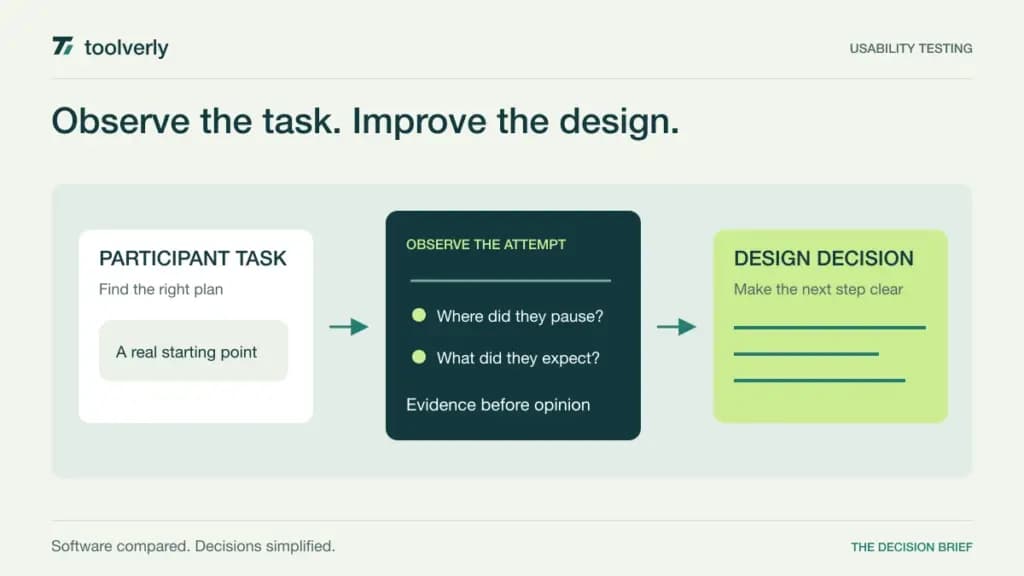
A usability study should answer a decision that a product team can act on. Can a new customer find the right plan? Does a manager understand an approval screen? Where does a participant stop before submitting an order? The platform matters because it determines what you can observe, who participates, and how easily the evidence reaches the person changing the interface.
Maze, Lyssna, UserTesting, Userlytics, and Useberry provide different routes into participant research. Compare the study workflow before comparing seat prices. A subscription with generous researcher access can still leave recruitment, study volume, or particular research methods outside your budget.
Research checked October 2, 2026. This comparison uses current official product and pricing sources. We have not conducted a hands-on study across these platforms. Listed offers use the displayed currencies; recruitment and contract terms need a separate check. Recommendations below concern workflow fit, not measured participant quality or research outcomes.
Five usability testing platforms compared
| Product | Best fit | Main strength | Price reference | Meaningful tradeoff |
|---|---|---|---|---|
| Maze | Product teams connecting prototype research to decisions | Prototype testing with a broader research portfolio | Request configured pricing | Methods and recruitment depend on package |
| Lyssna | Teams combining quick studies with deeper research | Several research methods within one workspace | Free: US$0; paid Growth and custom Enterprise | Panel responses cost extra on every plan |
| UserTesting | Organizations formalizing participant research | Qualitative studies with enterprise packaging choices | Request pricing | Edition and commercial model both matter |
| Userlytics | Teams balancing their own audience and panel research | Self-recruitment and project-based options | Current Premium card: US$699/month | Confirm commitment and panel charges |
| Useberry | Teams iterating studies across projects and versions | Response allowances with configurable study capacity | Growth: €83/month, billed yearly (€996/year) | One included seat and separate recruitment budgeting |
Maze
Maze is a candidate when product designers want to evaluate an interface before engineering commits to the next version. Its current packages page lists prototype testing across plans, with limits, and card sorting. Panel recruitment, mobile research, interview studies, and automated reporting appear in the Enterprise feature descriptions. The current page directs buyers to sales rather than presenting a fixed public subscription amount.
Strength: the research portfolio can support a conversation from an early navigation question to a more developed product decision. For an evaluation, prepare one task with a clear starting point and a success condition. Ask a designer to explain the proposed change using the resulting evidence, without having the researcher interpret every screen for them.
Limitation: a portfolio page does not establish which methods and allowances are included in your particular proposal. Request study limits, researcher access, recruitment costs, and required reporting capabilities in writing. Maze fits teams that can define a repeatable study process and identify which parts deserve a larger package. It is less useful to budget around an old entry-level price found elsewhere than around a current, scoped offer.
Lyssna
Lyssna combines methods such as first-click testing, prototype testing, card sorting, and interviews. Its official pricing page offers a Free plan with three seats and 15 self-recruited test and survey responses. Growth includes five seats, five in-depth studies per month, unlimited self-recruited test and survey responses, and capabilities such as live website testing and think-aloud recordings. Responses from Lyssna’s panel are priced separately on all plans.
Strength: a team can distinguish a brief directional question from a deeper study instead of treating every project as the same research event. That helps a research owner plan a month of work. Try a small navigation question first, then check whether a more involved task requires a different study allowance or method.
Limitation: free access and paid recruitment are separate decisions. Calculate the participant budget using the actual audience, screening requirements, and study duration. Confirm the selected billing term for Growth before comparing its recurring charge. Lyssna fits teams that want several methods in one place and are willing to manage study capacity deliberately. Unlimited quick studies do not remove the need to recruit suitable participants or read the evidence carefully.
UserTesting
UserTesting’s current plans page separates Test-based Consumption from Team-based Unlimited and combines those commercial models with Advanced, Ultimate, and Ultimate+ editions. Advanced includes unmoderated think-aloud work, surveys, and moderated Live Conversation studies. Higher editions expand the research and organizational toolkit. Pricing requires a proposal; an unlimited label should be interpreted within the written scope of the selected plan.
Strength: the packaging gives a larger organization a way to evaluate both how research is consumed and which capabilities its teams need. In a demonstration, involve the people who commission studies and those who review findings. Have them find one relevant recording, understand the participant’s task, and decide what evidence to share with a product owner.
Limitation: choosing an edition alone does not settle the commercial terms. Ask about usage accounting, recruitment, integrations, and how a new department joins the program. UserTesting fits organizations that need a planned research service across several teams. A smaller team should still price its own realistic study calendar; enterprise capability counts are a poor substitute for a clear expected volume and an accountable owner.
Userlytics
Userlytics supports research on websites, apps, and prototypes, with project-based, enterprise, self-recruitment, and Limitless options. The current visible pricing card showed Premium at US$699 per month with five seats. Project-based work and Limitless use configured quotes. An older FAQ on the same page still mentions lower subscription figures; we use the current card as the reference and recommend confirming the commercial proposal, commitment, and panel fees directly.
Strength: the distinction between supplying your own participants and buying recruitment makes an important cost decision explicit. A team with an established customer research group can evaluate a different budget from one seeking a narrow external audience. Prepare both scenarios when requesting terms rather than assuming every participant has the same acquisition cost.
Limitation: the headline subscription does not explain all the conditions of a research program. Check the allowed study types, account roles, participant source, and any project services in the proposed package. Userlytics fits teams that want to compare self-recruitment with assisted or panel work. Ask the vendor to demonstrate the exact proposed configuration so that a broad capabilities list does not become an accidental purchasing assumption.
Useberry
Useberry’s pricing and configuration page lists Free at €0 with ten responses per month, one project, and one seat. Growth is €83 per month billed yearly, totaling €996 per year, with 300 responses per month, one included seat, unlimited projects and versions, and five interviews monthly. Additional seats and response capacity can be purchased. Its response allowance concerns your own audience; participant-pool recruitment needs its own budget.
Strength: explicit capacity makes it easier to connect a research calendar to a configuration. Count the studies, versions, respondents, and collaborators needed for the next quarter. Then ask a designer to compare evidence from two versions of the same task. The useful output is a reason to change or retain a design, not simply another completed study.
Limitation: a low annual-equivalent rate may cover only one person who builds studies. Separate that person from colleagues who only review results, and check which roles consume paid seats. Useberry fits teams that iterate across several design projects and can forecast response volume. Avoid choosing a capacity tier from a single busy week; also consider the quieter months and the commitment involved in annual billing.
Choose around the research decision
Start with one question, one target audience, and the evidence that would change your mind. Asking whether a screen is easy to use is too broad. Asking whether a first-time administrator can invite a colleague without help provides a task, a context, and an observable outcome. Apply the same task to every shortlisted platform during your own evaluation.
Recruitment comes next. Existing customers may know your terminology too well to expose a new-user problem. A general panel may lack the specialist knowledge your business workflow requires. Document the screening criteria and the participant source before estimating study cost. Keep recording access and retention requirements close to the study plan so the research owner can explain what is collected and why.
Feedback collection is an adjacent process. Our product feedback comparison covers incoming requests and prioritization, while software test management tools organize QA cases. Those records can inform a usability question, but they do not replace watching the intended user attempt the task.
- Check the proposed method, audience, and study allowance together.
- Separate subscription, recruitment, incentives, and optional services.
- Have a reviewer locate evidence without the researcher guiding every click.
- Define who turns a finding into a design change and checks it afterward.
Shortlist Maze for a scoped product research program, Lyssna for mixed study methods, UserTesting for organizational research packaging, Userlytics for participant-source choices, and Useberry for configurable project capacity. Choose the workflow your team can use to make a defensible decision.
Original illustration by Toolverly. Read about our publication or send a correction.