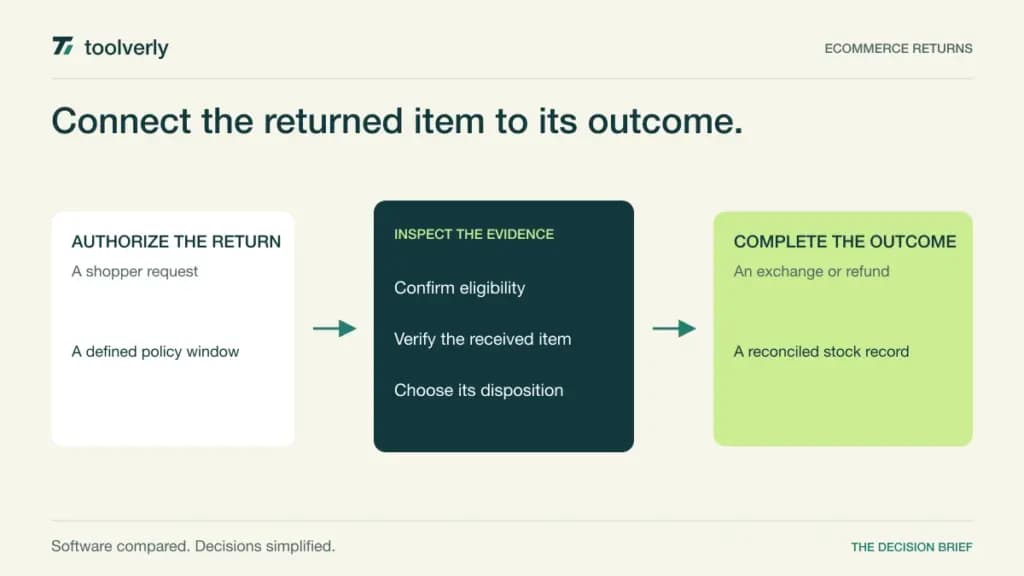
A returns portal can make the shopper’s first step easier while leaving the merchant’s hardest work untouched. Someone still has to establish eligibility, offer a suitable exchange, identify the incoming item, decide whether it can be resold, and reconcile the refund. Ecommerce returns software is valuable when those decisions form a connected workflow rather than a series of messages between support and the warehouse.
Loop, AfterShip Returns, ReturnGO, Happy Returns and ReturnLogic emphasize different parts of that workflow. The right choice depends on your commerce platform, return policies, physical receiving process and appetite for exchanges. A convenient drop-off experience and a correct financial outcome are both useful, but they require different capabilities.
Official product and pricing sources were checked on October 12, 2026. This comparison does not claim hands-on testing, a reduction in returns or recovered revenue. Public fees describe software offers; shipping, handling, incentives, integrations and commercial commitments require separate confirmation.
Compare the request, the item and the financial outcome
| Product | Best fit | Main strength | Meaningful tradeoff |
|---|---|---|---|
| Loop | Brands emphasizing exchanges | Returns policies and exchange journeys | Advanced features and funded-return terms need scoping |
| AfterShip Returns | Structured return automation | Eligibility, routing and tiered workflows | Quotas, overages and neighboring products affect cost |
| ReturnGO | Configurable post-purchase processes | Return alternatives and operational integrations | Platform and package determine feature availability |
| Happy Returns | Box-free physical drop-off | Software connected to reverse logistics | Network fit and logistics terms are central |
| ReturnLogic | Receiving and disposition visibility | Return records connected to item condition | Usage pricing and contract details need clarification |
Loop
Loop combines return processing with exchange options and configurable policies. Its current pricing comparison includes automatic returns processing, refund and store credit workflows, with capabilities such as Shop Now, Instant Exchange and Bonus Credit associated with the Advanced offer. The practical question is how easily a shopper can reach an appropriate replacement while the merchant preserves a reliable order record.
The advantage is a returns journey that can support an exchange rather than ending automatically in a refund. The limitation is that incentives and instant replacements need operational rules: inventory, price differences and a replacement shipment must remain explainable when the original item is late or incorrect.
Best fit: commerce brands that want exchanges to be a deliberate part of their returns program. Ask for a demonstration involving an unavailable size, a gift return and a mixed order.
Price context: Essential starts at $155 per month and Advanced at $340 per month. Checkout+ advertises free software and return shipping under its program. Confirm eligibility, who funds that program, included services, usage charges and contract terms before comparing it with an ordinary paid subscription.
AfterShip Returns
AfterShip Returns offers a branded return journey with eligibility rules, routing, labels, refunds and exchanges. Its current Essentials, Premium and Enterprise packaging distinguishes foundational automation from advanced workflows, integrations and customization. The benefit is describing a repeatable return process using conditions rather than manually approving every ordinary request.
The limitation is that product boundaries matter. Some workflows depend on adjacent capabilities, such as delivery-date return windows requiring a Tracking plan. Carrier connections, return zones, retention, APIs and integration scope also differ by tier. Confirm the specific combination rather than assuming every AfterShip feature belongs to Returns.
Best fit: merchants seeking structured return rules and a broader post-purchase connection. Evaluate one automatically eligible return and one exception that must reach a human.
Price context: the current live page lists annual return allowances and per-return overages, with monthly and annual billing choices. Enterprise is custom priced. We omit a universal starting amount because an older official help article describes different packages and figures. Price the current volume configuration, label costs and any Return Care consumer-funded program separately.
ReturnGO
ReturnGO supports a self-service portal with exchanges, refunds, gift cards and store credit, plus approval automation and shipping integrations. Higher packages add operational capabilities such as item validation, packing slips, ERP connections and more advanced automation. This makes it relevant when the return process needs to connect with several existing business systems.
The advantage is the range of return alternatives and operational configuration. The tradeoff is integration scope: the vendor notes that platform limitations can restrict features, and the Shopify self-service application does not include all enterprise capabilities. A feature listed somewhere in the platform is not sufficient evidence that it will work with your stack.
Best fit: merchants with specific policy, warehouse or system requirements. Ask for a return spanning more than one item and a product exchange with a price difference.
Price context: Premium starts at $147 per month and Pro at $297 per month; Enterprise uses custom pricing. These are starting figures with quote invitations. Confirm volume allowances, billing commitment, platform support, integrations and add-ons in the actual offer rather than interpreting the headline as a complete operating cost.
Happy Returns
Happy Returns connects returns software with a physical reverse logistics service. Its Return Bar network provides box-free, label-free drop-off, with in-person item verification and consolidated movement of returned goods. That changes the buying decision: you are evaluating a shopper and warehouse service as well as a return authorization interface.
The advantage is connecting drop-off, verification and physical handling. The limitation is geographic and operational fit. A network service must support the places your customers use, the products they return and the destinations that receive them. Marketing claims about speed or savings should not be treated as guaranteed results for your business.
Best fit: retailers where drop-off convenience and consolidated returns are important. Map your customers and item types before evaluating the portal alone, then ask how an item that fails verification is handled.
Price context: the reviewed official site directs merchants to a commercial discussion and does not present a universal numeric software subscription. Treat the service as quote based. Request software, drop-off, transportation, receiving, exception handling and any minimum commitments as distinct commercial terms.
ReturnLogic
ReturnLogic combines shopper return options with visibility into return status, automated rules, reporting and item disposition. Its current page highlights exchanges, bonus credit and tracking the condition of returned products. This is useful when the main bottleneck is knowing what came back and what should happen next.
The advantage is bringing operational evidence into the return record rather than considering the case finished when a label is created. The limitation is that software still needs a reliable receiving process. Ask who scans the item, how damaged and resalable goods are distinguished, and how those decisions reach the inventory and finance systems.
Best fit: merchants that need support and warehouse teams to share a consistent return history. Demonstrate a partial return, an incorrect item and a received item awaiting a disposition decision.
Price context: the current plan card advertises no subscription or platform fee, with usage charges ranging from $3.90 to $0.25 per return; Enterprise is custom. Its FAQ also retains a $299-per-month statement and 12-month contract language. Obtain a written quote resolving the applicable offer, usage rate, commitment and renewal terms.
Evaluate exceptions before approving automatic refunds
Prepare a small set of representative orders: a normal return, a late request, a gift, an exchange with a price difference, a bundle with one returned component, and a parcel containing the wrong item. Follow each from request to authorization, physical receipt and final outcome. Use your actual policy so the demonstration reveals where manual work remains.
Decide which event should trigger the refund. A request, carrier scan, verified drop-off and warehouse inspection are different forms of evidence. Establish what happens when an exchange is sent but the original item never arrives. The software should make that state visible without forcing staff to infer it from several systems.
Our ecommerce shipping comparison covers outbound fulfillment and carrier workflows. Our inventory management comparison helps define stock ownership and reconciliation. A returns product should connect those neighboring responsibilities, with clear authority for changes.
Build the budget from annual and peak return volume, labels, physical handling, incentive costs, support and integrations. Include the cost of maintaining policy changes. A subscription saving means little if exceptions require repeated manual refunds or the warehouse cannot identify returned items reliably.
- Confirm supported storefronts, markets and return methods.
- Demonstrate eligibility rules and human exception routing.
- Trace exchanges, refunds and inventory changes separately.
- Verify receipt and disposition evidence.
- Compare quotas, usage fees and contract commitments.
Shortlist Loop for exchange-focused journeys, AfterShip Returns for structured automation, ReturnGO for configurable integration needs, Happy Returns for physical drop-off logistics, and ReturnLogic for item disposition visibility. Select the option that makes the financial and physical outcome understandable to the team handling the exception.
Official sources checked October 12, 2026
Loop pricing; AfterShip Returns pricing; ReturnGO pricing; Happy Returns service; ReturnLogic pricing and terms.
Original illustration by Toolverly. Read about our publication or send a correction.