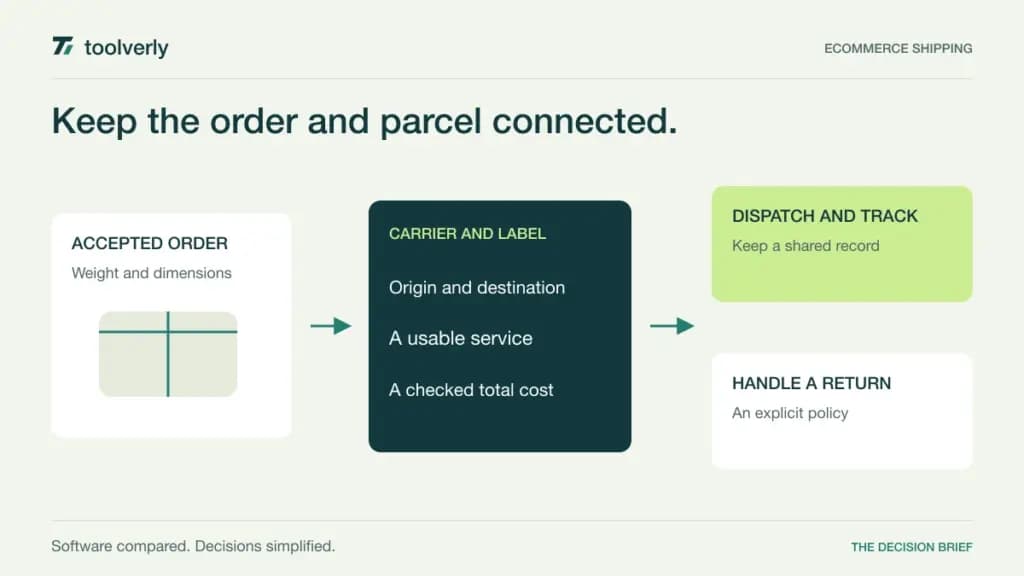
A paid order is only the beginning of the shipping workflow. The business still needs the correct package, an available carrier service, a readable label, a dispatch handoff, and useful tracking. If the customer changes an address or returns an item, someone must handle that exception without confusing the original order record.
ShipStation, Shippo, Easyship, Sendcloud, and Pirate Ship approach this work with different carrier coverage, operational depth, and billing models. The best choice depends first on where parcels originate and which services your customers actually need. A low subscription price does not make an unavailable route usable.
We reviewed official information on October 7, 2026. This article provides product research and a practical evaluation framework, not a live carrier-rate test. Subscription amounts exclude postage unless explicitly stated. Shipping rates, taxes, insurance, surcharges, and region-specific eligibility must be checked for a representative shipment.
Five shipping workflows compared
| Product | Best fit | Main strength | Meaningful tradeoff | Price context |
|---|---|---|---|---|
| ShipStation | Stores with growing operational complexity | Order automation and broader fulfillment workflow | Advanced capabilities and volume change the plan | Starter $14.99/month at 50 shipments |
| Shippo | A focused multicarrier label operation | Label creation with a low-volume entry plan | Own-account and API fees need separate attention | Free up to 30 labels; Pro annual tier |
| Easyship | Merchants comparing international delivery choices | Courier selection and tax/duty tools | Origin country and endpoint usage affect costs | US Plus $29/month, billed monthly |
| Sendcloud | Stores coordinating delivery and returns | Carrier, checkout, and post-purchase connections | Subscription plus label and overage charges | EUR plans with separate per-label fees |
| Pirate Ship | US-origin USPS and UPS parcel shipping | Free software with batch labels and tracking | A narrower carrier and origin scope | No monthly software fee; postage payable |
ShipStation
ShipStation combines store connections, labels, rate shopping, order automation, and fulfillment capabilities. Its current pricing separates Starter, Standard, and Premium by both functionality and shipment volume. Standard lists order combining and splitting, existing carrier accounts, returns and exchanges, and basic warehouse management; Premium expands inventory, warehouse, and routing capabilities.
Its strength is coordinating a shipping operation that has outgrown one person printing labels individually. Evaluate the rule lifecycle: how a new order enters, which conditions select the package and service, and who can correct a mistaken rule before the next batch.
The current page’s 50-shipment monthly selection shows Starter at $14.99, Standard at $29.99, and Premium at $349.99 per month. Higher shipment bands cost more, and annual billing is an alternative. Postage, insurance, extra users, and selected add-ons remain separate considerations.
The limitation is buying operational depth before you can use it. A small store may not need advanced warehouse workflows, while a larger team may quickly encounter lower-tier boundaries. ShipStation fits a multichannel business with a named operations owner. Use a representative batch containing a split order, a delayed item, and a return to judge whether the selected tier supports your actual handoffs.
Shippo
Shippo’s application focuses on comparing carrier services, creating labels, connecting stores, tracking shipments, and return labels. Starter includes one user login and up to 30 labels per month. Pro adds branding and more support and user access, while Premier is designed around a configured higher-volume relationship.
The strength is a relatively focused path from order to shipment. For a small merchant, test whether imported dimensions, weight, and recipient information survive the journey into a label. Then check how an operator records a correction and keeps the storefront informed.
The Pro page displays $17 per month equivalent, $205 per year, for the annual 1–200-label selection. Retain the stated annual charge rather than treating that rounded monthly figure as a monthly contract. Starter charges $0.05 per label when using your own carrier account; that connection fee is absent on Pro and Premier.
Additional API calls not associated with Shippo labels and certain address-validation services have separate billing. This is the main limitation when comparing a dashboard subscription with an integration-heavy operation. Shippo suits a team needing approachable multicarrier shipping, provided the estimate separates postage, application tier, own-account use, insurance, and API activity.
Easyship
Easyship emphasizes courier comparison, shipping rules, imports from commerce platforms, and international tax and duty information. Its plans page explicitly varies by origin country. The US selection reviewed here includes a free plan with up to 50 monthly shipments, Plus up to 500, Premier up to 2,500, and Scale up to 5,000.
Its strength is bringing international delivery choices into the operational decision. Evaluate whether the selected service matches the promised customer experience: who pays duties, which tracking events are available, and how an undeliverable parcel is handled. A quoted transit estimate should not become an unconditional delivery promise.
For the US monthly billing selection, Plus is $29, Premier $69, and Scale $99 per month. Own-courier-account label fees, advanced API quotas and overages, and fulfillment add-ons appear separately. Other origin countries may have different inclusions and prices.
The limitation is assuming a global brand means every route and integration behaves identically. Easyship is a useful candidate for cross-border merchants that can define their shipping origin and common destinations. Ask for the full cost of a typical international parcel, including purchased services and applicable surcharges, before comparing the subscription with another vendor’s headline rate.
Sendcloud
Sendcloud connects carrier choices, order processing, tracking communication, checkout delivery options, and returns. Lite includes a limited set of users, integrations, and shipping rules; Growth introduces a branded return portal and more post-purchase capabilities. Higher tiers extend automation, integrations, and operational support.
The strength is maintaining the journey after checkout. A customer service team should be able to understand the same shipment the warehouse dispatched. In a demo, trace a missed delivery through tracking, a customer question, and the return policy instead of stopping when a label prints successfully.
The current pricing uses a base subscription plus a per-label fee. Lite lists €0.10 per label, Growth €0.09, Premium €0.08, and Pro €0.07, alongside plan limits and additional overage rules. Monthly and yearly billing selections differ. Obtain a plan-specific amount for your country and billing period rather than assuming the visible monthly equivalent is universally applicable.
Carrier availability and contract compatibility are another constraint. Sendcloud fits merchants whose delivery and return operations benefit from connected customer communication. Compare base cost, expected labels, peak-month overages, and carrier charges together. Confirm the exact return features your selected tier includes and who maintains the policy behind them.
Pirate Ship
Pirate Ship provides web-based USPS and UPS shipping, package presets, batch label printing, tracking, and shipment reports. Its software has no monthly fee, and the company says it is paid by carriers. You still pay for postage and any selected shipment services.
Its strength is a focused operation for a US-origin parcel business that needs labels and tracking without a broad warehouse subscription. It is particularly useful to evaluate when a store can manage stock and order ownership elsewhere and simply needs a dependable shipping handoff.
The main limitation is carrier and origin fit. The official page explicitly limits its UPS discounts to shipments originating in the United States. Do not interpret an international destination as support for dispatching parcels from every country. Check both the sending location and service before adding it to a regional shortlist.
For evaluation, import a small set of realistic orders, compare package presets, and review the reports available to the person reconciling postage. Check how label sharing and reprinting fit your packing station. Pirate Ship belongs on the shortlist when its narrower coverage meets the business need; the absence of a software fee is valuable only after that coverage is established.
Compare a full shipping week
Build a sample with common domestic parcels, one cross-border order, an oversize package, a split shipment, and a return. Use the same measured weights and dimensions for every comparison. Do not buy labels or dispatch real parcels merely to inspect a demo; a representative quote and walkthrough can establish the first shortlist.
Ask how cancellations, duplicate imports, address corrections, and pickup cutoffs are represented. Decide which system owns the order status. If two systems can mark an order fulfilled independently, your evaluation needs to include that reconciliation rather than assume the integration prevents every mismatch.
- Confirm shipping origins, carrier services, and account eligibility.
- Separate software, label fees, postage, insurance, and surcharges.
- Model the peak month as well as normal volume.
- Assign an owner for tracking exceptions and return labels.
Our ecommerce platform comparison covers the storefront and checkout decision. Our inventory management guide covers stock availability and replenishment. Choose shipping software for the dispatch and delivery handoff between those systems and the customer.
Official sources and verification date
Product and pricing information checked October 7, 2026. These official references support the documented capabilities and commercial boundaries above; the evaluation advice is Toolverly editorial analysis.
- ShipStation plans and billing conditions
- Shippo application pricing
- Easyship origin-specific plans
- Sendcloud plans and label fees
- Pirate Ship software and carrier scope
Original illustration by Toolverly. Read about our publication or send a correction.