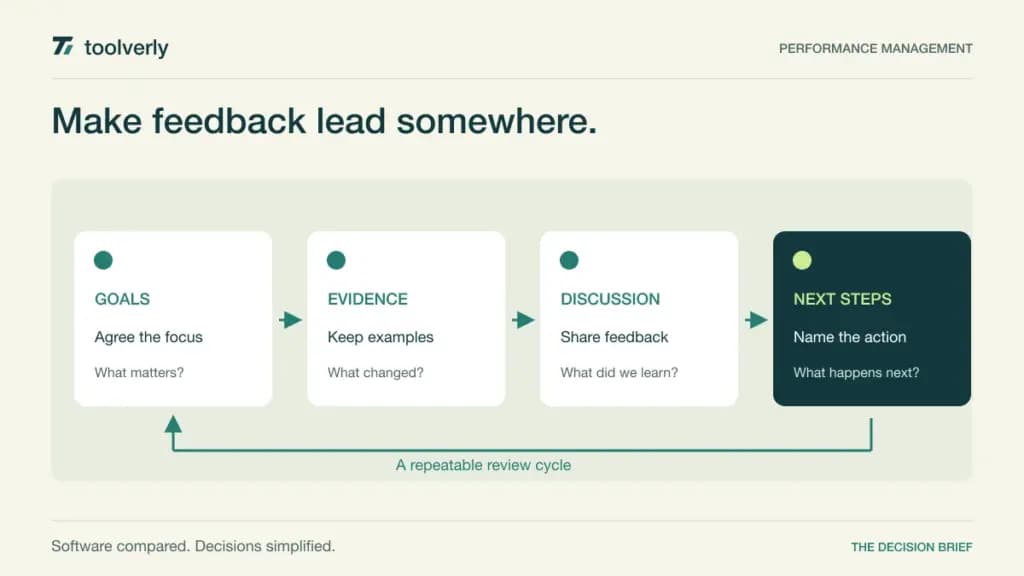
Performance management software is useful when it helps managers have better-supported conversations and gives employees a predictable review process. It is less useful when it merely turns a confusing annual form into a confusing online form. The buying decision starts with the cadence, evidence, and decisions your organization wants to support.
This comparison examines Lattice, 15Five, Leapsome, PerformYard, and Small Improvements for employee reviews, feedback, and development. Official features and pricing were checked on September 28, 2026. We have not conducted hands-on testing or measured improvements in employee performance. The recommendations below describe suitable evaluation scenarios, not guaranteed people outcomes. Dollar amounts in this guide are USD.
Define the review process before choosing the platform
Write down who contributes, who sees each response, when a manager discusses it with the employee, and what happens next. A review cycle might inform development planning, compensation, or both, but those purposes require explicit communication. Software cannot resolve unclear expectations about how feedback will be used.
For development activities after a review, our employee learning management systems comparison covers training delivery. A performance platform organizes feedback and goals; it does not automatically supply an appropriate learning program. Keep review guidance and manager instructions accessible through a documented process, potentially alongside your team wiki.
| Product | Evaluation focus | Verified price basis | Budget condition |
|---|---|---|---|
| Lattice | Reviews, goals, and manager routines together | Foundations $13/seat/month | Annual contracts; $4,000 minimum annual agreement |
| 15Five | Performance cycles connected to regular conversations | Perform $11/user/month, billed annually | Engage alone is a different, narrower purchase |
| Leapsome | A configurable collection of people modules | Custom quote | Minimum one-year contract; module scope matters |
| PerformYard | Configuring and operating a review process | Performance $5–$15/person/month, billed annually | Price depends on employee count and products |
| Small Improvements | A focused review and feedback toolkit | Grow $6/user/month, billed annually | 20-user minimum for Grow |
Lattice
Lattice is worth evaluating when the organization wants formal performance cycles connected to ongoing manager activity. Its pricing page lists Foundations at $13 per seat per month, combining performance, goals and OKRs, and manager tools such as one-to-ones, updates, and feedback. Contracts are annual, with a $4,000 minimum annual agreement.
Strength: a combined package can make it easier to assess the relationship between stated goals, regular conversations, and the eventual review. Instead of demonstrating each feature independently, ask a manager to reconstruct the evidence behind one employee’s development discussion.
Limitation: the minimum agreement materially changes the economics for a small company. Additional areas such as compensation or career development may also add cost. Request a proposal covering the actual population and modules rather than multiplying a headline rate by an assumed small seat count.
Best fit: teams that already intend to run both structured reviews and recurring manager practices. During evaluation, inspect permissions from an employee, manager, and administrator perspective. Confirm when feedback becomes visible and how corrections are handled. A comprehensive suite is useful only if the organization can explain its process clearly enough for people to trust it.
15Five
15Five’s current performance offer connects review cycles with feedback and manager conversations. The official plans list Perform at $11 per user per month on annual billing, including capabilities such as performance reviews, 360 feedback, goals and OKRs, talent assessment, one-to-ones, and check-ins. Total Platform is $16 on the same billing basis.
Strength: the product is a useful candidate when review season feels disconnected from the rest of the year. Evaluate whether managers can refer to relevant prior discussions without requiring employees to repeat every accomplishment from memory at the end of a cycle.
Limitation: the lower-priced Engage offer is not a substitute for the Perform package. Similarly, manager coaching and broader training services should be scoped separately instead of assumed to be included with every subscription. Compare the package needed for your actual review process.
Best fit: organizations willing to sustain a regular management rhythm. Run a small pilot over several conversations, not just a single review form. Check whether the prompts produce useful discussion or repetitive administrative work, and decide what managers should stop doing elsewhere when the new system becomes the agreed place for these records.
Leapsome
Leapsome offers configurable modules for areas including reviews, goals, and surveys. Its pricing explanation says the proposal depends on employees, selected modules, and contract terms, with a minimum contract of one year. There is no clear universal public per-employee price suitable for comparing all configurations.
Strength: a modular purchase can align the system with a defined process rather than requiring the buyer to adopt every people workflow immediately. The reviews offering lists automation, templates, visibility settings, calibration, analytics across cycles, and external reviewers. These are useful areas to examine when a simple annual questionnaire no longer matches the organization.
Limitation: implementation support needs explicit attention. The pricing FAQ associates Customer Success implementation services with annual contracts of at least €6,000 or US$6,000; support resources remain available more broadly. Clarify the help included in your particular proposal.
Best fit: teams with a specific design for reviews and a credible plan for adding related modules. Ask the vendor to demonstrate a complete cycle using your visibility rules, including an external contributor. Assess how administrators handle exceptions and late responses. A flexible platform should reduce manual coordination without making the process impossible for a new HR administrator to understand.
PerformYard
PerformYard is a candidate for organizations that care about adapting the software to their review process and getting practical implementation support. Its current pricing page gives a Performance range of $5–$15 per person per month, billed annually, with the final amount depending on employee count and selected products.
Strength: the Performance offer covers reviews, meetings, goals, engagement, feedback, and surveys. The page also describes a dedicated success manager, implementation, and training support. This makes the delivery model worth examining alongside the feature list, especially when a small HR team must coordinate a substantial change in process.
Limitation: the bottom of a published range is not a guaranteed price for every buyer. Talent Development is separately described, so capabilities such as succession or compensation planning should be included expressly in the proposal if required.
Best fit: a team with a defined review method that needs help configuring and sustaining it. Bring an awkward real scenario to the demonstration: a manager changes halfway through a cycle, an employee has multiple contributors, or one department uses a different timetable. Evaluate both the employee experience and the administrator effort needed to keep that case coherent.
Small Improvements
Small Improvements offers a focused progression from basic reviews to broader feedback routines. Its annual pricing lists Launch at $3 per user per month, Grow at $6, and Elevate at $9. Launch and Grow have a 20-user minimum; Elevate requires at least 30 users.
Strength: Grow provides a useful comparison point for teams seeking reviews alongside 360 and ongoing feedback, objectives, one-to-ones, and pulse surveys. This allows a buyer to assess a fairly complete recurring feedback workflow without assuming a larger HR suite is necessary.
Limitation: minimum user counts mean a very small team will not pay simply its headcount multiplied by the displayed rate. Advanced analytics and additional customization also belong to a higher tier. Optional tailored implementation sessions carry an additional fee, so distinguish standard resources from bespoke assistance.
Best fit: teams that want a recognizable, repeatable review and conversation process. Trial it with both a conscientious manager and someone who struggles to maintain administrative routines. The useful question is whether each can prepare a specific, constructive discussion without substantial extra coordination from HR. Also review how an employee returns to agreed objectives after the meeting ends.
Evaluate evidence, access, and follow-through
Build a scorecard around a complete cycle: setup, invitations, responses, manager preparation, discussion, and follow-up. Include time spent resolving exceptions. A system that looks effortless for one demonstration employee may create considerable work when reporting lines or schedules differ across departments.
Use fictional or appropriately prepared data during the first evaluation. Ask each finalist to show what different roles can see, how review records can be exported, and how access changes when a manager moves teams. Determine the organization’s retention and correction process with the people responsible for those decisions; a software feature alone does not define policy.
Shortlist Lattice for an integrated review-and-goals package, 15Five for connecting cycles to manager routines, Leapsome for modular configuration, PerformYard for process implementation, and Small Improvements for a focused feedback toolkit. Then let the pilot decide. The strongest purchase is the one employees understand, managers maintain, and HR can administer consistently after the first review deadline has passed.
Original illustration by Toolverly. Read about our publication or send a correction.