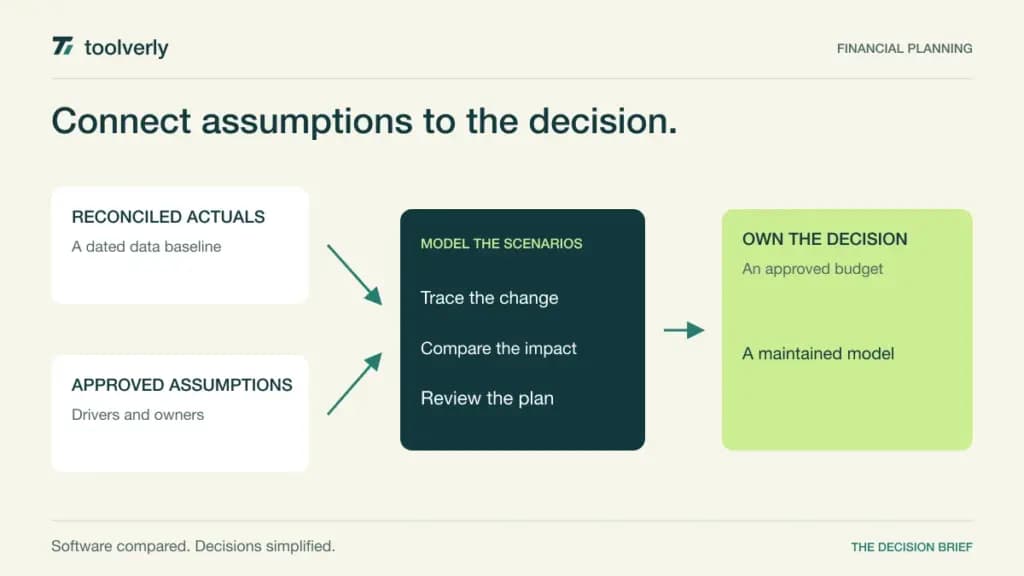
A finance team can reconcile last month’s actuals and still struggle to produce a usable forecast. Department owners submit different assumptions, hiring dates move, and the board asks which version includes the latest sales outlook. FP&A software is valuable when it connects the inputs, model, review process, and approved financial story.
This comparison covers Planful, Vena, Cube, Datarails, and Pigment. The focus is collaborative budgeting, driver-based forecasting, and scenario ownership. It is a software buying guide, not financial advice or a claim that a platform will improve forecast accuracy. Official product and commercial pages were checked October 10, 2026. Recommendations are editorial judgments, with no claimed hands-on implementation or savings measurements.
Start by naming the failure you need to fix. Some teams need a governed spreadsheet interface; others need a shared model across functions or stronger connections between close, consolidation, and planning. Avoid buying a large platform merely to automate one report. Conversely, do not expect a visualization tool to manage who submitted and approved an assumption.
Five financial planning approaches compared
| Product | Best fit | Main strength | Meaningful tradeoff | Pricing reference |
|---|---|---|---|---|
| Planful | Finance teams connecting planning and close | Planning, consolidation and reporting platform | Implementation scope needs a precise proposal | Sales-scoped quote |
| Vena | Microsoft and Excel-centered organizations | Spreadsheet modeling with centralized workflows | Sandbox, analytics and support vary by package | Professional and Complete; quote required |
| Cube | Teams working across familiar finance interfaces | Governed data with spreadsheet and reporting surfaces | Current integration packaging needs clarification | Bronze, Silver and Gold; quote required |
| Datarails | Finance teams retaining spreadsheet planning | Planning and reporting within a wider finance platform | User and integration allowances differ significantly | Professional, Premium and Expert; quote required |
| Pigment | Organizations coordinating several business plans | Shared models and connected assumptions | Model ownership and change control require investment | Sales-scoped quote |
Planful
Planful presents planning, close, consolidation, and reporting as one financial performance management platform. Its planning descriptions include forecasting and scenarios, while its broader product model links finance and operational stakeholders. This makes it relevant when the planning team loses context between actual results, entity rollups, and the forecast.
The current public pages direct buyers to a sales conversation rather than providing a verified universal subscription amount. Ask for a proposal that separates the planning scope, consolidation requirements, data connections, implementation services, and ongoing support. A platform’s broad capabilities do not establish which modules are included in your contract.
Our recommendation is to shortlist Planful when the handoff between close and planning is the central problem. The tradeoff is project breadth: bringing several financial processes together can require more ownership than replacing a workbook. Demonstrate a closed period, a revised department forecast, and a consolidated report with a traceable explanation of the difference. Decide who maintains dimensions and entity changes, and ask the implementation team to show how a new cost center affects existing models rather than assuming it is automatically harmless.
Vena
Vena centers its planning approach on Excel with a central database, workflows, collaboration, and Microsoft integrations. Its product descriptions include driver-based what-if models, top-down and bottom-up adjustments, dashboards, and planning submissions. This is a useful direction when finance wants stronger control while keeping a spreadsheet interface familiar to budget owners.
The current packages are Professional and Complete, with prices supplied through a sales discussion. Professional lists the platform, customer success support, and Vena AI. Complete adds capabilities including Vena Insights, premium support, a sandbox, and expert managed services. The pricing page explicitly distinguishes included import APIs from export APIs available for an additional fee.
The strength is preserving a familiar way of working while giving the planning process a shared structure. The limitation is that spreadsheet familiarity does not eliminate model maintenance. Our shortlist recommendation is Vena for Microsoft-centered teams with clear budget-owner workflows. Ask a department manager to submit a revised hiring plan, have finance reject one assumption, and then show the approved version in a report. Price sandbox and export needs early rather than discovering them during implementation.
Cube
Cube describes a governed finance data layer serving Excel, Google Sheets, web workflows, presentations, and other interfaces. The current Bronze, Silver, and Gold pricing page lists platform access, custom roles, unlimited dimensions and users, and dashboards. Higher packages list more collaboration integrations, automation, and support options.
All three plans require a custom quote. The checked page includes MCP capabilities in its overall platform description while also listing integration differences in tier summaries. Treat that as a detail to clarify in the written proposal: which connector, workflow, API, and support entitlement is actually included? API access, extra modules, and Premium Support+ appear as available add-ons.
Cube belongs on the shortlist when the main challenge is bringing reliable financial data into the interfaces the team already uses. Its tradeoff is the need to define the shared model behind those interfaces. Unlimited users does not mean unlimited implementation effort or unrestricted data access. Demonstrate one assumption changed in the planning surface, its effect on a variance report, and the permissions of an executive viewer. Evaluate recurring maintenance after the first attractive dashboard, especially account mappings and ownership of integration failures.
Datarails
Datarails combines reporting, planning, dashboards, mappings, workflows, and version control within its FinanceOS offering. The current pricing page distinguishes Professional with two users and one integration, Premium with five users and two integrations, and Expert with fifteen users plus fifty viewers and three integrations. Wider packages also introduce more finance modules.
Prices are supplied by quote. Obtain definitions for a user, viewer, and integration before comparing packages. Ask whether each source system, entity connection, or environment consumes an allowance, and how extra collaborators are priced. The page advertises no consultant fees, but your proposal should still specify the work included, the delivery responsibilities, and any third-party costs.
This is our shortlist for teams that want to retain spreadsheet-based planning while improving data gathering, submission, and reporting. The limitation is that package allowances may matter more than the broad feature list. Demonstrate a budget owner submitting a file, a finance reviewer returning it, and an executive viewing the approved result. Include a changed chart-of-accounts mapping and an unavailable source feed so the team can see how corrections and stale data are communicated.
Pigment
Pigment positions its platform around connected planning across Finance, Sales, HR, and Operations. Its descriptions emphasize shared definitions and assumptions, scenarios, adaptable structures, and embedded AI assistance. The attraction is seeing how a change in one plan affects another instead of maintaining separate workbooks with competing versions of the same input.
The official pages checked here direct buyers to a scoped sales conversation; no verified standard subscription price was available. Ask for the commercial definition of model builders, contributors, viewers, integrations, environments, support, and any AI entitlement. Budget for the process and model work your own team must provide, not only the software agreement.
Pigment is our shortlist when cross-functional planning is itself the requirement. Its flexibility creates a practical limitation: the organization must agree common dimensions, drivers, and change authority. Demonstrate a delayed hiring plan, a revised sales assumption, and their combined effect on a financial scenario. Ask how an approved baseline is preserved while people explore alternatives. Evaluate AI-generated explanations against the model and source data; an articulate summary should support a review rather than becoming the approval decision.
Buy a planning process that survives the next cycle
Use one actual planning question, such as how a delayed hiring start changes the forecast. Supply anonymized actuals, a department budget, and a documented expected calculation. Give a budget owner limited access, have finance review a submission, then ask an executive to compare baseline and revised scenarios. The goal is an explainable decision rather than a polished screen.
Separate source facts from assumptions. A closed ledger period has a different status from a manager’s proposed revenue target. Define refresh dates, owners, rounding, currencies, and approval states. Request an audit trail that connects the final report back to the submitted drivers and the person who approved them.
Compare first-year and renewal costs at the same scope. Include integration work, training, model design, additional environments, support, and internal administrator capacity. Request a phased implementation with acceptance criteria for the first useful cycle. Do not accept a generic promise of faster forecasting as a substitute for those criteria.
Before signing, check the export path, what happens when the model owner leaves, and how a structural change is introduced without corrupting the approved baseline. Agree who reconciles each source and who repairs a failed refresh. A model that depends on an undocumented specialist can recreate the same vulnerability as the spreadsheet it replaced.
Operational bookkeeping remains a separate concern; see our accounting software comparison. For distributing and exploring business reports more broadly, compare business intelligence software. FP&A earns its place when the organization needs to submit, revise, and approve the future plan itself.
Official sources and verification date
Checked October 10, 2026. Product descriptions and package boundaries are official-source facts; shortlists and evaluation scenarios are Toolverly editorial analysis.
- Planful platform
- Vena platform
- Cube packages
- Datarails packages
- Pigment platform
- Vena packages
- Planful commercial contact
- Pigment commercial contact
Original illustration by Toolverly. Read about our publication or send a correction.