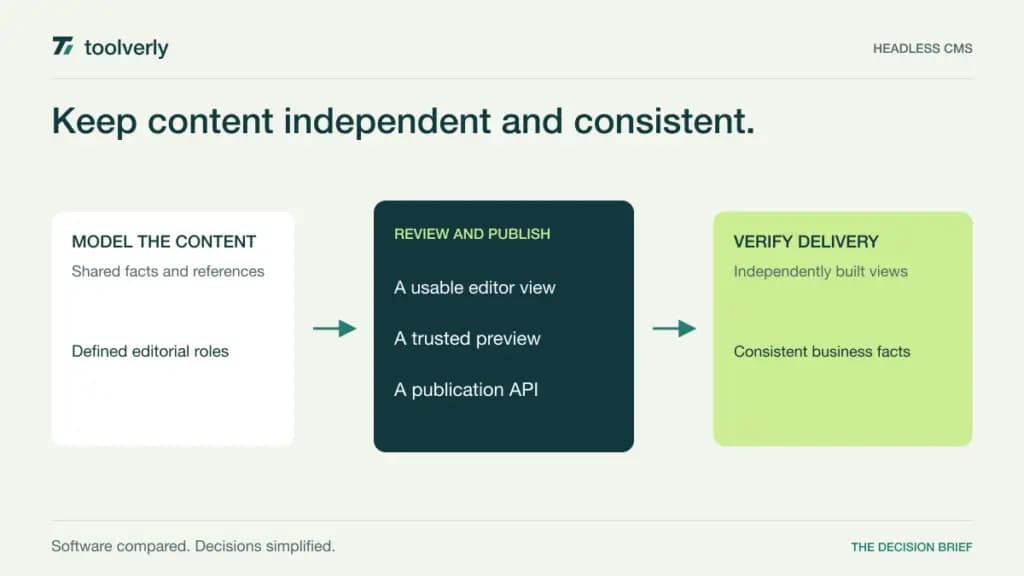
A business website becomes harder to maintain when the same content is copied into several frontends, editors depend on developers for routine changes, or a campaign cannot be previewed reliably. A headless CMS separates structured editorial content from the application that displays it. The business maintains a content source; engineering builds the delivery experience around APIs.
Contentful, Sanity, Strapi, Storyblok, and Directus make different choices about content modeling, editor interfaces, hosting responsibility, and commercial limits. This comparison uses official features and pricing checked on October 11, 2026. It does not assume that headless architecture improves every website or that any platform eliminates implementation work.
If deployment operations are the unresolved question, see application hosting platforms. The visitor’s discovery experience is another separate layer, covered in our website search comparison. A CMS should supply dependable content to both.
Compare the operating models
| Product | Best fit | Main strength | Meaningful tradeoff |
|---|---|---|---|
| Contentful | Managed structured content across channels | Content models, APIs, and editorial collaboration | Plan and space allowances are separate purchasing dimensions |
| Sanity | Customized editorial workflows | Configurable Studio and hosted content backend | Customization requires ongoing developer ownership |
| Strapi | Teams wanting control of the CMS runtime | Open-source CMS with self-hosting flexibility | CMS licenses and managed hosting are separate |
| Storyblok | Visual editing around reusable components | Editor-facing page composition and preview | Components still need a maintained frontend implementation |
| Directus | Content tied closely to a database | Database-backed APIs and an administrative interface | Current seats, collection limits, and grant eligibility matter |
Contentful
Contentful provides managed content models, delivery and management APIs, previews, and editorial collaboration. Its current commercial structure distinguishes the platform plan from the spaces used for projects. This matters when a company has multiple markets or applications rather than one small website.
The official page lists Lite at $300 per month, with twenty users, three roles, three locales, scheduled publishing, and a Starter Space. A larger Lite Space is an additional purchase. Enterprise is custom. API calls, asset bandwidth, records, content types, and environments are dimensions to review rather than assuming that a subscription contains unlimited projects.
Best fit: organizations that want a managed content service with defined editorial and delivery interfaces. Limitation: expanding a space or adding separately priced products can change the budget. Request an architecture-specific offer covering the number of applications, environments, and editorial users.
For a pilot, model one reusable business fact that appears in several places, such as a product description with localized variants. Have an editor update it and inspect the result in every consuming surface. The evaluation should show whether references and publication controls prevent inconsistent copies, not simply whether a developer can fetch JSON.
Sanity
Sanity combines a customizable Studio editing interface with its hosted Content Lake backend. Its published plans include real-time content handling, previews, and visual editing; collaboration features and permission roles expand on paid packages. That flexibility is useful when editorial work has a specific shape that a generic collection of fields does not express well.
Free lists up to twenty seats and public datasets, with a restricted role set. Growth is $15 per paid seat per month, with free viewers, private or public datasets, and additional collaboration capabilities. Self-serve billing is monthly; Enterprise pricing is custom. Higher usage and add-ons such as additional datasets change the total cost.
Strength: the editorial interface can be designed around the actual content model. Limitation: somebody must maintain that customization and its integrations. Best fit: teams with a developer who can own the editor experience as an ongoing product surface.
Ask an editor to create a realistic entry containing references, an image, and a conditional field. Watch where they need instructions and whether validation explains a problem clearly. A successful customized interface should reduce avoidable uncertainty for the editor; flexibility has little business value if routine changes still require a developer’s intervention.
Strapi
Strapi provides an open-source CMS with content management, role-based access, and REST and GraphQL APIs. Community is free under the MIT license. Growth adds capabilities including live preview, releases, and content history; Enterprise expands governance and support. Teams can self-host or buy Strapi Cloud hosting.
The current CMS Growth offer is $45 monthly including three seats, with additional seats at $15 monthly. SSO is a separate Growth add-on; Enterprise is quoted. Cloud Starter lists $35 per project per month, with higher hosting packages for additional resources and operations. These are separate products: buying hosting does not automatically establish the paid CMS feature entitlement.
Best fit: engineering teams that want runtime control and a CMS they can extend. Limitation: self-hosting transfers responsibility for availability, upgrades, and recovery to the operator. A free license is not a zero-cost production service.
Run an editorial change through the same path intended for production: draft, preview, publication, and frontend refresh. Also discuss who can update plugins and resolve an incompatible upgrade. The decision should include a named operational owner and a maintenance budget, not only a preference for open-source software.
Storyblok
Storyblok emphasizes visual editing alongside reusable content components. Editors work with a preview connected to the implemented website, while developers define the components and delivery behavior. That can make it suitable for marketing teams that need to assemble pages while preserving an agreed design system.
The current Starter offer is free with limited seats, one space, and defined traffic and API allowances. Growth lists $99 monthly or $90.75 per month on annual billing, with five included seats and optional expansions. Growth Plus lists $349 monthly or $319.91 on annual billing. Higher business requirements need a scoped offer. Trials provide temporary access beyond the eventual free plan.
Strength: editors can relate structured components to the rendered page. Limitation: visual editing depends on a correct and maintained frontend connection. Best fit: businesses that publish many component-based marketing pages.
Have an editor build a page using approved blocks, change a shared component, and preview a scheduled campaign. Inspect whether the interface allows combinations the frontend cannot render well. Freedom should stay within understandable boundaries, so the pilot needs both editorial feedback and review from the person responsible for design consistency.
Directus
Directus places APIs and an administrative interface around database-backed content. Its current site describes REST and GraphQL delivery, visual editing, permissions, and self-hosted or cloud operation. It is worth considering when content is closely related to an existing database model rather than an isolated publishing repository.
Current Core is free with three Studio seats, twenty-five collections, and five flows. Team is $499 per month on an annual commitment or $599 month to month, including ten SSO seats. Cloud hosting is a separate $99 monthly add-on for Core or Team. The Open Innovation Grant offers broader free self-hosted access to qualifying organizations under $5 million annual revenue and fewer than fifty employees; eligibility should be confirmed.
Best fit: teams wanting a database-oriented content backend. Limitation: remembered older licensing and cloud prices are not the current offer. Model the seats and collections you actually need before comparing totals.
Use one content relationship that the business already understands, such as a service linked to several locations. Ask an editor to maintain it while a developer checks access from the consuming application. The useful outcome is a clear boundary between editorial permissions and application access, with enough structure to prevent accidental changes to unrelated operational data.
Choose the workflow before the architecture
Begin with a content map: types, shared references, locales, assets, roles, and publication states. Identify who creates, reviews, previews, and approves each type. Avoid designing the entire model around today’s page layout if the business expects to reuse facts across websites, apps, or other channels.
Evaluate the editor’s full journey. Create a draft, fix validation errors, preview unpublished content, approve it, publish, and verify delivery. Try a withdrawal and a changed URL. A content API that returns the newest record does not prove every consuming frontend has refreshed correctly.
Document engineering ownership separately. Hosted content services still require schema maintenance, preview integration, migration planning, and frontend cache handling. Self-hosted systems add runtime and database operations. Decide who handles the work after the initial agency or implementation project ends.
Compare commercial dimensions using a realistic twelve-month plan. Include seats, spaces or datasets, locales, environments, usage, governance features, hosting, support, and optional AI functions. Do not compare a free self-hosted license directly with a managed service price without including the operating work.
Shortlist Contentful for managed multi-channel structure, Sanity for a tailored editorial workspace, Strapi for runtime control, Storyblok for visual component workflows, and Directus for database-oriented content. A successful pilot lets editors complete their real tasks while engineering can explain delivery, permissions, and operational responsibility clearly.
Official sources
Checked October 11, 2026: Contentful pricing and spaces; Sanity plans; Strapi CMS licenses; Strapi Cloud hosting; Storyblok plans; Directus current terms; Directus content model. Confirm final tax treatment and contract scope before purchase.
Original illustration by Toolverly. Read about our publication or send a correction.