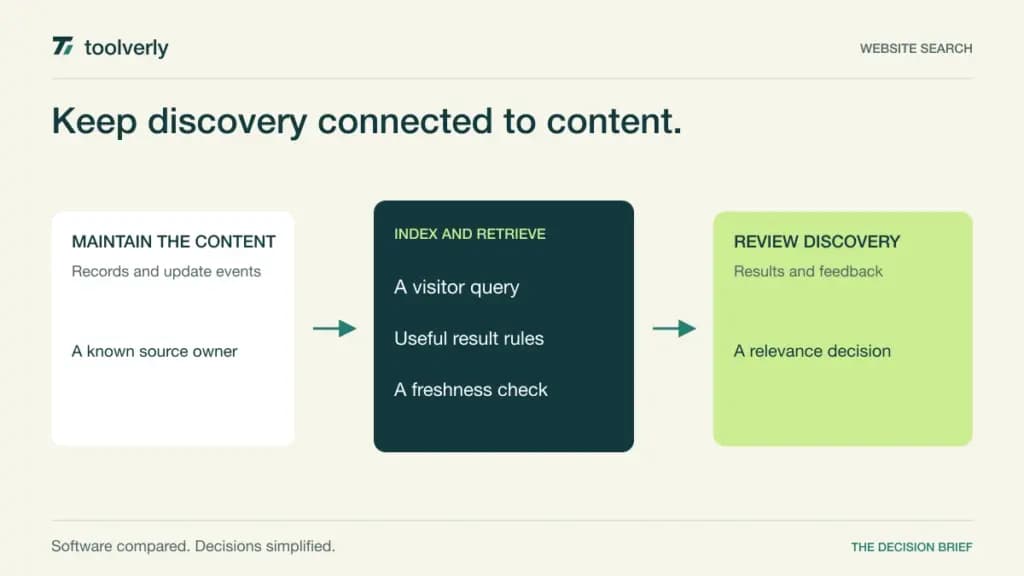
A visitor can know exactly what they need and still leave a business website because search returns an old page, misses a product synonym, or offers no useful filters. The search platform matters, but so does the content pipeline that tells it what is current. A successful search experience connects maintained records, retrieval, relevance rules, and feedback.
This guide compares Algolia, Typesense, Meilisearch, Elasticsearch, and Coveo for website search. The reader decision is implementing search inside your site, catalog, or knowledge experience. It is separate from improving rankings on external search engines. Official product and pricing pages were checked October 10, 2026. We did not benchmark latency, relevance, uptime, or conversion; recommendations are editorial analysis.
Define the experience first. A catalog with filters and product rules differs from a documentation library, and both differ from permission-sensitive enterprise knowledge. Count indexed records, updates, languages, searches, and deployment regions. Specify what should happen when a page is withdrawn or an item becomes unavailable. A promising demo index is only the beginning of the operating cost.
Five website search platforms compared
| Product | Best fit | Main strength | Meaningful tradeoff | Pricing reference |
|---|---|---|---|---|
| Algolia | Teams buying managed search and relevance tools | Search APIs, query suggestions and rules | Requests, records and feature tiers affect cost | Grow: $0.50/additional 1,000 requests after allowance |
| Typesense | Developers wanting configurable search infrastructure | Typo tolerance, filtering and tunable ranking | Cluster sizing and resilience need planning | Cloud configuration calculator |
| Meilisearch | Teams choosing managed or self-hosted search | Cloud and open-source deployment paths | Resource and usage models need workload estimates | Cloud advertised from $20/month |
| Elasticsearch | Engineering teams with complex retrieval requirements | Keyword, vector and hybrid search control | Architecture and consumption need ongoing ownership | Serverless compute, storage and egress units |
| Coveo | Enterprise sites unifying several content sources | Connectors, relevance and business controls | Implementation and add-on scope require a proposal | Query/item entitlements; quoted subscription |
Algolia
Algolia offers managed search with query suggestions, synonyms, relevance rules, analytics, and progressively richer AI capabilities. The checked pricing page separates Build, Grow, Grow Plus, and an annual Elevate offer. This is useful when a business wants a managed search service with documented commercial boundaries rather than managing the engine’s infrastructure.
Grow includes 10,000 search requests per month and 100,000 records, then lists $0.50 per additional 1,000 requests and $0.40 per additional 1,000 records. Grow Plus lists $1.75 per additional 1,000 requests after the same request allowance, with the stated record overage unchanged. The free Build record allowance is smaller, so do not mix its limits with Grow.
Our recommendation is to shortlist Algolia when managed delivery and maintained relevance tools fit the team’s ownership model. Its tradeoff is that billable requests are not the same as human visitors, and copied indexes or search-as-you-type behavior can affect consumption. Model actual request patterns and confirm counting rules. Demonstrate synonym changes, a withdrawn page, and a merchandising rule with an expiry date before selecting a tier.
Typesense
Typesense describes an open-source search engine with typo tolerance, synonyms, filtering and faceting, tunable ranking, sorting, and semantic or vector search. Typesense Cloud provides dedicated clusters. The attraction for developers is direct control over the indexed schema and retrieval behavior while retaining a managed hosting option.
The Cloud calculator starts from memory, vCPUs, region, and optional high availability or a Search Delivery Network. It states there are no fixed record or operation limits on the dedicated cluster. That is a commercial model, not a guarantee of unlimited throughput. Capacity remains constrained by the selected resources and workload. Bandwidth and support scope should be included in the estimate.
This is our shortlist for a developer-owned search implementation that wants explicit infrastructure choices. The limitation is that someone must size the dataset and traffic, including growth and failures. Avoid comparing a small single-node demonstration with another vendor’s resilient production setup. Ask for a configuration based on indexed fields, record size, expected concurrency, and geographic distribution. Evaluate deletion propagation and relevance settings as carefully as the initial import.
Meilisearch
Meilisearch offers managed Cloud and an open-source self-hosting path. The official pricing page lists Cloud from $20 per month with usage-based or resource-based billing and included email support. Enterprise offers custom infrastructure, support, and advanced features by proposal. Self-hosting gives infrastructure control while leaving upgrades, scaling, and operational recovery with your team.
The estimator compares document and search assumptions against instance and disk costs. Its examples are configurations, not a universal $20 production package. Use the same dataset size and traffic profile when comparing billing models. If an advanced feature such as personalization, analytics, or a dedicated support channel is required, verify its entitlement rather than inferring it from the base Cloud heading.
Our shortlist recommendation is Meilisearch when the team values a choice between a managed start and its own deployment. The tradeoff is evaluating the whole service rather than the software license alone. Demonstrate indexing changes, a field filter, a misspelled query, and the way administrators inspect unsuccessful searches. Confirm how a resource resize affects service and billing. A self-hosted option is sensible only when the organization has a named maintainer and an operating budget.
Elasticsearch
Elasticsearch supports lexical, semantic, and hybrid retrieval, with filters, aggregations, and access-control capabilities. Elastic offers self-managed, hosted Cloud, and Serverless deployment models. This makes it a strong candidate when website search sits inside a broader engineering architecture or requires precise retrieval and data handling.
The Serverless pricing page separates ingest, search, and machine-learning compute measured in VCU-hours from retained storage and transferred data. It advertises search compute as low as $0.09 per VCU-hour and ingest as low as $0.14; these are component floor rates, not monthly service totals. Region, configuration, support, inference, and additional features can change the bill. Estimate each relevant unit.
Elasticsearch is our shortlist for a team that has the expertise to maintain search mappings, relevance, ingestion, and consumption. Its flexibility is also the limitation: choosing the engine does not deliver a completed visitor interface. Demonstrate the difficult retrieval case, then show how an engineer diagnoses a stale result or failed update. Confirm feature availability in the selected subscription and how permissions are applied when public and restricted content share a search architecture.
Coveo
Coveo combines indexing and connectors with hybrid search, query suggestions, relevance tuning, analytics, and business rules. Its current packaging distinguishes Service, Website, and Workplace from Commerce. Website and Service use entitlement-based pricing, while Workplace has a seat-based model. Choosing the right use case is essential before comparing proposals.
The pricing page describes query and indexed-item capacity, with standard annual and three-year subscriptions. It identifies generative answering and other advanced capabilities as add-ons rather than assuming they are in the base plan. Commerce units also cover recommendation usage and catalog items. Dollar totals require a proposal configured to the selected experience and volume.
This is our shortlist for an enterprise website that must connect multiple maintained sources and coordinate relevance with business stakeholders. Its tradeoff is implementation and commercial complexity. Request the required connectors, refresh behavior, item capacity, query allowance, and add-ons in writing. Demonstrate a source permission change, an expired page, and a business rule that another administrator can inspect. A broad platform is valuable only if the organization can maintain the sources and relevance policy it connects.
Evaluate the failed search as well as the successful one
Build a query set from real visitor language. Include exact names, misspellings, synonyms, broad intents, filtered queries, and terms that should return no result. Decide what a good answer looks like before viewing demonstrations. Compare the same source records and expected outcomes across platforms; a vendor’s sample catalog cannot establish fit for your content.
Then change the data. Withdraw a document, update a product’s availability, and alter a permission. Record how long each change takes to reach the index and whether the interface reflects it. An index can be technically healthy while showing outdated business facts, so give the publishing pipeline a named owner.
Estimate costs from search behavior rather than monthly visitor totals. Autocomplete, retries, replicas, filters, and recommendations may have distinct counting or capacity effects. Include non-production environments, resilience, support, indexing work, and the cost of maintaining the user interface. Ask for both a normal month and a traffic-spike estimate.
Before purchase, check four practical questions: who changes relevance rules; who investigates zero-result queries; who repairs failed source updates; and how the service is replaced if required. Preserve the data schema and evaluation queries in your own documentation. Otherwise, the company may accumulate relevance rules that no one can explain after a staff change.
For measuring whether discovery supports visitor behavior, see our website analytics comparison. If the underlying content is customer assistance, our knowledge base software guide helps with authoring and maintenance. Search improves access to that content; it cannot supply an answer that has never been written or kept current.
Official sources and verification date
Checked October 10, 2026. Product features and pricing units are from official sources. Fit assessments and evaluation procedures are editorial analysis, with no claimed performance benchmarks.
- Algolia plans
- Typesense Cloud calculator
- Meilisearch options
- Elastic search capabilities
- Coveo packaging
- Typesense features
- Elastic Serverless billing
Original illustration by Toolverly. Read about our publication or send a correction.