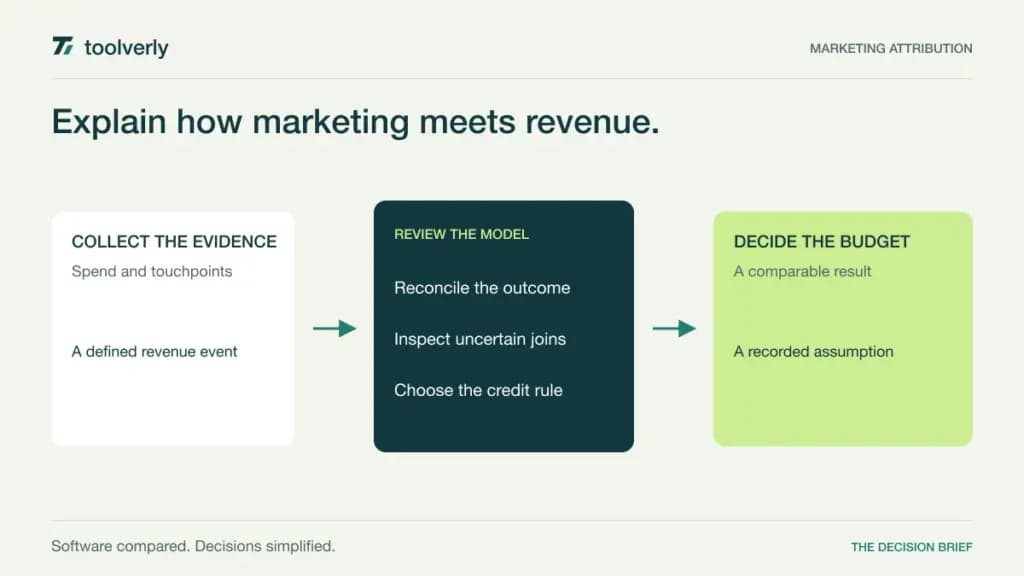
The ad platform reports a conversion, the CRM records a deal, and finance recognizes revenue in a different month. Each number can be internally consistent while answering a different question. A marketing attribution platform helps connect touchpoints and spending to business outcomes so the team can make a defensible budget decision.
Dreamdata, HockeyStack, Ruler Analytics, Triple Whale, and Northbeam span account-based B2B journeys, lead-driven businesses, and ecommerce measurement. They are not interchangeable simply because all show revenue dashboards. Start with the unit of your business decision: an account opportunity, a qualified lead, or an order. Then examine how the tool explains the evidence behind channel credit.
Research checked October 13, 2026. This comparison uses current official sources, not independent performance tests. Attribution allocates observed or modeled credit; it does not by itself prove that spending caused an incremental sale. Vendor customer results are not forecasts for your organization.
Compare the revenue-measurement decision
| Platform | Best fit | Main strength | Meaningful tradeoff |
|---|---|---|---|
| Dreamdata | B2B teams connecting account journeys to revenue | Account-oriented attribution and activation options | Advanced attribution and add-ons need a custom quote |
| HockeyStack | Revenue teams joining marketing, sales, and CRM evidence | Connected GTM reporting with scoped implementation | No verified public numeric subscription rate |
| Ruler Analytics | Businesses converting through forms, calls, and sales | Lead-to-revenue matching and channel attribution | Traffic and integration requirements affect indicative rates |
| Triple Whale | Ecommerce brands joining order and advertising data | Multi-touch attribution within a broader commerce workspace | GMV tiers and annual commitments shape the bill |
| Northbeam | Brands evaluating paid-media performance across channels | First-party attribution with optional broader measurement | Spend-based plans and optional services need scoped terms |
Dreamdata
Dreamdata approaches attribution around B2B accounts, customer journeys, and revenue. Its current offer separates a free entry plan from advanced Attribution and Activation capabilities. The free plan lists B2B web analytics, company identification, an audience builder, and ad-spend reporting, with two months of user history and five seats. It should be evaluated as a bounded starting point rather than the complete long-cycle attribution package.
Advanced attribution uses custom pricing. Activation and data warehouse capabilities are identified as add-ons, while support and data-control provisions need scoping. A useful quote should distinguish the historical window, tracked-user volume, business units, source connections, and activation destinations. A B2B sales cycle lasting many months makes history coverage a purchasing requirement rather than a cosmetic reporting choice.
Strength: an account-oriented framework for connecting marketing activity to sales outcomes. Limitation: the completeness of that account journey depends on identity, CRM quality, and the available history. Dreamdata fits teams prepared to maintain their CRM stages and account relationships. Demonstrate several contacts from the same account, a reopened opportunity, and a late revenue adjustment. Ask the operator to explain how those events change attribution rather than accepting only the final chart.
HockeyStack
HockeyStack describes an environment that joins marketing, sales, and revenue insights. Its pricing page lists connections with GTM tools and CRM, support from the success team, and custom setups for complex data environments. The current page does not establish a numeric subscription price. Older public rates therefore should not be carried into a purchasing comparison without a new scoped quote.
For a B2B team, the important evaluation is how campaign activity meets opportunity evidence. Define what constitutes sourced pipeline, influenced pipeline, and closed revenue before the demonstration. Those labels can produce different totals even when the underlying events are unchanged. Ask which sources, historical imports, attribution approaches, exports, and implementation work belong to the proposed package.
Strength: a connected view for teams that want marketing and revenue operations to work from shared evidence. Limitation: a tailored data setup requires clear definitions and ongoing ownership; software cannot make inconsistent sales-stage usage meaningful automatically. HockeyStack fits organizations with someone responsible for the GTM data model. Include a deal with missing contacts and a campaign with imperfect tracking. Examine how uncertainty appears and what the team can correct without silently rewriting the history.
Ruler Analytics
Ruler Analytics is relevant when conversions begin through forms, phone calls, live chat, or offline sales activity. Its official comparison lists first-party tracking, CRM and advertising connections, and multiple attribution models. That makes the lead-to-revenue handoff central: a captured enquiry becomes useful for budget decisions only when its eventual business outcome can be joined back to the marketing journey.
The GBP display lists Small from £299 per month for up to 10,000 monthly visits, or £269 per month under the annual-deal display. Medium, Large, and Advanced expand traffic allowances and capabilities. The page labels all rates indicative and says product, data, and integration requirements also affect pricing. Clarify call tracking, implementation, additional domains, and the actual annual commitment before treating the entry rate as your final bill.
Strength: connecting lead-generating channels with CRM revenue outcomes. Limitation: advanced segmentation, impression attribution, and broader modeling vary by package. Ruler fits businesses where calls and sales conversations matter as much as online checkout. Demonstrate a form lead that converts later by phone and one that never becomes qualified. Check whether the reporting preserves that distinction and how duplicate enquiries affect the matched customer journey.
Triple Whale
Triple Whale’s current plans are Foundation, Automate, and Enterprise, alongside a free offer. Foundation includes multi-touch attribution through Triple Pixel and a broader reporting workspace. Automate adds operational and AI workflows; Enterprise adds a wider measurement scope, including marketing mix modeling and incrementality. Buy the capability needed for measurement before assuming automation of media changes is also required.
The pricing page ties paid packages to annual gross merchandise value and the selected plan. It describes twelve-month subscriptions with either monthly billing or annual prepayment; monthly payment does not mean monthly cancellation. Annual prepayment locks the revenue tier for the year under the stated terms. Exact prices depend on the selected GMV tier, so obtain that selection and renewal behavior in writing instead of publishing an unscoped starting rate.
Strength: connecting ecommerce order measurement with a broader commerce operating view. Limitation: revenue growth can change the commercial tier, and assisted analysis or automation brings its own usage and permission questions. Triple Whale fits brands that want this combined workspace. Evaluate refunds, repeat customers, and an order influenced by several channels. Keep net revenue definitions and model windows visible before using the result to move budget.
Northbeam
Northbeam emphasizes first-party multi-touch attribution across advertising channels. Its current plans page uses annual marketing spend to describe commercial fit. Starter targets brands below $1.5 million in annual ad spend; Professional describes marketers spending up to $500,000 monthly. Growth combines attribution with support through a preferred agency arrangement, while Enterprise covers more complex operations.
Professional displays $3,500 per month and still asks buyers to request a quote. Starter displays $1,500, but the visible unit is labeled ambiguously rather than clearly as a recurring monthly charge, so confirm its billing basis directly. Growth and Enterprise are custom-priced. Incrementality and media mix modeling are optional in relevant packages; they should not be assumed to come with every attribution subscription.
Strength: a measurement offering oriented toward paid-media decisions, with options for broader analytical support. Limitation: spend bands, optional measurement, and service scope need confirmation, and modeled channel credit remains different from causal evidence. Northbeam fits brands prepared to compare its reporting with their existing ad and order systems. Demonstrate a view-through conversion and a customer returning after an earlier campaign. Ask why the assigned credit differs from an ad platform’s own report.
Make the models answer the same business question
First define the revenue event. Is the team allocating credit to an order, a closed opportunity, recognized revenue, or net revenue after refunds? Choose a reporting date, currency policy, and treatment of cancellations. Otherwise two tools can disagree because they count different outcomes, not because one discovered better marketing.
Next, inspect the observation boundary. Some touchpoints are missing, some are matched indirectly, and some channels have different data availability. Ask how anonymous activity, offline contacts, multiple devices, and consent choices affect the journey. Preserve an unmatched or uncertain category rather than forcing every outcome into a clean channel label.
Use this evaluation checklist:
- Choose account, lead, or order as the primary unit.
- Reconcile a small sample to CRM or commerce records.
- Document attribution windows, models, and eligible touchpoints.
- Inspect refunds, duplicate leads, missing contacts, and late changes.
- Separate attribution reporting from experiments that estimate incremental impact.
- Price history, domains, traffic, GMV, spend, integrations, and services using the applicable vendor meter.
Our website analytics comparison helps with traffic and visitor measurement. Our small business CRM guide covers maintaining sales relationships and stages. Attribution joins that evidence for a budget decision; it does not remove the need to keep either source trustworthy.
Start with Dreamdata or HockeyStack for B2B revenue journeys, Ruler for lead-to-sale matching across calls and forms, and Triple Whale or Northbeam for ecommerce and paid-media decisions. Choose the platform whose team can explain an individual revenue record, its uncertain touchpoints, and the reason behind its channel credit.
Original illustration by Toolverly. Read about our publication or send a correction.