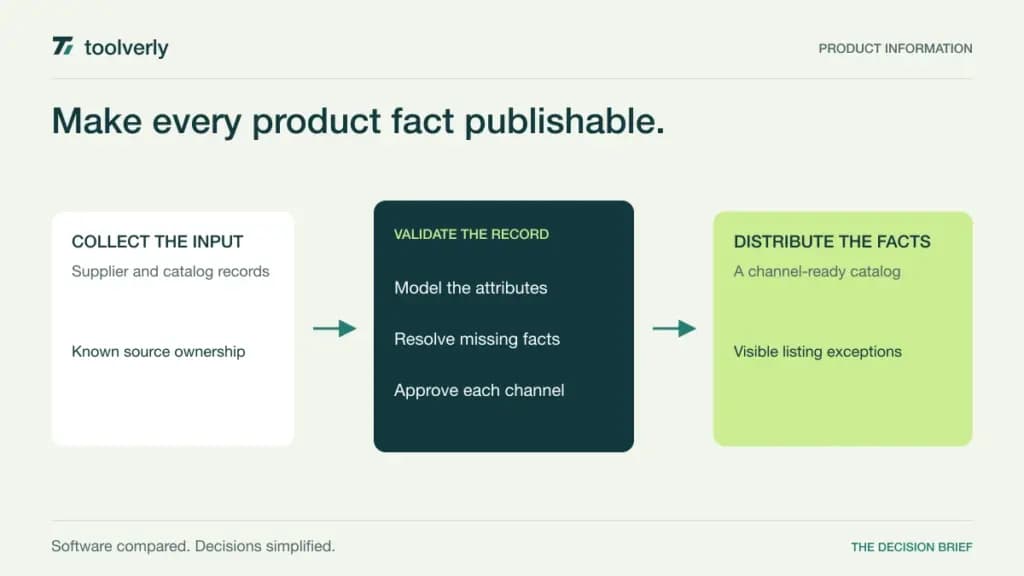
A product can be in stock and still be impossible to sell confidently. Its dimensions may differ between a supplier spreadsheet and a storefront, a translated description may refer to an older model, or a retailer may reject a listing because a required attribute is missing. Product information management software addresses that operating problem: maintain a coherent product record, enrich it, check it, and distribute the right version to each destination.
Akeneo, Pimcore, Plytix, Salsify, and Inriver approach this work from different directions. Some emphasize catalog governance; others combine product information with broader data management or digital shelf distribution. The useful comparison is the path from an incomplete supplier record to an accepted channel listing, including who owns exceptions along the way.
This is a source-based comparison, not a hands-on performance test. Official product and commercial information was checked on October 12, 2026. Public starting figures exclude implementation and should not replace a scoped proposal. Dynamic calculators and quote-based packages require confirmation for your actual catalog.
Compare the product record and its destination
| Product | Best fit | Main strength | Meaningful tradeoff |
|---|---|---|---|
| Akeneo | Governed catalog enrichment | Product models and channel readiness | Workflow and add-on scope depend on package |
| Pimcore | Complex connected data models | Flexible modeling with broader data capabilities | Engineering and infrastructure ownership need scoping |
| Plytix | Collaborative product content operations | Unlimited users with modular outputs | SKU-based configuration and modules affect cost |
| Salsify | Retailer-facing product experiences | Central content connected to syndication | A wider platform requires a defined rollout |
| Inriver | Distributed product content governance | Ingestion, enrichment and distribution lifecycle | Commercial scope is customized |
Akeneo
Akeneo is a strong candidate when teams need a shared product catalog with deliberate enrichment and publication rules. Its PIM organizes product attributes and relationships, while the current Product Cloud packages distinguish foundation work from more advanced collaboration and governance. This gives a buyer a way to describe who supplies data, who corrects it, and who approves it for a particular channel.
The advantage is a product-focused operating model. A merchandising team can evaluate completeness and localization alongside the catalog structure rather than treating every listing as an independent document. The limitation is package scope: advanced rights, collaboration workflows, supplier intake and activation capabilities should be checked against the chosen package and its add-ons.
Best fit: brands and distributors that need repeatable enrichment across product families, languages and destinations. In an evaluation, ask an editor to repair one inherited attribute and show which variants change. That reveals whether the catalog model matches the business.
Price context: the current comparison lists Growth, Advanced and Premium, with Advanced and Premium requiring quotes. Confirm the Growth offer, service scope and activation allowance rather than treating its displayed starting figure as a complete deployment budget.
Pimcore
Pimcore is relevant when the catalog contains complicated relationships and the business wants product information connected to a broader data platform. Its PIM supports adaptable data models, onboarding, data quality, workflow and distribution. Product information can sit alongside media and other managed data instead of being forced into a narrow flat catalog.
The advantage is flexibility for unusual product structures, technical specifications and connected systems. The tradeoff is responsibility. Flexible modeling still requires somebody to define the schema, build integrations, maintain the environment and keep the editor experience understandable. A successful proof of concept should include the person who will operate it after the implementation partner leaves.
Best fit: manufacturers or organizations with substantial integration requirements and available technical ownership. Ask the vendor to demonstrate a configurable assembly, a replacement part and a translated technical attribute using your sample records.
Price context: the current USD pricing view shows Professional On-Premises at $9,900 per year and Enterprise On-Premises at $29,900 per year. PaaS is custom priced. These are licensing or platform figures, not a promise that migration, hosting, custom development or support work is included.
Plytix
Plytix combines PIM and digital asset management with collaborative catalog work and optional distribution modules. Its pricing configuration starts with SKU volume and a plan, then allows modules such as feed management, brand portals, product data sheets and commerce connections. Unlimited users are included across the displayed plans.
The advantage is letting more contributors work on product content without making every new editor a separate seat negotiation. The limitation is that users are only one cost dimension. SKU count, output modules, API capacity, CDN traffic and permissions still matter, particularly when a catalog feeds several storefronts or partners.
Best fit: product teams seeking a shared catalog workspace with understandable distribution choices. Evaluate a spreadsheet import, an asset association and the export format your partner actually accepts. Then ask how a rejected output is corrected and sent again.
Price context: the current calculator and product page do not expose a consistently interpretable base price in every retrieved view. We therefore omit a fixed subscription amount. Request the selected SKU configuration and modules in writing. Each displayed plan includes monthly AI credits; unlimited AI and distribution modules are separate choices, not automatically included functionality.
Salsify
Salsify positions product information within product experience management. Its platform combines centralized product content with syndication, enhanced content, integrations and digital shelf capabilities. That makes it particularly relevant when the difficult work is meeting many retailer requirements and maintaining the information shoppers encounter across destinations.
The advantage is connecting content operations to external channel requirements. A catalog record is useful only if the destination receives and accepts the appropriate fields and media. The limitation is breadth: a buyer can easily discuss an expansive digital shelf program when the immediate problem is a few unreliable catalog exports.
Best fit: brands and commerce teams with demanding retailer or marketplace distribution. Start the demonstration with one rejected listing and follow the correction through the relevant destination. Separate the core content repository from syndication, enhanced content and analytics scope.
Price context: the reviewed official product page routes buyers to a sales discussion and does not provide a numeric platform subscription. Treat commercial scope as quote based. Ask for destinations, integrations, onboarding, support and expansion terms to be named explicitly; a demo request itself establishes neither a price nor a commitment.
Inriver
Inriver describes product content as a lifecycle of ingestion, enrichment, syndication and optimization, with validation and orchestration across that work. Its offering includes content onboarding, distribution and related product content capabilities. This is useful for organizations where different departments and markets own different parts of the same product information.
The advantage is a lifecycle view that makes handoffs and governance part of the catalog discussion. The tradeoff is that the software cannot settle unclear ownership by itself. Buyers still need definitions for valid data, permission to approve it, and a process for changing shared facts without creating regional inconsistencies.
Best fit: manufacturers and brands coordinating product information across systems, markets and channels. Ask two departmental users to resolve a conflicting attribute and demonstrate how the approved value reaches an intended destination.
Price context: Inriver’s official plans are customizable and direct buyers to a commercial conversation. No universal numeric subscription is presented. Confirm the purchased capabilities, catalog assumptions, integration services and ongoing support in the proposal, including how additional markets or destinations change its scope.
Build the evaluation around a difficult product family
Use one real product family with variants, shared assets, technical units, missing fields and a translated description. Include at least two destinations with different requirements. A tidy demonstration catalog rarely exposes the work that makes a PIM valuable: resolving conflicting inputs and delivering an accepted output.
Trace five steps: import the record, model its relationships, enrich its content, approve the correct version, and confirm delivery. Assign a named owner to each exception. Record what happens when a supplier removes a field, an editor changes a shared value, or a destination rejects a required format. Ask how those failures become visible to the person who can fix them.
Keep catalog facts separate from warehouse facts. Our inventory management comparison covers stock and operational control. If the challenge is maintaining reusable media and usage context, the digital asset management comparison helps define the neighboring system’s role.
- Identify the authority for each shared product attribute.
- Demonstrate variant inheritance and channel-specific overrides.
- Check validation, localization and approval responsibilities.
- Confirm required destination formats and rejection handling.
- Price migration, integrations, operations and expansion together.
Shortlist Akeneo for product-focused governance, Pimcore for flexible connected models, Plytix for collaborative catalog work, Salsify for retailer-facing distribution, and Inriver for coordinated product content lifecycles. Choose the option that your editors and integration owners can sustain through the next supplier change and channel launch.
Official sources checked October 12, 2026
Akeneo packages; Akeneo PIM; Pimcore pricing; Pimcore PIM; Plytix pricing; Plytix PIM; Salsify product experience management; Inriver product overview; Inriver plans.
Original illustration by Toolverly. Read about our publication or send a correction.