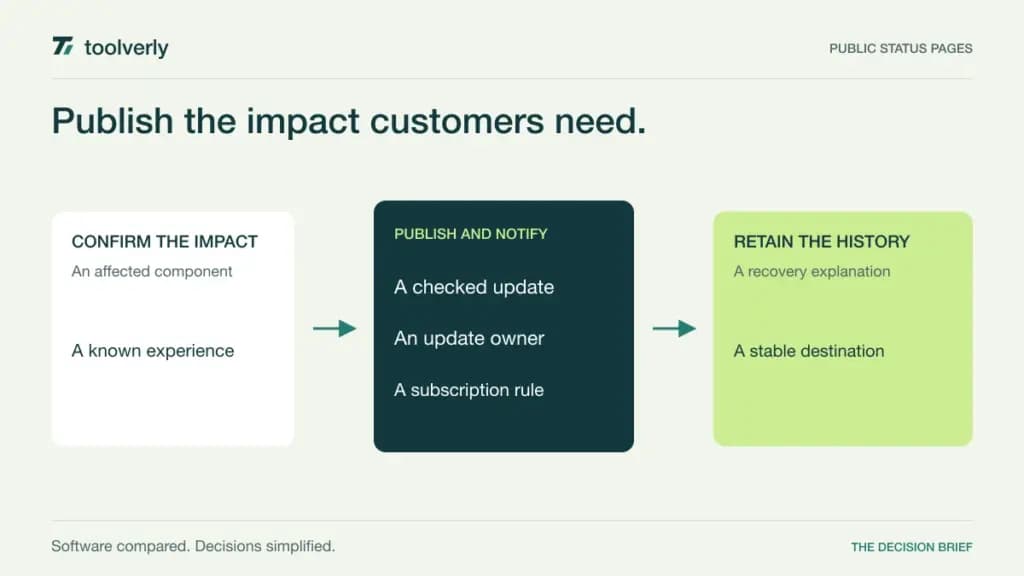
When a service fails, customers need to know whether the problem is theirs, which functions are affected, and where the next update will appear. A public status page gives those questions a stable destination. Its value comes from accurate components, clear ownership, and timely communication, rather than a permanently green dashboard.
This comparison covers Atlassian Statuspage, Instatus, Better Stack, Status.io, and Sorry. Official pages were checked on October 9, 2026. The recommendations are editorial analysis of documented features and pricing; no outage drills or performance tests are claimed.
A status page publishes the customer-facing account of an incident. Uptime monitoring detects selected technical symptoms, while incident management software coordinates the internal response. Connect those processes deliberately. An alert may justify investigation without proving that every customer function is unavailable.
Before comparing plans, list the components customers recognize. Use names such as checkout or file upload when those correspond to distinct experiences. Decide who can publish, who confirms impact, which updates reach subscribers, and how maintenance is announced. Those rules should work even when the main application is unavailable.
Five public status page options
| Product | Best fit | Main strength | Meaningful tradeoff |
|---|---|---|---|
| Atlassian Statuspage | A structured customer communication program | Several page and subscriber tiers | Public, private, and audience pricing differ |
| Instatus | Teams combining a page and monitoring | Bundled operating capabilities | Domain and subscriber limits vary |
| Better Stack | Teams using its monitoring stack | Integrated publication and signals | Branding and access extras can be substantial |
| Status.io | Services with detailed component structure | Component and location communication | Advanced controls require tier review |
| Sorry | Teams prioritizing communication ownership | Subscriptions and team controls | Private pages and additional teams add scope |
Atlassian Statuspage
Atlassian Statuspage distinguishes public, private, and audience-specific pages. Its public plans include incident and maintenance communication, components, templates, and API access, with progressively larger subscriber and team allowances. This suits a business that wants customer communication to have an explicit structure and administrative boundary.
The strength is a mature range of publication models. The limitation is comparing a public-page subscription with a private or audience-specific requirement. Even within public plans, notification channels and component subscriptions differ. Define who receives which update before deciding that a small subscriber allowance is sufficient.
The public Free plan includes 100 subscribers and two team members. Hobby is $29 monthly with 250 subscribers; Startup is $99 with 1,000, while Business is $399 with 5,000 and component subscriptions. Higher tiers and other page types have separate pricing. Best fit: teams needing a structured external communication program. Ask whether the selected tier supports your actual channel and component subscription policy.
Instatus
Instatus bundles status pages with monitoring and incident-response capabilities. Its current plan comparison includes monitor checks, alert channels, on-call members, subscriber allowances, and page types. This can suit a small operations team trying to reduce the number of tools involved in detecting a problem and announcing its customer impact.
The strength is keeping related operations close together. The tradeoff is buying a bundle without distinguishing which function owns the decision to publish. An automatic monitor state should not become a misleading customer announcement. Establish when a person adds explanation and when the page should recover automatically.
Starter is free, with a public page, 200 subscribers, and no custom domain in the checked comparison. Pro lists 5,000 subscribers and custom-domain support; Business expands scope and adds SAML SSO. Paid totals are dynamically displayed, so confirm the chosen monthly or annual quote rather than relying on the page title’s starting figure. Best fit: a team wanting combined operations with explicit publication rules and a suitable domain tier.
Better Stack
Better Stack connects status pages to its monitoring and incident environment. Its status product supports customer subscriptions, component-specific updates, maintenance notices, embedded views, and customization. It is a natural candidate for a team already using those technical signals and wanting the public explanation to share an operating workflow.
The strength is the connection between investigation and communication. The limitation is treating a monitoring subscription as an all-inclusive branding package. The pricing page separates status pages, subscribers, customization, white-labeling, and private access. The total can change sharply when the requirement goes beyond a branded subdomain.
Its free personal-project offer includes one status page. The checked pricing lists additional public pages at $15 monthly or $12 monthly on annual billing, with 1,000 subscribers included in the status-page section. Removing its footer is separately listed at $250 monthly or $208 on annual billing. Confirm which base subscription applies. Best fit: teams using Better Stack that can accept its branding or intentionally budget for the additional scope.
Status.io
Status.io publishes incidents and maintenance around components and flexible containers. Its comparison also covers component subscriptions, location views, external service status, feeds, and monitoring integrations. This can suit a service whose public availability needs a more detailed structure than one overall operational indicator.
The strength is modeling the relationships customers care about: an affected service, region, or dependency. The limitation is making that model too complicated to update under pressure. A detailed page is useful only when the team can identify the affected components consistently. Check which advanced communication and access controls exist in the chosen tier.
Monthly USD prices are $79 for Basic, $149 for Standard, and $349 for Plus. The listed subscriber allowances are 500, 2,000, and 5,000, with five, twenty, and fifty team members respectively. Annual subscriptions advertise a 5% discount. Best fit: teams with meaningful component or location distinctions. Demonstrate a partial disruption and verify that subscribers receive the appropriate explanation rather than an unnecessary all-system alert.
Sorry
Sorry emphasizes status communication, customer subscriptions, incident reporting, and maintenance notices. Its current plan includes component subscriptions, team member SSO, role controls, and a custom domain. This makes it a candidate for organizations where several people contribute updates but publication responsibility must remain clear.
The strength is putting the communication routine and team controls together. The tradeoff is assuming the standard offer covers every audience and page configuration. Private pages, multiple pages, and extra team members are presented as additions. Decide whether a separate internal page is actually required before adding it to the proposal.
The checked monthly offer starts at $99 with 1,000 subscribers and five team members. Additional team members start at $5 monthly each. Annual payment is available, while enterprise requirements use a discussion with the vendor. Best fit: a team prioritizing governed communication with component subscriptions. Ask an editor and approver to rehearse a maintenance notice and a revised incident update in their real roles.
Evaluate the update, subscription, and recovery
Prepare a fictional partial outage with a clearly defined customer impact. Write an initial update stating what is affected, what is still available, and when another update is expected. Avoid announcing a root cause before it has been established. The page should support useful communication while the technical investigation remains incomplete.
Next, subscribe to one component and to the complete page using demonstration accounts. Publish a maintenance notice and an incident revision. Check which messages are sent and how a recipient changes preferences. Subscriber totals matter, but notification behavior is the more practical test of whether the page fits your audience.
Recover the fictional incident and inspect the history. A restored indicator should not erase the explanation of what happened. Decide whether a final summary belongs on the page or in another maintained destination, and assign its author. Keep the public narrative consistent with the internal timeline without publishing sensitive investigation details.
Build a cost model containing pages, subscribers, team members, branding, private access, and channels. Treat monitoring or on-call features as a separate scope decision even when sold in one bundle. Then document who can publish if the usual communication owner is unavailable.
- Name components in customer language.
- Set an update owner and review path.
- Check subscriptions and channel delivery.
- Price domains, branding, and extra pages.
- Rehearse recovery and retained history.
Choose Atlassian Statuspage for an explicit page model, Instatus for a combined operating bundle, Better Stack for integration with its signals, Status.io for meaningful component structure, or Sorry for a communication workflow with suitable team controls.
Official sources and verification date
Checked October 9, 2026: Atlassian Statuspage pricing, Instatus plans, Better Stack status features, Status.io tiers, Sorry pricing, and Better Stack add-ons.
Original illustration by Toolverly. Read about our publication or send a correction.