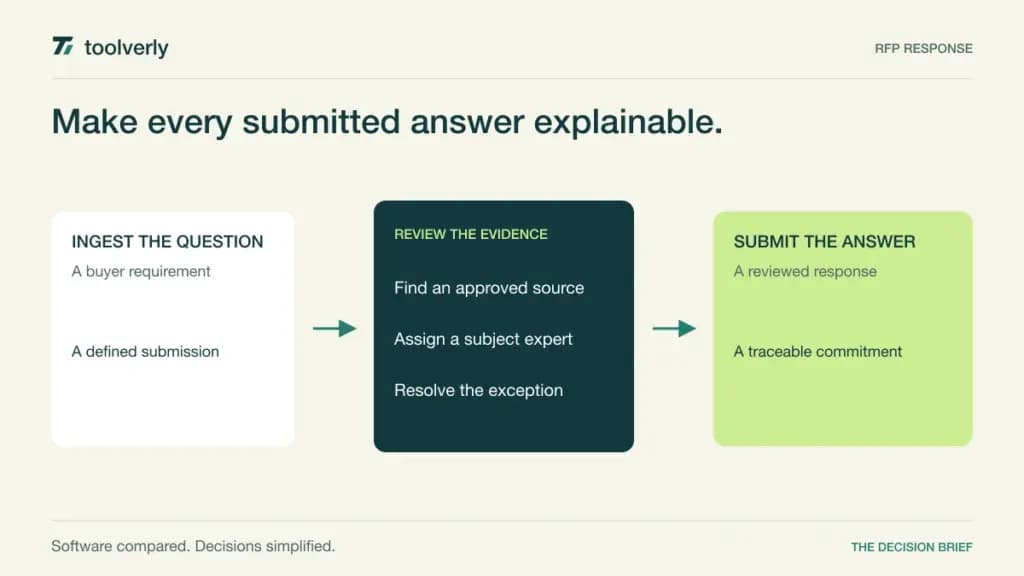
A buyer sends a workbook with hundreds of questions and a fixed deadline. Your team knows many answers, but they live in old responses, product documents, and colleagues’ memories. The risk is not simply slow writing. A polished response can still contain an outdated feature claim, a commitment nobody approved, or an answer intended for another customer.
RFP response software helps sellers ingest questions, locate evidence, involve subject experts, and return the requested documents. Loopio, Responsive, Qvidian, AutoRFP.ai, and Inventive AI differ in library management, workflow breadth, and charging models. Evaluate how each handles a difficult answer, not just how quickly it fills a familiar question.
Research checked October 13, 2026. Features and commercial terms come from official vendor pages. We have not measured accuracy, bid win rates, or drafting time. AI-generated answers still need an authorized reviewer.
Compare the response workflow
| Product | Best fit | Main strength | Meaningful tradeoff |
|---|---|---|---|
| Loopio | Teams maintaining a repeatable answer library | Library, projects, and tiered review capabilities | Advanced reviews and integrations need package scoping |
| Responsive | Organizations coordinating broad response operations | Content and collaboration across unlimited projects | Platform fee, licenses, and services affect the quote |
| Qvidian | Teams combining RFx answers and formal documents | Content reuse with document templates and approvals | Configuration and commercial scope need a demonstration |
| AutoRFP.ai | Teams budgeting by annual response projects | Unlimited users with published project allowances | Annual project counts and contract terms matter |
| Inventive AI | Teams connecting dispersed knowledge to response drafting | Source-connected AI response workflows | Usage charges sit alongside a fixed platform fee |
Loopio
Loopio organizes reusable content and response projects around an ongoing proposal process. Its current packages are Foundations, Enhanced, and Enterprise. Foundations lists unlimited projects, unlimited library entries, and generative AI. Enhanced adds a multilingual library, confidential projects, and multi-step reviews. Enterprise adds separate business units and sandboxes, making it relevant when organizations must keep distinct content and teams controlled.
Pricing requires a custom quote. The FAQ describes Foundations as including ten seats; do not substitute an old public starting price for the current offer. Project translation, onboarding packages, and integrations are shown as add-on options. Include occasional subject experts and library managers in the license discussion, not only the people producing the final response.
Strength: a recognizable library-and-project structure for repeatable response work. Limitation: governance capabilities vary by edition, and unlimited projects do not make every related service included. Loopio fits teams willing to maintain approved answers as an ongoing responsibility. In a demonstration, expire a product answer, assign its replacement, and verify how the approved version becomes available to a different project. A library becomes useful through ownership, not simply through importing more documents.
Responsive
Responsive describes a strategic response management platform with Emerging, Growth, and Enterprise editions. Its pricing page lists unlimited response projects and a foundation of content management, collaboration, and AI support. Growth adds capabilities such as intake requests, LookUp, and advanced integrations; Enterprise adds broader security, control, and reporting options. This breadth can matter when responses involve sales, legal, security, and regional specialists.
The page displays Emerging starting from $10,000 and explains that the platform fee is an annual subscription. The total deployment also includes user licenses and possible add-ons or services. That displayed starting figure should not be presented as a complete quote for a specific team. Request a schedule covering each role, integration, and required implementation task.
Strength: support for a response operation spanning multiple teams and use cases. Limitation: a broader platform needs a clearly bounded initial rollout and commercial scope. Responsive fits organizations that need shared content governance beyond a single proposal owner. Bring a real escalation to the demonstration: a security answer that cannot be approved by sales. Trace who receives it, how a response remains blocked, and what the final project records after approval.
Qvidian
Qvidian covers RFx responses alongside proactive proposals, statements of work, and presentations. Its current platform overview describes a central content library, branded templates, automatic answering, AI Assist, and collaboration with review and approval workflows. Content expiration and document formatting are particularly relevant for organizations whose responses must combine reusable answers with formal narrative sections.
The official RFQ workflow includes suggested content and configurable collaboration, while its proposal capabilities connect content reuse, templates, and Salesforce data. These are adjacent workflows rather than a guarantee that every integration is included in a standard subscription. No current numeric platform price was verified; obtain a scoped quote covering licenses, AI capabilities, implementation, and training.
Strength: connecting structured answers with consistently formatted business documents. Limitation: templates, content permissions, and integrations need deliberate configuration. Qvidian fits teams with formal document standards and reusable material across the deal cycle. Ask it to return a buyer’s original spreadsheet and a branded narrative attachment. Review whether edits, references, and required formatting remain understandable in the files the buyer actually receives.
AutoRFP.ai
AutoRFP.ai uses response projects as its main commercial unit. The published pricing page lists Scale at $899 per month, paid yearly, with 24 projects per year; Accelerate is $1,299 per month, paid yearly, with fifty. Enterprise has a custom project allowance and negotiated terms. The equivalent annual amounts are $10,788 and $15,588 before any applicable taxes or contractual adjustments.
Both listed plans include unlimited users, content, and AI, alongside integrations and support. A project means an RFP, due diligence exercise, tender, or security questionnaire, including related clarifications and documents. The vendor says it usually corresponds to one CRM opportunity. Establish the boundary in your contract when a customer launches multiple evaluations.
Strength: including expert collaborators without per-seat pricing. Limitation: annual project capacity is still a constraint, and paid-yearly pricing is not monthly cancellation. The thirty-day refund has stated activity requirements, and contracts carry a minimum twelve-month term after the initial period. AutoRFP.ai fits teams whose response volume can be forecast. Include an unusually long project and a small follow-up questionnaire in the discussion so the counting method is clear before purchasing.
Inventive AI
Inventive AI centers its pitch on connecting enterprise knowledge to AI-assisted response production. Its product overview describes a unified knowledge hub, content-gap and conflict identification, expert collaboration, and response agents. That approach is relevant when the strongest evidence resides in maintained source systems rather than a single manually curated answer spreadsheet.
The current pricing page describes usage-based RFP and security-questionnaire charging with unlimited users. A fixed platform fee covers setup, onboarding, and access to features. Pricing is personalized, so a volume estimate alone is not the whole bill. Ask how response units are counted, how unused capacity is carried forward, and how additional usage is approved. Do not use a promotional or blog starting figure as a binding platform quote.
Strength: combining source-connected knowledge and assisted drafting. Limitation: conflicts in underlying documents still require a person with authority to resolve them. Inventive fits teams with dispersed knowledge and a named owner for each source. Demonstrate two contradictory product statements, one obsolete document, and one question with no supported answer. The useful outcome is a visible unresolved issue, rather than an apparently confident sentence that hides uncertainty.
Evaluate one difficult response from intake to export
Choose a real completed questionnaire with confidential details removed. Include repeated questions, a requirement that changed since the previous bid, and an answer requiring legal or security approval. Ask every shortlisted vendor to show intake, suggested content, source evidence, assignment, review, and export using the same material.
Keep drafting and commitment separate. A system can summarize an approved policy without having authority to promise a custom service level. Make reviewers responsible for claims, exceptions, dates, and customer-specific obligations. Track unanswered requirements explicitly so a blank field cannot quietly become a generic answer during export.
Use this purchasing checklist:
- Confirm supported input and output formats, including buyer portals.
- Assign owners and review dates to reusable source material.
- Check permissions across business units and confidential projects.
- Include occasional experts in seat or usage calculations.
- Define project boundaries, overages, renewals, and implementation costs.
- Verify that a reviewer can explain the evidence behind the submitted answer.
Our business proposal software comparison covers proactively presenting an offer, while contract lifecycle platforms covers negotiating and administering agreements. An RFP response tool serves the earlier evidence-and-questionnaire stage and should hand work to those systems deliberately.
Start with Loopio for maintained answer libraries, Responsive for broad response operations, Qvidian for formal document reuse, AutoRFP.ai for project-based planning, and Inventive for connected knowledge workflows. Prefer the system that makes unsupported answers easy to find and resolve before the submission deadline.
Original illustration by Toolverly. Read about our publication or send a correction.