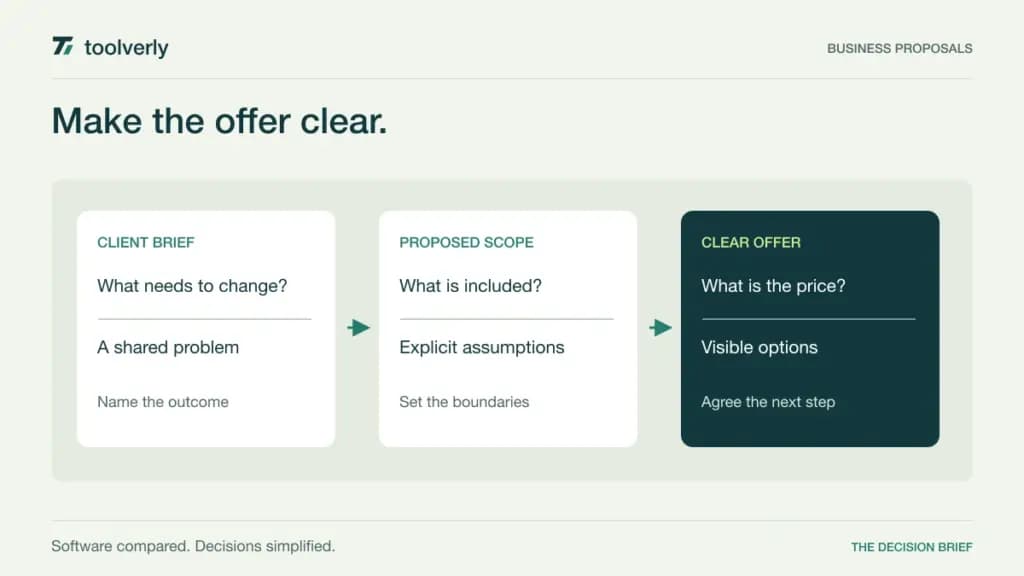
A business proposal needs to do more than look polished. It should connect the buyer’s problem to a clear scope, make the price understandable, and help both sides agree on the next step. Reusing a document can save time, but it can also carry an old promise or the wrong fee into a new deal.
PandaDoc, Nusii, Better Proposals, Qwilr, and Prospero approach that work with different balances of reusable content, interactive presentation, sales workflow, and subscription limits. The decision is whether you need a controlled team process or a quick way for a small service business to create a persuasive, consistent proposal.
We checked official product and pricing pages on September 27, 2026. Amounts below use USD and distinguish annual rates from monthly billing. This is a documentation-based comparison, not a test of close rates or a claim that a particular layout will win more business. Payment processing and optional integrations may carry separate costs.
Compare the proposal workflow, not just the template
Trace a real opportunity from the initial brief to the accepted scope. Identify who writes the response, who approves discounts, and who checks delivery commitments. A proposal platform is useful when it preserves those decisions while reducing repetitive formatting. It cannot repair a vague offer or replace a conversation about what the customer actually needs.
| Product | Best fit | Main strength | Meaningful tradeoff |
|---|---|---|---|
| PandaDoc | Sales teams with approval requirements | Proposals connected to agreement workflows | Relevant controls sit above the entry tier |
| Nusii | Consultants and small agencies | Reusable proposal content with simple team plans | Active-proposal capacity matters |
| Better Proposals | Teams wanting interactive pricing | Clear proposal-building and sales integrations | Monthly send limits vary by plan |
| Qwilr | Teams selling through a web experience | Interactive proposals with broader team packages | Higher plans have included-seat commitments |
| Prospero | Freelancers prioritizing recurring proposal work | Unlimited proposals on a small starting plan | Team size changes the displayed estimate |
PandaDoc
PandaDoc is a reasonable shortlist choice when proposals belong to a broader sales agreement process. Its Business plan combines custom quotes, a content library, branding, deal rooms, and approval workflows. That is useful when several sellers reuse standard material but managers still need control over pricing or commitments.
The annual-billing view of PandaDoc pricing lists Business at $49 per seat per month, excluding applicable taxes. Starter is $19 per seat per month annually, but it is oriented toward creating and signing forms and agreements. Comparing only Starter’s headline price would miss the proposal features many teams are actually buying.
The strength is reducing the gap between a drafted offer and the internal decision to send it. The limitation is scope: integrations marked with an asterisk and advanced capabilities such as CPQ can require additional terms or an Enterprise quote. Confirm your specific CRM connection rather than assuming every integration is included.
During evaluation, have a salesperson prepare an offer and a manager request a pricing correction before release. Check what happens to the approved content after a revision. PandaDoc is most compelling when that controlled handoff is frequent enough to justify a seat-based team subscription and an owner for the reusable content library.
Nusii
Nusii suits a consultant or agency that wants to reuse good proposal material without building an elaborate sales operations system. Its plans include unlimited templates and clients, a content library, proposal notifications, analytics, and PDF export. The central commercial boundary is active proposals rather than a simple count of every document ever created.
On Nusii’s monthly pricing, Freelancer is $29 per month for one user and five active proposals. Agency is $49 per month for three users and 20 active proposals, with additional users at $19 each. Agency adds capabilities including a custom domain, CRM and payment integrations, and automatic reminders. Annual billing offers two months free.
The strength is an approachable package for a small service team. The limitation is making sure the active-proposal allowance matches the number of concurrent opportunities, especially when buyers take weeks to decide. Confirm how active status is counted and how closing or archiving an opportunity affects capacity.
Nusii is a useful candidate when scope writing and presentation matter more than extensive approval routing. Test it with a real service package and a follow-up revision. Check that reusable sections stay editable where needed without allowing an outdated timeline or assumption to slip unnoticed into the next client’s offer.
Better Proposals
Better Proposals is worth evaluating when interactive pricing, reusable content, and a guided proposal-building workflow are the priority. The entry tier includes pricing tables, a content library, payment integrations, and viewing notifications. Higher tiers add sales connections and controls for a larger group of contributors.
The official Better Proposals pricing page lists Starter at $19 per user monthly or $13 on annual billing, Premium at $29 monthly or $21 annually, and Enterprise at $49 monthly or $42 annually. Starter allows one user and ten monthly sends; Premium lists 50 sends, while Enterprise lists unlimited sends.
Premium adds a custom domain, CRM integrations, and API or Zapier access. Enterprise includes manager approvals, content locking, and more advanced permissions. The strength is a visible progression from an individual proposal workflow to a more controlled team process.
The limitation is volume as well as access. A plan can have the right editor and still be unsuitable for the number of proposals your team sends. Confirm how the send allowance applies to a multi-user account and revised documents. In a trial, present optional services in a pricing table and inspect how the final selection reaches the people responsible for delivering the work.
Qwilr
Qwilr is a candidate for teams that want a proposal to behave like a branded web experience. Its offering combines interactive proposals, analytics, payment collection, and sales integrations. That format can be useful for explaining a service or solution with a coherent narrative, provided the buyer can still identify the exact commercial commitment.
The annual view of Qwilr pricing lists Starter at $35 per user per month. Growth is displayed at $275 per month including five users, and Scale at $750 per month including ten users; those team plans are billed annually. The included-seat packages are meaningful commitments, even if the team does not use every seat immediately.
The strength is the presentation model and its connection to a broader sales workflow. The limitation is assuming all integrations, automation, or advanced content behavior belong to Starter. API access also has usage fees, and services such as design or onboarding can be separately priced.
Evaluate Qwilr using a buyer’s actual review process. Open a proposal on a phone, forward it to another stakeholder, and check the final scope and pricing selection. It is a stronger fit when a web presentation helps explain the offer and the team can keep the approved commercial details clear across internal buyer handoffs.
Prospero
Prospero is an appealing starting point for a freelancer who creates proposals regularly and wants reusable material, templates, analytics, and reminders in one place. Its published offering includes unlimited proposals, a content library, integrations, and shared team content. That puts less emphasis on rationing document volume during everyday client work.
The one-user setting on Prospero’s pricing page displays $19 per month on monthly billing or $12 per month with annual billing. A team-size control changes the estimate, so those amounts should not be treated as a flat subscription for an unlimited workforce. The page offers a 14-day trial without requiring a credit card.
The strength is a low starting cost for a recurring proposal workflow. The limitation is determining whether its team controls match a more complex organization. Unlimited proposals does not mean every approval, CRM integration, or procurement requirement has been satisfied.
Prospero is a sensible candidate when one person owns both the commercial conversation and the document. During a trial, create a proposal from reusable content, change the service scope, and review the client-facing result on a small screen. Then check how an accepted offer will reach your project or invoicing process, including who records any changes agreed outside the proposal itself.
Choose for accurate scope and a usable handoff
PandaDoc deserves attention for controlled sales agreement workflows, Nusii for consultants and agencies with a manageable number of active opportunities, Better Proposals for interactive pricing and tiered team controls, Qwilr for a web-led buying experience, and Prospero for economical individual use. These are practical starting points, not promises about sales outcomes.
Prepare the same sample offer in each shortlisted tool. Include a base service, an optional addition, an explicit exclusion, and a change requested after the first draft. Ask someone who did not write it to explain what is included and what the buyer must do next. If that answer is unclear, revise the offer before adding more automation.
- Count users, active opportunities, monthly sends, and annual commitments separately.
- Check who owns reusable pricing, delivery assumptions, and approval rules.
- Confirm exports, buyer access, payment fees, and the handoff into delivery or invoicing.
Your CRM should retain the opportunity context and next action, while the proposal records the actual offer. If your main need is executing an already finalized agreement, our electronic signature comparison addresses that separate decision. A good proposal workflow makes the promised work easier to understand, approve, and deliver after the sale.
Original illustration by Toolverly. Read about our publication or send a correction.