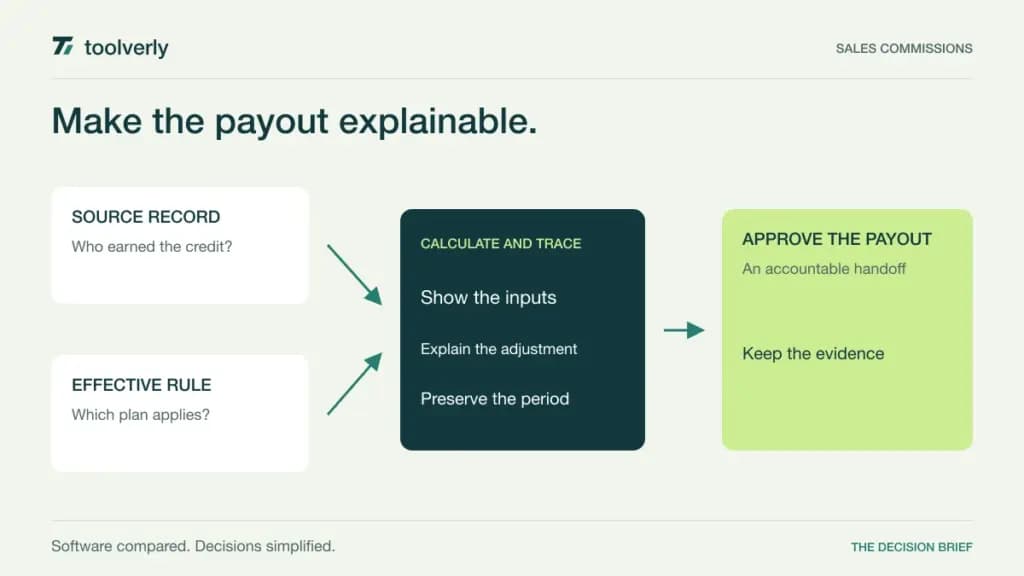
A commission dispute often begins before the calculation. A deal changes owners, a payment arrives late, or a plan amendment is applied to the wrong period. The seller sees one number, finance sees another, and a spreadsheet contains the only explanation. Sales commission management software should preserve the connection between source data, effective rules, approved adjustments and the eventual payout.
CaptivateIQ, QuotaPath, Everstage, Xactly Incent, and Salesforce Spiff all address that lifecycle. Their differences include how operations teams maintain rules, how reps investigate earnings, where approvals occur, and which services or connectors sit outside the subscription. A reliable evaluation starts with difficult historical examples rather than a clean demonstration deal.
Official product and pricing sources were checked on October 8, 2026. This is a documented-capability comparison with editorial buying guidance, not a calculation benchmark or accounting opinion. Keep authoritative opportunity fields in your CRM process and define the approved finance handoff alongside your accounting workflow. A commission platform needs both boundaries to be explicit.
Five commission operating models
| Product | Best fit | Main strength | Meaningful tradeoff |
|---|---|---|---|
| CaptivateIQ | Operations teams combining complex data | Flexible preparation and plan calculations | Implementation and add-on scope affect cost |
| QuotaPath | Teams wanting a visible pricing structure | Plan management through payout approval | A platform fee precedes extra-seat charges |
| Everstage | Teams owning frequent plan changes | No-code plan control and earnings visibility | Commercial scope requires a tailored quote |
| Xactly Incent | Structured compensation programs | Reusable rules and incentive statements | Product and service boundaries need definition |
| Salesforce Spiff | Organizations using Salesforce workflows | Statements, tracing and approval routes | External connectors and premium support cost extra |
CaptivateIQ
CaptivateIQ combines data preparation, plan configuration and workflow automation. Its commission administration product describes native connectors and APIs, combining data sources, validation and effective dating. That makes it relevant when compensation depends on more than a single closed opportunity: employee attributes, quotas, rates and finance records may all matter.
The practical strength is the ability to place those inputs inside a maintained calculation process. Flexibility also creates a responsibility: someone must own transformations and explain why each source wins when records disagree. Ask an administrator to show a correction flowing from source data to a rep’s statement, including the prior period’s evidence.
Pricing is custom. The official page describes seats covering administrators and payees, a one-time setup fee, and scope influenced by plan complexity and integrations. Reporting is included, but ASC-606 reporting is identified as an add-on subscription. Best fit: teams with varied data and compensation logic who can maintain an operating owner. Limitation: implementation, support services and optional modules must be itemized. Separate subscription cost from the work needed to establish trustworthy inputs. Commission administration capabilities and CaptivateIQ pricing.
QuotaPath
QuotaPath publishes a relatively explicit commercial structure alongside plan building, forecasting, discrepancy handling and approvals. Growth includes custom plans and a basic approval-to-payout workflow. Premium adds capabilities such as plan modeling, multiple approval levels, API access and more advanced data integrations. Select the tier using a real close process, especially if payroll sync or complex eligibility is required.
The annual-billed Growth offer lists a USD525 monthly platform fee covering the first five users, then USD35 per additional user per month. Premium lists USD800 per month covering five users, then USD50 per additional user. Those are not five seats charged again on top of the platform fee. Administrators as well as payees can count as users; optional managed services require separate scoping.
Best fit: teams wanting to understand both the workflow and the cost before a sales conversation. Limitation: connector breadth and approval requirements can move a buyer into Premium. Build a cost model with all approvers, operators and sellers included. During evaluation, raise a discrepancy, resolve it, and verify that the approved payout remains traceable after a later source correction. QuotaPath features, fees and user definitions.
Everstage
Everstage presents commission operations as a process owned by the compensation team. Its current platform describes a drag-and-drop plan builder, plan simulation, pipeline-based earnings forecasts and an audit trail from plan to payout. The intent is to let operations maintain changing rules while reps can see how a deal affects their expected earnings.
That can fit a business where plan changes are frequent enough that administrator independence matters. Test the meaning of that independence: let the intended operator change an accelerator, assign an effective date and explain the impact without a vendor-led screen share. A forecasting display should also make clear which assumptions remain dependent on unclosed or unpaid deals.
The official pricing page requests a custom quote rather than publishing a rate. The broader platform includes Incentives, CPQ and Planning; do not assume a commissions contract includes every product. Best fit: teams seeking direct operational ownership of compensation rules and rep visibility. Limitation: product scope, implementation work and renewal terms need written agreement. Ask which connectors, environments, training and ongoing plan-maintenance services the proposed price covers. Everstage’s platform overview and custom pricing.
Xactly Incent
Xactly Incent is designed for administering incentive compensation with configurable rules, quotas and rate tables. Its product page describes customized incentive statements, reports and dashboards, and management-by-objectives workflows. This makes it a relevant candidate when compensation has a defined governance process and needs more structure than a personal spreadsheet.
The statement is an important evaluation artifact. A rep should be able to understand the credited transaction, the applicable rule and any later adjustment. Administrators should also demonstrate how reused rule components behave when one business unit changes its plan. A reusable configuration is valuable only when its scope and ownership remain understandable.
Pricing is available by quote; the reviewed product page does not establish a public per-user rate. Xactly’s broader portfolio includes separate commission expense accounting and other sales performance tools, so confirm which are included in an Incent proposal. Best fit: organizations with a formal compensation function and repeatable program administration. Limitation: suite breadth and implementation can complicate comparisons. Request a product-by-product scope, administrator responsibilities and an example of a reopened period before treating the proposal as comparable to a narrower commission subscription. Xactly Incent capabilities and quote route.
Salesforce Spiff
Salesforce Spiff provides commission plan management, rep statements, earnings estimates, calculation tracing and audit trails. Its pricing comparison also lists effective dating, adjustments, customizable approval routes and dispute resolution. These features are useful when a seller’s question should lead to an explainable calculation rather than a request for a new spreadsheet.
The checked list price is USD75 per user per month billed annually. Spiff is a paid addition to Sales Cloud, rather than an assumed standard CRM feature, and it can also appear in broader sales performance packages. Additional one-way connectors to external systems, excluding Salesforce, are listed at USD250 per connector per month. Premium support is listed at 30% of net price. Confirm the contract basis for every additional charge.
Best fit: teams that want commission visibility near an established Salesforce process. Limitation: the full operating cost can include other licenses, connectors and support. The pricing FAQ says trial licenses are not currently offered, so request a demonstrated proof of your key scenarios. Have both a rep and a finance approver inspect the same trace, with access limited to their legitimate responsibilities. Salesforce Spiff pricing and inclusions.
Evaluate an explanation, then the payout
Select a small set of historical transactions with known, approved outcomes. Include a split deal, a rule change, a credit correction and a late payment. State which system owns each field and whether compensation is earned at booking, invoicing or collection. The evaluation should expose disagreements in your own process as well as limitations in a candidate product.
Ask every vendor to reproduce the outcomes and preserve the explanation. A matching total is insufficient if nobody can explain a difference at transaction level. Examine approvals, the cut-off date, adjustment permissions and the file or integration passed to payroll. Keep the authoritative plan document connected to the version that actually ran.
- Count payees, administrators, managers and finance approvers.
- List required data sources and who owns connector failures.
- Define period closing, corrections and dispute escalation.
- Separate subscription, setup, support and accounting-module charges.
- Ask how historical statements and evidence can be exported.
Shortlist CaptivateIQ for flexible data preparation, QuotaPath for visible package economics, Everstage for operations-led rule maintenance, Xactly Incent for structured program administration, or Spiff for Salesforce-centered visibility. Choose the system that your team can explain, approve and maintain through the next exception.
Original illustration by Toolverly. Read about our publication or send a correction.