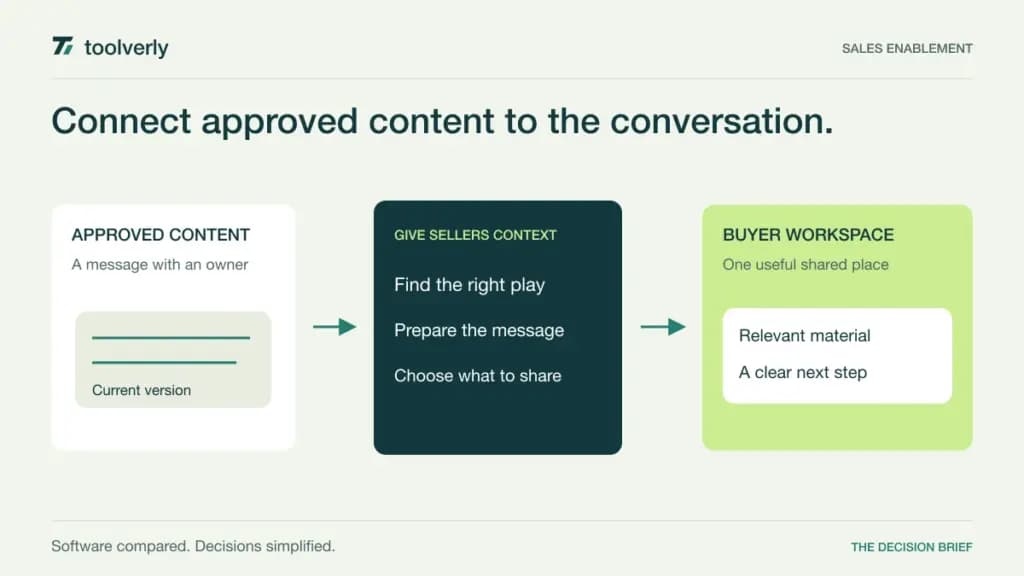
A sales team can have plenty of approved content and still struggle to use the right material in a conversation. A presentation is out of date, a new seller cannot find the relevant play, or a buyer receives several disconnected links. Sales enablement software connects maintained content with seller preparation and buyer engagement.
This comparison covers Highspot, Showpad, Allego, Mindtickle, and Dock. The main decision is how sellers find, practice, and share useful material, rather than how a business stores every brand asset or records every deal. Our guides to CRM software and digital asset management software cover those adjacent decisions. An enablement layer should have a clear relationship with both systems and a named owner for the content it distributes.
Official pages were checked on October 4, 2026. We did not conduct hands-on testing. Highspot is now part of Seismic following the officially announced August 2026 merger, so Seismic is not presented here as an independent sixth alternative. Buyers should ask about current packaging and the product roadmap.
Compare content, seller preparation, and buyer workspaces
| Product | Useful starting point | Pricing reference | Boundary to review |
|---|---|---|---|
| Highspot | Governed sales content and contextual plays | Good, Better, and Best packages; custom quote | Training, coaching, and current Seismic packaging |
| Showpad | Content distribution with seller learning | Per-user quote across three packages | User types and package capabilities |
| Allego | Content alongside learning and coaching | Per-user quote, annual payment upfront | Contract length and extra managed services |
| Mindtickle | Sales content, plays, and buyer engagement | Request a scoped quote; no amount on the checked product page | Content management versus broader platform modules |
| Dock | Content and shared buyer workspaces | Standard: listed USD 350/month for five users | Billing term, asset limits, and governance tier |
Highspot
Highspot publishes Good, Better, and Best packages with quote-based pricing. Its Good offering includes content governance, search and personalization, Sales Plays, Digital Sales Rooms, CRM integration, and analytics. Training and coaching are part of broader packaging. The official merger announcement places Highspot in the Seismic family; a current proposal should explain which product and commercial package you are buying, rather than assuming the two brands remain unrelated providers.
Strength: governed content and contextual plays create a useful framework for helping sellers choose material around a particular conversation. Evaluate whether an approved asset has a clear owner and a clear reason to use it.
Limitation: the full readiness and coaching requirement may extend beyond the entry package. Product integration plans also warrant a specific discussion following the merger.
Best fit: organizations formalizing content governance and seller guidance together. Ask for a demonstration that moves from an approved play into buyer sharing, then identifies the relevant feedback for its content owner.
Showpad
Showpad offers Professional, Advanced, and Expert packages through a per-user quote, with licensing options for adjacent teams. Its offering connects a content library, pages and collections, shared buyer spaces, and seller learning. Mobile and offline use are available across the listed packages, while more advanced readiness and integration capabilities depend on scope. Confirm the user types and features in your quote instead of assuming a single rate covers every department.
Strength: it is a candidate when sellers need approved material in several working contexts, including meetings where connectivity is limited. Include the mobile content experience in the evaluation rather than judging only the administrator’s library.
Limitation: flexible licensing adds questions about occasional contributors and other teams. A learning capability list also needs to be translated into the particular package offered.
Best fit: organizations connecting content distribution with structured seller preparation. Ask how a replaced asset is handled across collections, shared spaces, and material that a seller downloaded earlier.
Allego
Allego combines sales content, digital sales rooms, learning, coaching, and conversation intelligence. Pricing is per user per month, with an annual payment upfront. The vendor says a typical agreement runs for three years, while one- and two-year options are available. The public page does not provide a universal per-user amount. Additional managed configuration and content services can have separate costs, so distinguish the platform subscription from help operating the program.
Strength: content and reinforcement can be evaluated together. A manager can ask how a newly introduced message becomes material a seller can find, practice, and use with a buyer.
Limitation: the commitment period matters as much as the monthly equivalent. A team that expects to reorganize its enablement program should examine renewal and expansion terms carefully.
Best fit: organizations with an active coaching process and a need to connect it to sales content. Put the contract term, included assistance, and separately purchased operational services into the comparison.
Mindtickle
Mindtickle’s current sales content management offering centers on Asset Hub, with search, sharing, and engagement information. Sales Plays support guided selling, and digital sales rooms provide a buyer-facing place for content. The product page also describes governance through audits and version management. It does not publish a subscription amount; request a scoped quote and distinguish the content management requirement from other capabilities in the broader platform.
Strength: it ties asset discovery to how material is used. That creates a useful demonstration scenario for an enablement manager who needs to understand why a particular message is reaching buyers.
Limitation: platform breadth makes it important to keep the purchased modules explicit. A general demonstration can include capabilities outside the package being quoted.
Best fit: teams connecting governed content, contextual selling plays, and buyer sharing. Ask how a content audit leads to a replacement, who approves the new version, and what happens to material already sent to a buyer.
Dock
Dock combines shared buyer workspaces with a content library and playbooks. Free has a bounded allowance including ten workspaces and 25 content assets. Standard is listed at USD 350 per month for five users and 100 assets, with additional seats at USD 50 per month; confirm its billing term. Premium is USD 1,000 per month, billed annually, for ten users and 250 assets. Broader content lifecycle controls are in Enterprise, so do not assume the Standard library includes that governance scope.
Strength: a persistent buyer workspace gives a small selling team a concrete place to organize the material for a deal. The useful question is whether the buyer can understand the next step from that workspace.
Limitation: asset allowances and higher-tier governance may become important as the library grows. Price the maintained content portfolio, not just the initial seat count.
Best fit: teams prioritizing content sharing and collaborative buyer spaces over a large training program. Evaluate one deal’s workspace and the approved materials behind it.
Evaluate an asset through a real sales conversation
Choose one realistic conversation before requesting demonstrations: a seller needs a message for a particular buyer role, a current case study, and an explanation of the next step. Ask each provider to show how the seller finds that material, understands when to use it, and shares it. Use your terminology and your approval rules so the evaluation does not depend on a vendor’s unusually tidy sample library.
Next, replace the case study or change a product claim. Follow the update through approved libraries, collections, plays, and buyer workspaces. Determine whether an owner can find every affected location and what remains accessible in older shares. Content governance is a recurring operational task; the software should make the consequence of an update understandable.
Separate seller preparation from buyer engagement in your requirements. Some teams primarily need discovery and sharing. Others need practice, coaching, reinforcement, and evidence that a message was understood before sellers use it. Request a quote that identifies these modules and the roles of sellers, managers, content owners, and occasional contributors. Include implementation and ongoing program management in the budget.
Use engagement information carefully. An opened asset is evidence of interaction, not proof that it caused a sale or answered every concern. Ask how the platform helps a seller choose a sensible next conversation and how a content owner identifies obsolete or unhelpful material. Keep the business interpretation with the team rather than treating every view count as a result.
- Name the owner, audience, approval date, and intended use of each important asset.
- Confirm current modules, user types, contract term, and paid implementation services.
- Inspect version changes in material already shared externally.
- Check the relationship with your CRM and wider asset library.
- Define how a seller gets help when the standard play does not fit.
Highspot, Showpad, and Mindtickle merit attention for a governed enablement operation. Allego deserves a close look when coaching and content need to work together. Dock offers a focused comparison point for shared buyer workspaces and a bounded content library. Choose around the seller’s task and the content owner’s maintenance process.
Official sources and verification date
Checked October 4, 2026: Highspot pricing, Seismic’s Highspot merger announcement, Showpad pricing, Allego pricing, Mindtickle sales content management, and Dock pricing.
Original illustration by Toolverly. Read about our publication or send a correction.