An SEO subscription should help a team decide what to investigate and what to change next. Collecting more keyword ideas or technical warnings is easy; turning them into a sensible queue of work is harder. The right platform needs enough research depth for your market and enough capacity for the sites, people, and reports you actually manage.
Semrush, Ahrefs, SE Ranking, Moz Pro, and Serpstat combine keyword research, site analysis, and search monitoring in different packages. This comparison focuses on selecting that operating workspace. Search-volume estimates, link indexes, and ranking observations are useful evidence, but they do not guarantee traffic or business results.
Research checked October 1, 2026. The comparison uses official plan information rather than hands-on accuracy benchmarks. Prices are USD reference subscriptions; annual equivalents require the stated annual commitment. Package names, AI-search features, user allowances, and usage limits deserve a fresh check before purchase.
Five SEO tools compared
| Product | Best fit | Main strength | Price reference | Meaningful tradeoff |
|---|---|---|---|---|
| Semrush | Teams wanting a broad search-research workspace | Keyword research, audits, and position tracking | SEO: US$139/month; US$117.33/month on annual billing | Dedicated AI-search monitoring changes the package |
| Ahrefs | Analysts investigating sites, keywords, and links | Connected exploration and historical context | Lite: US$129/month | Credits, history, and additional users affect the fit |
| SE Ranking | Teams needing substantial daily keyword tracking | Tracking and research with defined project capacity | Core: US$129/month; US$103.20/month paid annually | Core has one manager seat and ten projects |
| Moz Pro | A small team managing a limited website portfolio | Research, crawling, and reporting in a bounded plan | Standard: US$99/month; US$79/month on annual billing | Three sites and 300 tracked keywords on Standard |
| Serpstat | Solo practitioners organizing core SEO work | Research and monitoring at a lower annual entry price | Individual: US$50/month, annual offer | Daily research and project limits require planning |
Semrush
Semrush’s current SEO and AI-search plans distinguish SEO from packages that combine it with AI-search monitoring. SEO costs US$139 monthly, or US$117.33 per month on annual billing, and covers five websites and 500 daily tracked keywords. It includes keyword and competitor research, site auditing, and position tracking. Starter SEO + AI is US$199 monthly, adding an AI-search allowance; that capability should not be assumed from the lower SEO price.
Strength: Semrush is a useful candidate when research and ongoing monitoring need to share a workspace. Ask an evaluator to take one topic from a competitor observation to a proposed page improvement and a tracking plan. The output should be a decision with supporting evidence, not just an exported keyword list.
Limitation: seats, reporting additions, and AI-search scope can alter the total subscription. Name the employees who will investigate data and those who only receive a report. Semrush fits a team with several connected search tasks, provided it budgets the package actually needed to complete them.
Ahrefs
Ahrefs combines Site Explorer, Keywords Explorer, Site Audit, and Rank Tracker. Its pricing page lists Lite at US$129 per month, including one user, 750 tracked keywords, six months of historical data, and a monthly user-credit allowance. Standard is US$249 monthly and expands history and capacity while removing that user-credit limit. Additional users and products such as Brand Radar have separate commercial terms; they are not all covered by the Lite entry price.
Strength: Ahrefs deserves a trial when analysts spend time moving between a website, its pages, search terms, and links. Choose a site you know well and investigate a genuine question. Check whether the data views and exports let another colleague understand the reasoning without needing a separate explanation for every screen.
Limitation: a credit allowance can matter to an exploratory research style, while the historical window matters to long-running investigations. Estimate both before choosing Lite. Ahrefs fits teams that value investigation depth and will measure the usage generated by their normal research habits rather than selecting a tier from keyword capacity alone.
SE Ranking
SE Ranking’s current subscription page lists Core at US$129 monthly or US$103.20 per month paid annually. Core provides ten projects, one manager seat, 2,000 daily tracked keywords, 100 AI prompts, and a 250,000-page monthly audit allowance. Growth increases project, seat, and monitoring capacity. Keyword, competitor, and backlink research sit alongside auditing; agency-oriented additions such as white-label features have their own packaging.
Strength: Core gives a buyer a clearly defined tracking and project budget to compare against an actual portfolio. Build a sample list by website, country, device, and topic. Confirm how those combinations consume the allowance, because a spreadsheet with 500 phrases does not automatically imply only 500 units of every monitoring requirement.
Limitation: a generous tracking number does not solve a shortage of working seats or client-facing reporting options. SE Ranking fits teams whose main need is a repeatable monitoring routine supported by research tools. Agencies should evaluate client access and reporting separately from the manager seat that conducts the analysis.
Moz Pro
Moz Pro packages keyword research, site crawling, link analysis, and reporting. The official pricing comparison lists Standard at US$99 monthly, or a US$79 monthly equivalent on annual billing. Standard covers one user, three sites, and 300 tracked keywords. Medium expands those allowances to two users, ten sites, and 1,500 tracked keywords at US$179 monthly or US$143 per month on annual billing.
Strength: a bounded package can make the evaluation straightforward for a small website portfolio. Select the pages and queries that matter to one business objective, then inspect the workflow from an audit observation to a report an owner can act on. The test should reward clarity of the next step as much as the quantity of available information.
Limitation: Standard’s site and keyword caps can become restrictive when work expands into several markets or client accounts. Model that expansion before committing annually. Moz Pro fits a buyer who wants a manageable set of recurring SEO tasks and whose portfolio aligns with the selected plan’s limits.
Serpstat
Serpstat offers keyword research, site analysis, rank tracking, auditing, and backlink analysis. Its pricing page shows Individual at US$50 per month on the annual offer, covering five projects and 100 site, keyword, or link research searches per day. Team is shown at US$100 per month on annual billing and adds shared-access and reporting capabilities. Audit, ranking, export, and API allowances also need to be matched to the intended workload.
Strength: Individual provides a lower-cost annual starting point for a solo practitioner whose research fits the daily allowance. During evaluation, keep a simple tally of searches used to produce one useful recommendation. This reveals whether the package supports the actual task rather than an idealized low-usage day.
Limitation: daily limits and project caps can interrupt a concentrated research session even when the monthly price looks attractive. Serpstat fits buyers comfortable planning within those boundaries. A team should assess the appropriate shared package rather than work around a personal plan with informal account sharing.
Compare decisions, capacity, and delivery
Begin with three questions you need to answer this month. For example: which existing page deserves an update, which technical issue prevents a useful page from being discovered, and which competitor topic deserves closer investigation? Give each platform the same questions. Keep the inputs consistent so the comparison is about the work, not different demonstration datasets.
Then separate search visibility from visitor behavior. An SEO platform can help identify where you appear and what to investigate, while website analytics software helps assess what visitors do after arriving. Connect the two in your evaluation, but do not treat a ranking movement as proof of a sale or a product improvement.
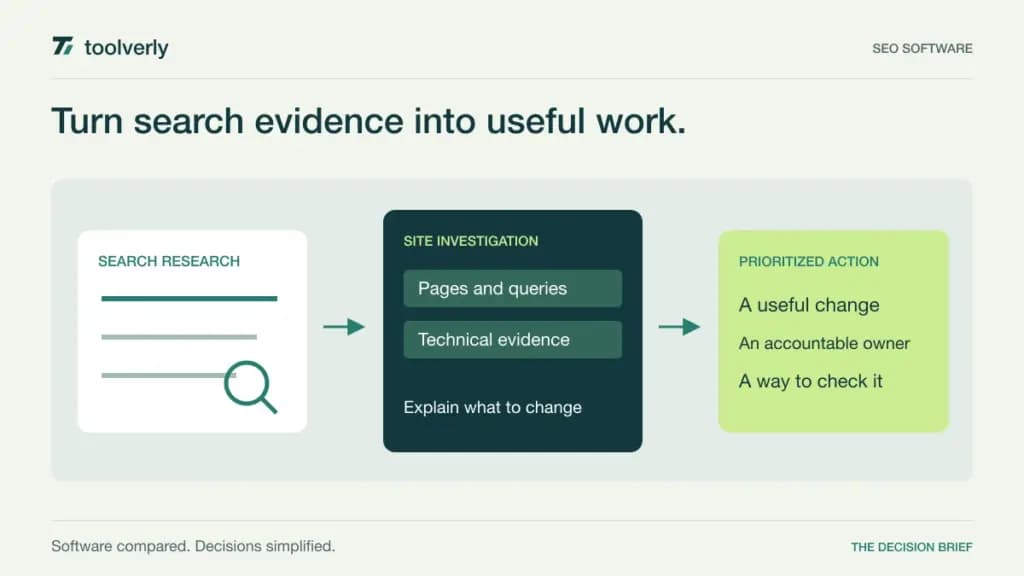
Finally, examine the delivery path. An audit finding should become a prioritized task with an owner, supporting evidence, and a way to check the change. If recommendations disappear after export, the problem may sit in your project management process. Buying a larger crawl allowance will not establish that ownership.
- Count sites, markets, working users, and report recipients.
- Check tracking frequency and how location and device combinations count.
- Estimate crawl, research, export, and historical-data requirements.
- Separate classic SEO needs from paid AI-search monitoring.
- Trial one full research-to-action cycle before paying annually.
- Record the plan, billing term, and optional services in the budget.
Semrush suits connected research workflows; Ahrefs is a strong investigation candidate; SE Ranking makes tracking capacity central to the decision. Moz Pro is worth evaluating for a bounded portfolio, and Serpstat for a solo workflow that fits its allowances. Choose the platform that helps your team produce and complete the right work, not the largest pile of reports.
Original illustration by Toolverly. Read about our publication or send a correction.