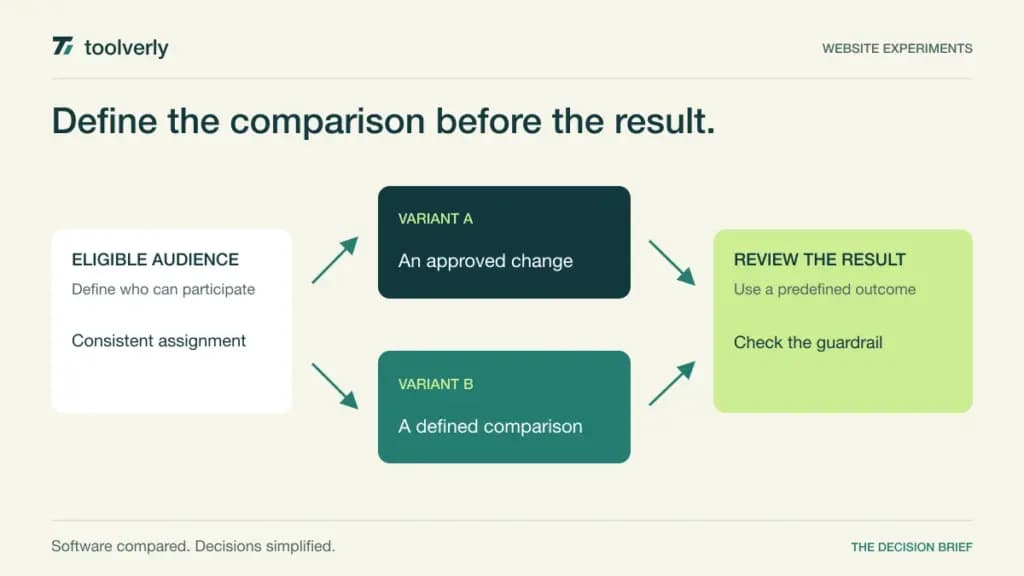
An A/B test needs more than two page designs. It needs a defined audience, consistent assignment, a measurable outcome, and a rule for deciding what the result means. The platform should support those decisions without encouraging a team to call a winner whenever a dashboard looks favorable.
Optimizely, Wingify, Kameleoon, Convert, and Webtrends Optimize offer different editing, traffic, and package models for website experimentation. Compare the experiment your team can implement and interpret responsibly. A visual editor is useful for some changes; other tests require engineering support, identity coordination, or a measurement plan that reaches beyond the page being changed.
How this comparison was prepared
Official product and pricing sources were checked October 5, 2026. We did not run live experiments, benchmark page performance, or measure conversion lift. The criteria are experiment creation, assignment and audience scope, outcome definitions, statistical safeguards, operational review, and traffic billing. Vendor claims about speed or revenue are not evidence of results for your website.
The vendor landscape has changed: VWO and AB Tasty announced their unification under Wingify in September 2026. This comparison therefore gives that vendor family one position rather than counting the two earlier brands as independent alternatives.
| Product | Best fit | Main strength | Meaningful tradeoff | Pricing reference |
|---|---|---|---|---|
| Optimizely | Broader experimentation programs | Web and code-oriented experiment scope | Commercial package needs scoping | Request a proposal |
| Wingify | Tiered web experimentation | Editors and experiment workflows | Advanced safeguards vary by tier | Custom proposal |
| Kameleoon | Prompt-based experiment creation | Entry package with named safeguards | Code and other channels cost extra | PBX Starter from $495/month |
| Convert | Teams seeking a published entry price | Explicit traffic and project allowances | Active experience limits apply | Growth USD399/month, monthly |
| Webtrends Optimize | Web tests with scoped service needs | Multiple experiment types | Free account is time and traffic limited | Up to 10,000 sessions/month free for 12 months |
Optimizely
Optimizely’s current experimentation product presents visual website editing alongside code-oriented experimentation, multivariate testing, and AI-assisted creation workflows. The public product page invites a commercial discussion rather than publishing a fixed subscription amount. Ask for a proposal covering the actual channels, users, traffic, and implementation requirements.
Best fit: A business coordinating a broader experimentation program across marketing and engineering. Strength: The product scope accommodates more than a simple page-copy comparison. Limitation: The commercial and operational boundaries need to be established for your proposed configuration.
Prepare a small text change and a more involved checkout change. Ask which can be produced through the proposed editor, which requires your engineers, and how each is reviewed before exposure. Request an explanation of how outcomes are defined and how conflicting experiments would be managed. Do not treat an AI-generated variant as an approved experiment: the team still needs to validate the hypothesis, the implementation, and the interpretation of the result.
Wingify
Wingify’s Web Experimentation and Rollout packages use Growth, Pro, and Enterprise tiers with custom proposals. Growth lists visual and code editors, A/B and split testing, and targeting. More advanced reporting, sample ratio mismatch checks, guardrails, and multivariate scope appear higher in the package structure; enterprise controls also need explicit scoping.
Best fit: Teams comparing a staged route from web tests to a more governed program. Strength: Named tiers help identify which operational controls belong in the proposal. Limitation: An entry package should not be assumed to include every statistical or approval capability shown across the platform.
Write down the safeguards your team considers necessary before choosing a tier. Include a primary outcome, an unwanted side effect, and a case where assignment or measurement becomes unreliable. Ask how the proposed package makes those issues visible. Because the brand family has changed, request a current contract and migration explanation instead of relying on an earlier VWO or AB Tasty price sheet.
Kameleoon
Kameleoon’s PBX Starter plan is advertised from $495 per month, with ten experiments and 50,000 tested visitors per month. The package lists sequential testing, sample ratio mismatch checks, multiple-testing correction, and holdout capabilities. JavaScript and CSS editing, feature experimentation, mobile, and personalization are additional scopes; enterprise pricing is custom.
Best fit: Teams interested in prompt-based experiment creation within a defined entry allowance. Strength: The published package names both activity limits and statistical safeguards. Limitation: A code editing or additional-channel requirement can take the buyer beyond the starting price.
Choose a change with a clear visual requirement and one with a technical dependency. Ask how generated output is checked against your design, accessibility, and event definitions before launch. Establish what counts as an experiment and a tested visitor under the agreement. Confirm currency, billing term, and additional scope directly; a published starting monthly reference is not enough to calculate the full contract commitment.
Convert
Convert Growth is USD399 per month on monthly billing with 100,000 monthly tested users. The annual option is USD299 per month, charged as USD3,588 per year, with a 1.2 million annual tested-user pool. Growth allows five projects and five active experiences per project. Higher-tier capabilities and development support have separate boundaries; taxes are extra.
Best fit: Teams that want a published starting commitment and explicit project and traffic allowances. Strength: Buyers can compare monthly billing with an annual traffic pool directly. Limitation: Active experience limits and implementation responsibility still need to match the program.
Estimate how many projects and overlapping experiences your team genuinely needs. Include internal QA traffic, repeat users, and the seasonal distribution of visitors in your questions about counting rules. Ask how unused or unexpected traffic is treated under the chosen agreement. A transparent list price is useful, but it does not remove the need for an engineer or analyst to own the implementation and measurement plan.
Webtrends Optimize
Webtrends Optimize’s feature list includes A/B, split URL, and multivariate testing, visual and code editing, and additional implementation approaches. Its free account covers up to 10,000 sessions per month for twelve months. That offer is bounded by both traffic and duration; request a commercial proposal for the paid scope and support you need afterward.
Best fit: Buyers comparing experiment types alongside their desired level of service. Strength: The public feature list describes several ways to implement a comparison. Limitation: A session-limited free account is not equivalent to a permanent free production plan or a tested-user allowance.
Specify whether your team expects self-service operation or help planning and implementing experiments. Ask the vendor to distinguish the software scope from any services in the proposal. For a small site, begin by assessing whether the chosen outcome is frequent enough to inform the intended decision. Access to sophisticated experiment types cannot compensate for an unclear hypothesis or too little relevant traffic.
Choose a measurement plan your team can maintain
Define the eligible audience, assignment unit, primary outcome, and review rule before comparing editors. Record the guardrails that would make an otherwise positive result unacceptable. Ask how the platform supports consistent assignment and how your team should handle missing events, tracking changes, or an unexpected audience split. Avoid comparing traffic prices until the counting units are understood.
Behavioral reporting and experimental evidence answer different questions. Our website analytics comparison covers observing visits and actions. Our usability testing comparison covers learning from participants performing tasks. Either can inform a hypothesis, but neither alone establishes the outcome of a controlled website variant comparison.
A practical buying checklist
- Write one clear hypothesis with an eligible audience, primary outcome, guardrails, and decision rule.
- Include both an editor-friendly change and an engineering-dependent change in the vendor evaluation.
- Specify how events, assignment consistency, and unexpected audience splits will be checked.
- Map safeguards, approvals, concurrent tests, and editing needs to the exact quoted tier.
- Compare sessions, tested visitors, monthly tested users, and annual pools using each vendor’s definitions.
- Confirm currency, tax, overage rules, project allowances, support, and implementation responsibility.
- Document how experiments and results can be archived and exported when the contract ends.
Choose the platform that supports a defensible experiment your team can build, operate, and interpret. The useful result is a decision backed by a defined comparison, with uncertainty and limitations preserved instead of replaced by an attractive headline lift.
Sources and verification date
Official product information checked October 5, 2026. Prices are published reference points, not binding offers; confirm tax, currency, region, contract term, and package scope before buying.
- Optimizely experimentation
- Wingify packages
- Wingify merger announcement
- Kameleoon plans
- Convert pricing
- Webtrends Optimize feature list
- Webtrends Optimize free account terms
Original illustration by Toolverly. Read about our publication or send a correction.