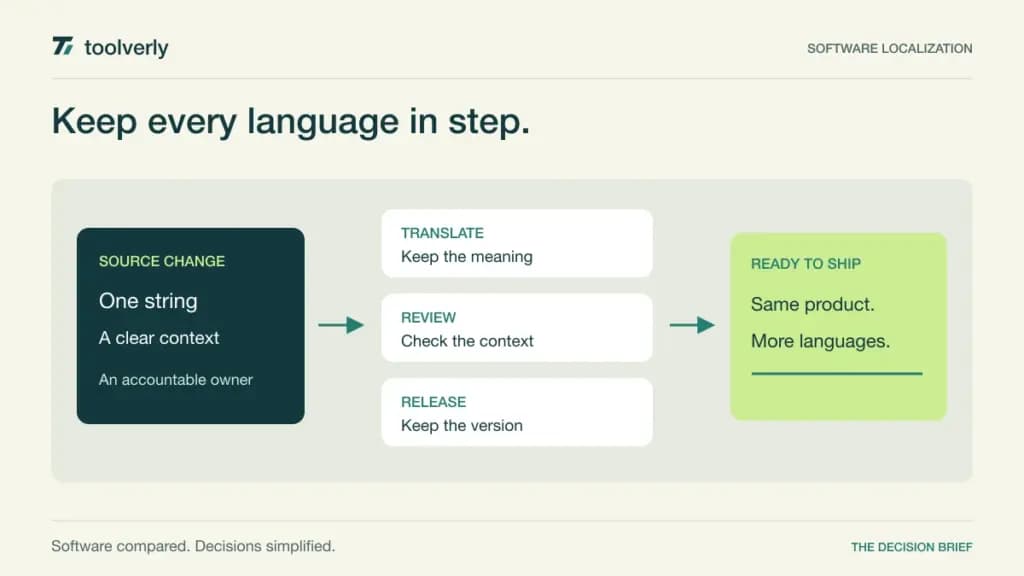
Software localization becomes difficult when translated text stops moving with the product. A developer changes a label, a designer revises a screen, and a translator works from yesterday’s spreadsheet. The resulting problem is not simply missing words. It is uncertainty about which version is ready to ship, who reviewed it, and whether the translation still fits its context.
Lokalise, Phrase, Crowdin, Transifex, and Localizely approach that coordination problem with different packages and capacity models. This guide focuses on managing multilingual software strings and their release workflow. It is a different decision from choosing a general project management platform, although the two systems should agree on owners and deadlines.
Official product and pricing sources were checked on September 26, 2026. The comparisons below are editorial judgments based on those sources, not claims of translation-quality testing. Prices retain the displayed currency and billing basis. Translation services, machine translation, and platform subscriptions can represent separate costs, so a low platform price is not a complete localization budget.
Define the release handoff before comparing plans
Map a string’s journey from source repository to translation, review, and release. Include screenshots, placeholders, plural forms, and an accountable reviewer for each language. A useful pilot should change an existing string after translation and show what happens next. The team needs to know whether an old translation becomes visibly stale and whether an approved version can be recovered.
Also compare the vendors’ capacity units. A hosted word multiplied by target languages differs from a source string key that can hold several translations. Seats, processed words, AI allowances, and integrations add further dimensions. Keep the terminology and style rules in a maintained reference; our team wiki comparison covers systems that can hold the surrounding product knowledge.
| Product | Best fit | Main strength | Important tradeoff |
|---|---|---|---|
| Lokalise | Product teams coordinating frequent multilingual changes | Structured workflow and context capabilities | Processed-word and advanced-feature allowances matter |
| Phrase | Organizations connecting software localization with broader language work | Dedicated software package within a larger platform | Package scope and annual commitment need review |
| Crowdin | Teams connecting content repositories and many contributors | Broad integration ecosystem and translator access | Target languages multiply hosted-word usage |
| Transifex | Teams needing localization integrated with development | Developer interfaces and tiered translation workflows | Commercial amounts require direct confirmation |
| Localizely | Smaller application teams with a defined string inventory | Clear string-key plans and Flutter options | Advanced review features require organization plans |
Lokalise
Lokalise is a sensible candidate when localization involves product, design, and engineering rather than a single file owner. Its package structure separates entry-level task coordination from richer automation, language resources, and release controls. The value is keeping the work attached to an evolving product instead of repeatedly assembling a translation package by hand.
On the checked annual-billing view, Explorer was US$149 per month, Growth US$379, and Advanced started at US$1,049. Explorer listed unlimited hosted words and standard seats, five projects, ten languages, and processed-word capacity starting at 60,000 per year. Growth adds glossary and translation-memory capabilities; Advanced includes branching and versioning. Enterprise requires an estimate. Consult Lokalise’s current plan comparison.
The strength is a path from basic coordination to more controlled workflows. The limitation is that “unlimited hosted words” does not remove the other capacity boundaries. A team repeatedly updating existing content should estimate processed words, not just the size of the repository. In a demonstration, follow one changed button label through context, review, and export. Then confirm that the required integration and approval sequence are included in the quoted package rather than an assumed future upgrade.
Phrase
Phrase is relevant when software localization sits within a larger language operation. Its current pricing separates business plans from a Developer and Designer offering. That distinction helps avoid buying a broader platform bundle merely because its headline is the first one visible on the pricing page.
The dedicated Software UI/UX package lists 15 Strings seats, one million Strings Managed Words, and unlimited languages. The checked US-dollar view showed US$525 per month, billed annually. The broader Team business package has a different capacity mix and price. These are package prices, not per-translator rates; confirm how additional capacity and professional translation work would be charged. See Phrase’s package and capacity details.
The appeal is a software-focused entry into a wider localization platform. The tradeoff is making the package boundary explicit before signing an annual agreement. Prepare a list of the roles that need access: developer, localization manager, designer, reviewer, and external linguist. Ask which role consumes which seat and demonstrate the repository-to-review handoff using your actual file format. For teams with only a small, occasional translation requirement, the coordination overhead and included capacity may exceed what they need today.
Crowdin
Crowdin fits teams with many content connections and contributors. Its official materials emphasize repository synchronization, a translation editor, glossary and translation memory, and a broad integration catalog. Translator access and manager access are treated differently, which is useful when many people contribute language work but only a few administer the process.
The checked regional annual view showed Pro from €45 per month, with an annual total of €545, 60,000 hosted words, two private projects, and two integrations. Team started at €136 per month, with an annual total of €1,636 and five managers. Displayed monthly equivalents are rounded. Hosted words are source words multiplied by target languages. The free plan also carries a translation-memory donation condition. See Crowdin’s pricing and definitions.
The strength is connecting an ongoing content pipeline to a large contributor group. The limitation is capacity expansion: adding languages can increase hosted-word needs without any growth in the English source. Estimate the next six months of both content and languages. For confidential commercial material, review the exact plan’s project visibility and data terms before importing it. A free account is useful only when its conditions match the intended work.
Transifex
Transifex is a candidate for development teams that want localization connected to their existing tooling. Its current Starter plan lists an online editor, translation memory, unlimited projects and files, content and design integrations, and developer access through APIs, SDKs, a CLI, and webhooks. Those interfaces can reduce recurring manual file transfers when someone owns the integration.
Growth adds features including screenshots for context, advanced translation memory, and glossary management. The comparison lists ten collaborators for Starter, 30 for Growth, and 100 for Enterprise+. The public page checked during this review did not display a numeric subscription price. Request an amount and billing basis for the selected capacity; Growth and Enterprise+ AI word allowances are specifically tied to annual plans. Refer to Transifex’s official plan matrix.
The strength is a development-oriented route into a structured translation workflow. The limitation is that the visible feature list alone does not establish total cost or the effort required to maintain synchronization. Ask the vendor to show conflict handling when a source file changes during review. For the commercial discussion, provide collaborator roles, expected languages, and annual change volume. A written quote against that workload is more useful than an unsupported starting-price estimate.
Localizely
Localizely is especially approachable for teams that can describe their application as a known collection of string keys. Its plans use hosted keys rather than multiplying each source word by every target language. The platform also offers Flutter-specific in-context editing and over-the-air translation options, with plan and add-on boundaries worth checking.
Starter includes 500 hosted string keys, one project, and unlimited users and languages for US$16 per month billed annually, or US$19 on monthly billing. Bronze, the first organization plan, lists 5,000 keys and five projects at US$125 annually billed per month, or US$150 monthly. Organization plans add capabilities such as translation memory, glossary, QA checks, and branching. Free includes 250 keys but lacks paid API access. See Localizely’s plans and add-ons.
The advantage is a capacity model a smaller engineering team can estimate directly from its codebase. The limitation is feature scope: a personal plan’s generous language allowance does not imply that organization-level review controls are included. Count active keys, identify obsolete ones, and test an import and export before migration. If over-the-air updates matter, price their usage separately and define who is allowed to change production wording after an application release.
Choose the workflow that survives the next release
Shortlist Lokalise for frequent changes requiring richer coordination, Phrase for a software team connected to a broader language operation, and Crowdin for many contributors and content integrations. Consider Transifex when developer interfaces are central to the handoff. Localizely is compelling when a smaller app team values a clear key-based inventory and its relevant application integrations.
Use the same small release for every evaluation. Include an ambiguous label, a pluralized sentence, a placeholder, a long translation that strains the layout, and a late source change. Ask a real reviewer to explain which items are ready and why. This is an evaluation design, not a reported test result.
Before committing, request an export of translations, glossary, and relevant history, then document the expected migration path. Assign one owner to stale strings and another to language approval. The platform can coordinate a release, but the team still needs a clear definition of acceptable wording and a person willing to approve it.
Original illustration by Toolverly. Read about our publication or send a correction.