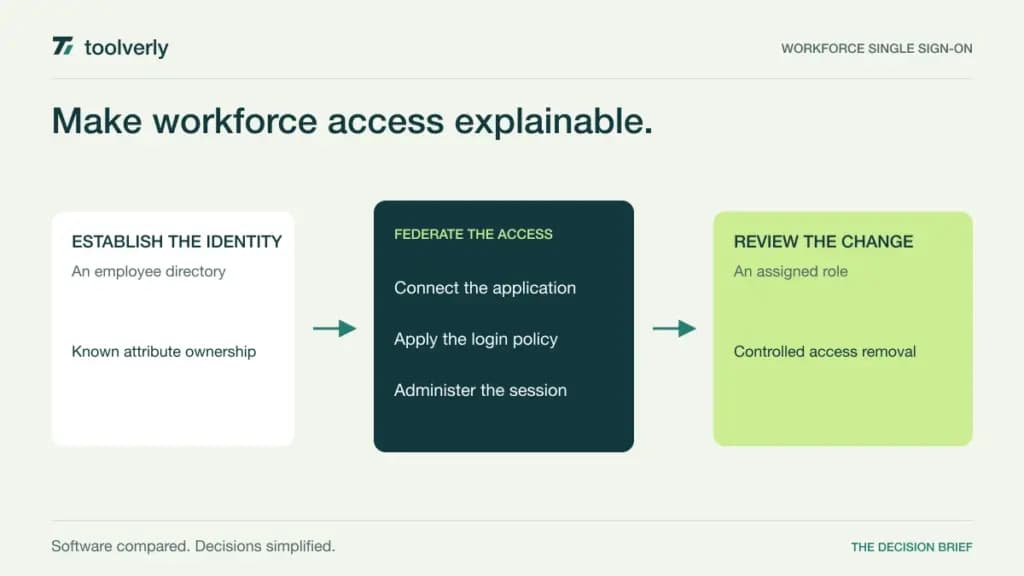
When each business application has its own login and account process, an employee’s access becomes difficult to understand. A workforce single sign-on platform lets applications trust a central identity system, so authentication and access policies can be managed more consistently. The useful outcome is not simply one fewer password: it is a login process that the organization can administer, explain and change when somebody’s role changes.
Okta, Microsoft Entra ID, JumpCloud, Cisco Duo and Keycloak offer different ways to establish that foundation. They vary in directory integration, policy packaging, surrounding device capabilities and who operates the identity infrastructure. This comparison concerns employee and contractor application access; customer identity plans are a separate buying decision.
Official information was checked on October 12, 2026. This is a source-based comparison, not a penetration test, security certification or measured authentication benchmark. Feature availability depends on licensing and configuration. A successful SSO login does not establish that every application account or existing session is removed when employment ends.
Compare the identity authority and its operating model
| Product | Best fit | Main strength | Meaningful tradeoff |
|---|---|---|---|
| Okta | Mixed business application estates | Workforce federation and policy suites | Advanced capabilities change suite and add-on scope |
| Microsoft Entra ID | Microsoft-centered organizations | Cloud identity integrated with existing subscriptions | Policy and governance require careful license checks |
| JumpCloud | Combined identity and device operations | Directory, SSO and related administration choices | Package and individual feature costs differ |
| Cisco Duo | Authentication-focused access programs | MFA and SSO with tiered identity controls | Higher assurance and device controls vary by edition |
| Keycloak | Teams operating their own identity service | Open protocols, federation and customization | Availability, upgrades and support remain an operating responsibility |
Okta
Okta’s current Workforce Identity offering groups capabilities into suites. Starter includes single sign-on, with higher suites adding broader identity administration and security capabilities. The attraction is a workforce identity service that can sit across applications instead of requiring the organization to use one application vendor for everything.
The advantage is a clear place to administer authentication across a mixed estate. The limitation is commercial scope: SSO, adaptive authentication, lifecycle management and governance should not be assumed to have identical inclusion. Match your requirements to the actual suite and add-ons rather than collecting feature names from several product pages.
Best fit: organizations with many business applications and a dedicated owner for identity operations. Demonstrate a directory change, access to an assigned application and the handling of a user who should no longer authenticate.
Price context: Starter begins at $6 per user per month, Core Essentials at $14 and Essentials at $17, billed annually. Professional and Enterprise require quotes. These are workforce suite figures; the separately priced customer identity platform is not part of this comparison. Confirm contracted populations, additional products and support.
Microsoft Entra ID
Microsoft Entra ID is particularly relevant where Microsoft cloud identity already anchors employee access. The Free offering includes foundational directory and SSO capabilities, while P1 and P2 extend the available identity controls. The pricing page also distinguishes Entra Suite and separate governance and network access offerings.
The advantage is continuity with an existing Microsoft identity environment and potentially included licensing. The limitation is that a familiar Microsoft subscription name does not establish every user’s entitlement. Confirm the precise plan, the population using premium controls and any additional prerequisites before budgeting a rollout.
Best fit: organizations already using Microsoft identity who want to extend consistent application authentication. Ask for an explanation of a standard user, a contractor and an administrator, including which policies and licenses apply to each.
Price context: the current US page lists P1 at $7 and P2 at $10 per user per month, paid yearly with an annual commitment. P1 is included in specified packages such as Microsoft 365 Business Premium and enterprise E3; P2 is included in enterprise E5. Entra Suite is an additional offer with an Entra ID P1 prerequisite, not a substitute for checking base licensing.
JumpCloud
JumpCloud combines directory and access capabilities with device-related administration options. Its current pricing offers both packages and individual products. The SSO package combines SSO and MFA access to resources with Password Manager, while broader platform packages address additional identity and device work.
The advantage is evaluating related administration responsibilities together when the same team manages identities and endpoints. The limitation is that a low individual product price is not the price of a full operational package. Directory, authentication, lifecycle and device capabilities need to be selected deliberately.
Best fit: teams seeking a coordinated approach to workforce access and device operations across their chosen environment. In a demonstration, distinguish an application’s authentication policy from a device management action. Ask which administrator handles each and what happens when only one system has updated.
Price context: the SSO package shows $11 per user per month billed annually or $13 billed monthly. Broader platform offers use sales discussions. Individual feature prices are also listed, and suspended users remain billable according to the FAQ. Confirm the complete selection, support and applicable taxes rather than adding one headline feature to your budget.
Cisco Duo
Cisco Duo’s current editions connect multifactor authentication with SSO and progressively broader identity and device controls. Essentials includes single sign-on, passwordless authentication, Duo Directory and Trusted Endpoints. Advantage and Premier add further capabilities, so the comparison should begin with the assurance and application access requirements you actually need.
The advantage is a focused authentication conversation that can expand to related identity and device context. The limitation is assuming every advertised control is in the entry edition. Define the required methods and policies, then check their edition and application compatibility.
Best fit: organizations building or extending an authentication program where MFA, SSO and endpoint trust need to be considered together. Demonstrate an ordinary login, an unavailable authentication device and the administrator’s recovery process without using a real employee account.
Price context: Essentials lists $3, Advantage $6 and Premier $9 per user per month. Duo Free supports up to ten users and has a narrower scope. Self-service licenses are purchased in user increments: ten below 100 users and 25 above 100. Confirm the purchased capacity and subscription term; a displayed monthly unit does not settle the contractual billing commitment.
Keycloak
Keycloak is an open-source identity and access management option for teams prepared to operate their own service. It supports SSO, OpenID Connect and SAML, identity brokering, and federation with LDAP or Active Directory. Administrators manage users, applications, permissions and sessions through its console.
The advantage is control over the identity service and its integration model. The limitation is operating responsibility: somebody must maintain hosting, database reliability, updates, monitoring, recovery and configuration. An open-source identity system is not automatically a managed workforce administration program with commercial support.
Best fit: technically capable organizations with clear ownership for identity infrastructure or a separately contracted managed service. Evaluate the application integration, directory mapping and administrative workflow alongside the maintenance process. Include a plan for making configuration changes safely.
Price context: the upstream open-source software is available without a vendor per-user SaaS subscription. That does not make the production service costless. Budget infrastructure, operations, specialist help and any chosen commercial support separately. Do not compare a software download with a hosted suite without including the work needed to keep it available.
Evaluate access changes as well as a successful login
Choose a few representative applications, including one business-critical service and one with an awkward legacy integration. For each, document the supported federation protocol, application-side plan, account provisioning method and owner. Some SaaS products require a higher subscription to enable enterprise SSO, so the identity provider’s fee can be only part of the cost.
Test the lifecycle in a controlled evaluation: establish an account, assign access, change a role, remove an assignment and inspect what happens to active sessions and the application account. Authentication, provisioning, authorization and session termination are related but separate actions. Ask the vendor to show their boundaries instead of assuming a directory update completes every step.
Our business password manager comparison covers shared credential handling for remaining password-based workflows. Our device management comparison helps define endpoint administration. Agree which system is authoritative for each responsibility before combining them.
- Map workforce directories and authoritative user attributes.
- Confirm federation and provisioning for important applications.
- Demonstrate policy enforcement and approved recovery paths.
- Verify removal of access and handling of existing sessions.
- Price licenses, application upgrades, operations and support together.
Shortlist Okta for a mixed application estate, Entra ID for Microsoft-centered identity, JumpCloud for coordinated identity and device work, Duo for an authentication-focused program, and Keycloak for a deliberately operated identity service. Choose the platform whose configuration and ongoing responsibilities your administrators can explain and maintain.
Official sources checked October 12, 2026
Okta plans; Microsoft Entra pricing; JumpCloud pricing; Cisco Duo editions; Keycloak capabilities.
Original illustration by Toolverly. Read about our publication or send a correction.