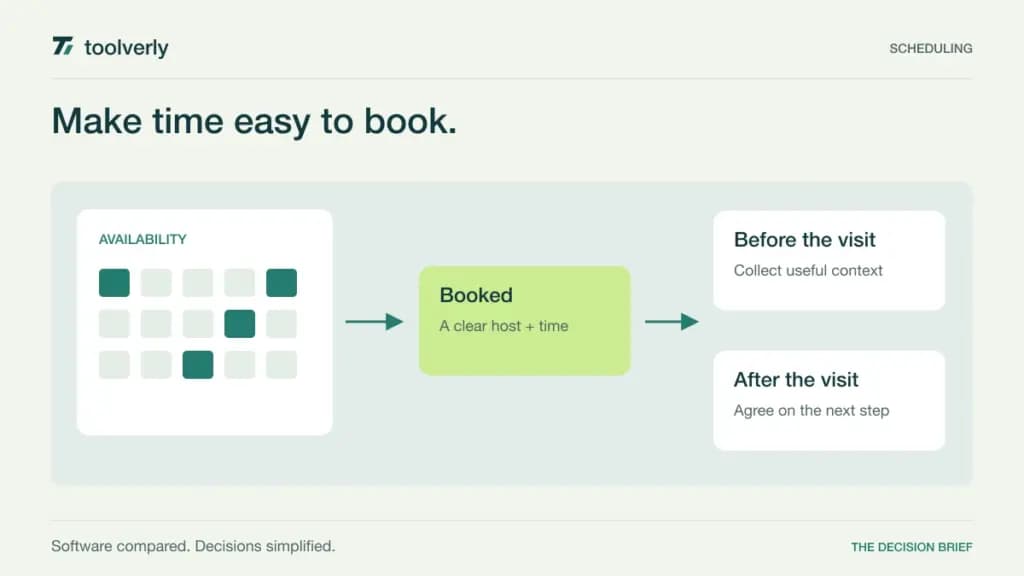
A booking link removes email back-and-forth, but the wrong setup can still send a prospect to the wrong person or fill a consultant’s day with unusable gaps. The useful question is what must happen around the appointment: finding shared availability, assigning an owner, collecting intake information, or taking payment.
This comparison covers Calendly, Cal.com, SavvyCal, Acuity Scheduling, and YouCanBookMe. It evaluates their documented capabilities and plan structure, with official sources checked on September 23, 2026. Recommendations are editorial judgments about workflow fit, not results from a hands-on speed or conversion test.
Which scheduling workflow do you need?
Separate three cases before comparing subscriptions. A solo professional needs an accurate view of personal availability. A sales team needs a way to distribute and qualify meetings. A service business needs appointments connected to preparation, payment, and repeat visits. The same booking screen can conceal very different operational requirements.
| Product | Best fit | Main strength | Tradeoff to examine |
|---|---|---|---|
| Calendly | Teams standardizing meetings | Clear progression from solo booking to routing | Routing requires a higher tier |
| Cal.com | Flexible individual and team scheduling | Broad individual allowance and team controls | Organizational controls add another tier |
| SavvyCal | Consultants coordinating with busy clients | Calendar overlay and preferred slots | Active booking links require a paid plan |
| Acuity Scheduling | Appointment-based services | Intake, payment, and calendar capacity | Choose capacity around staff or locations |
| YouCanBookMe | Customized booking journeys | Booking questions and tailored notifications | Page and calendar allowances vary |
Calendly
Calendly is a sensible shortlist choice when a business wants a repeatable meeting process across several roles. Its Free plan supports one event type and one connected calendar. Standard expands event types and calendar connections, and adds reminders, automations, and payment connections. Teams adds round-robin scheduling, qualification and routing, and centrally managed event types.
That separation matters for a practical rollout. A founder offering a single introductory call can begin with the free configuration. A sales manager assigning meetings across representatives should evaluate Teams from the outset; buying a lower tier first does not answer the routing question.
The annual billing view lists Standard at $10 per seat per month and Teams at $16. Meeting invitees do not need paid seats. Treat meeting recording and AI assistance as separate packaging decisions: the page offers Notetaker and Callie additions rather than including every capability in the base scheduling price. Our assessment is that Calendly fits standardized meeting operations; test an actual reassignment and cancellation before rolling it out.
Cal.com
Cal.com gives individuals a comparatively broad starting point: its free plan lists one user with unlimited event types and calendar connections. The paid Teams plan adds shared availability, round-robin distribution, collective events, routing forms, and booking analytics. These are relevant when a booking belongs to a team rather than a named individual.
The annual price is $12 per user per month for Teams and $28 for Organizations. Organizations adds capabilities such as sub-teams, role-based permissions, and SAML SSO and SCIM. Enterprise has custom pricing. Compare the actual administrative boundary your business needs; a single shared team and several independently managed departments are different requirements.
Our recommendation is to shortlist Cal.com when you want room to configure several appointment types without immediately paying for individual event variety. The tradeoff is deciding who maintains that configuration. Document ownership for routing rules, calendar access, and event templates. A flexible setup becomes harder to trust if every team member makes their own exceptions without checking the booking experience.
SavvyCal
SavvyCal emphasizes the recipient’s experience of choosing a time. Its calendar overlay lets a visitor compare their own events with your available slots. Preferred times, buffers, and meeting limits help shape a calendar instead of treating every empty period as equally desirable. Collective, round-robin, and group modes cover several kinds of shared scheduling.
This is particularly relevant to consultants and small service teams whose clients are also managing busy calendars. Our assessment is that the overlay deserves a trial with real external participants: the value depends on whether they use it, not just whether the feature exists.
The pricing page presents Basic and Premium paid plans, with unlimited calendars, links, and team scheduling in Basic. Premium adds custom domains, assistant delegation, and paid bookings. You can explore the product before paying, but activating scheduling requires an upgrade. Compare the current monthly and annual selection at checkout. If your main requirement is simply a permanent free booking link, start by evaluating the free tiers elsewhere in this comparison.
Acuity Scheduling
Acuity Scheduling deserves attention when appointments are the service being sold. Starter includes one calendar, client intake forms, email reminders, time-zone conversion, and payment-provider connections. Standard expands to six calendars and adds features such as text reminders, appointment waitlists, memberships, and packages.
Its pricing unit makes a material difference. The annual billing view lists Starter at $16 per month and Standard at $27; month-to-month prices are $20 and $34 respectively, before applicable taxes. Calendars can represent staff members or locations, so model your actual capacity instead of comparing the price directly with a competitor’s per-seat figure. A seven-day trial is available.
Our fit judgment favors Acuity for a business that needs booking and client preparation to work together. The tradeoff is the amount of appointment policy to configure. In a trial, include a first visit, a repeat visit, and a cancellation after payment. Check how the service description, intake answers, and staff calendar remain connected throughout that sequence.
YouCanBookMe
YouCanBookMe is worth examining when the wording and structure of a booking journey matter. Its free plan includes one calendar connection and one booking page, customizable booking questions, confirmation messages, and video-meeting connections. Individual expands to two calendars and two pages; Professional lists six calendars and ten pages, with more workflow and notification options.
That makes the count of distinct journeys a useful buying metric. A consultant may want separate pages for discovery, existing customers, and partner meetings even when one person hosts them all. Our recommendation is to draw those journeys before choosing a tier, then check which can share a page without making the visitor choose from irrelevant options.
Paid pricing varies with the selected term and currency. The source page did not expose a dependable numeric paid price during our review, so we are not reproducing its dynamic placeholders. Confirm the amount in the live selector. The practical tradeoff is managing page, calendar, and notification allowances together; a branding upgrade alone may not provide the booking capacity you need.
Compare the full booking sequence
Start with availability. Create a busy event in each connected calendar and verify that it removes the right slot. Repeat the exercise across time zones and around a working-hours exception. Then ask two people to attempt the same appointment. These are trial checks to perform, not claims that every product behaves identically.
Next, test ownership. For a team meeting, decide whether everyone must attend or any qualified host can take it. Those rules correspond to different event types. Include a host taking leave and a lead returning to an existing account owner. Write down who is responsible when automation cannot determine the right recipient.
Finally, follow the appointment into the rest of the business. A booking may need a customer record, preparation task, or follow-up email. If sales context belongs elsewhere, compare the CRM options for small businesses. For moving booking details between systems, our workflow automation comparison explains another part of that decision.
A short buying checklist
- List hosts, connected calendars, event types, and locations separately.
- Price the tier that includes your required routing and reminders.
- Check payment-processing charges and messaging allowances in addition to subscriptions.
- Try a booking, reschedule, cancellation, and staff absence on mobile.
- Assign an owner to review availability rules and broken integrations.
Choose Calendly for a standardized meeting process, Cal.com for flexible event configuration, or SavvyCal when the recipient’s calendar coordination is central. Put Acuity first when appointments include service intake and repeat purchases; consider YouCanBookMe when tailored pages and communications drive the experience. Shortlist two, then run the same complete appointment through both before committing annually.
Official sources
Checked September 23, 2026: Calendly plans, Cal.com plans, SavvyCal scheduling features and pricing, Acuity plans, and YouCanBookMe plans. Prices and packaging can change; annual monthly equivalents require the stated annual commitment.
Original illustration by Toolverly. Read about our publication or send a correction.