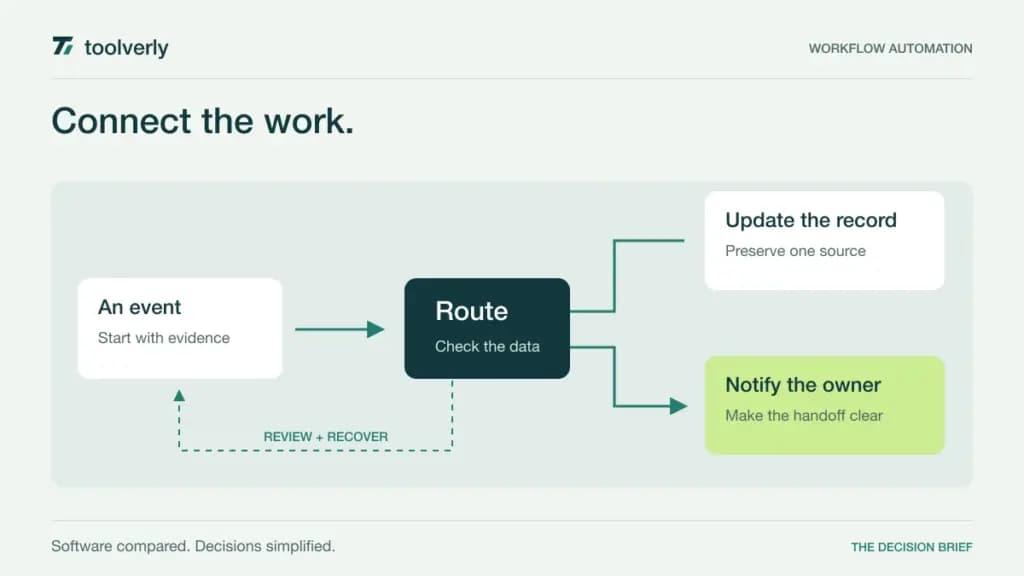
A new customer signs a proposal, and somebody copies the details into a CRM, creates a project, tells the delivery team, and updates a spreadsheet. Each step is small. The repeated handoffs are where information gets lost, records diverge, and nobody knows which action failed.
Workflow automation platforms connect those events and actions. The important buying decision is who will build, maintain, and repair the workflow. A nontechnical operations team needs a different editing experience from a developer responsible for custom APIs or an IT team automating desktop applications.
We compared Zapier, Make, n8n, Microsoft Power Automate, and Pipedream using official sources checked on September 22, 2026. This is an assessment of documented capabilities and operating models, not a hands-on reliability benchmark. Usage units differ substantially between vendors, so a thousand tasks, credits, and executions should never be treated as interchangeable.
Identify the work and the person responsible for it
Describe the trigger, the systems involved, and the result that counts as success. Then write down the exceptions: missing information, an expired connection, a duplicate event, or a destination that is temporarily unavailable. These conditions often decide whether a platform is practical for your team.
Draw a boundary between the system holding the authoritative record and the systems receiving copies. If two applications can update the same customer field, decide which change wins. Choosing the connector before deciding ownership can simply make conflicting updates happen faster.
Five automation platforms compared
| Product | Best fit | Main strength | Main tradeoff |
|---|---|---|---|
| Zapier | Operations teams connecting everyday apps | Broad connectors and accessible workflows | Task usage grows with the actions performed |
| Make | Teams working with branching visual processes | Scenarios with routers, filters, and data mapping | Complex scenarios and credit use need inspection |
| n8n | Technical teams wanting deployment choices | Code, integrations, and cloud or self-hosting | Self-hosting creates an operational responsibility |
| Microsoft Power Automate | Microsoft-centered business and desktop workflows | Cloud flows and desktop automation | Licensing differs by user and unattended process |
| Pipedream | Developers joining APIs and custom logic | Hosted workflows mixing actions and code | Compute usage and code maintenance remain relevant |
Zapier
Zapier is a sensible starting point for an operations team connecting common business applications. Its platform combines app-triggered workflows with supporting tools such as forms and tables. The appeal is assembling a useful process without first building and hosting an integration service.
Our assessment is that the fit is strongest when the required trigger and action already exist for the apps involved. Test the exact action, including the fields it exposes. An app appearing in a directory does not guarantee that its connector supports every operation you need.
The main tradeoff is consumption and packaging. Multi-step workflows, premium apps, and webhooks are associated with paid plans. Account for the work performed across a full business process rather than counting only its incoming events.
Pricing context: The Free plan lists 100 tasks per month and two-step Zaps. Paid plans use task tiers; the current page also links to updated usage rates for AI and code. Zapier plans and task usage.
Make
Make represents automation as visual scenarios. Routers and filters let a builder separate paths, while modules pass information between applications. It is worth considering when a process has several branches that an operations specialist wants to inspect together.
Our view is that the visual approach helps most when the team names steps clearly and keeps the diagram understandable. A scenario handling different order types, for example, should make the destination of each type obvious to a second maintainer.
The tradeoff is that a visible diagram can still contain complicated data transformations and usage patterns. Review what happens when one event produces multiple records, and check the credits consumed by the chosen modules rather than estimating cost from the number of scenarios.
Pricing context: Free includes 1,000 credits per month and a 15-minute minimum scheduled interval. Paid plans increase allowances and scheduling options. The pricing page explains module-based credit consumption and directs readers to additional usage details. Make pricing and credits.
n8n
n8n combines an integration editor with technical tools such as code steps, webhooks, and custom API requests. It offers managed cloud plans and self-hosted options, making deployment responsibility part of the purchasing decision.
Our assessment is that n8n suits teams that want visual workflow authoring while retaining technical control over unusual integrations. A developer should evaluate how custom logic is reviewed and how another person will diagnose a failed execution.
Self-hosting is a practical commitment: someone must operate the service, protect credentials, maintain backups, and handle upgrades. The Community Edition and commercial editions also differ in included capabilities. Hosting it yourself does not automatically provide every collaboration or governance feature.
Pricing context: Cloud Starter is listed at €20 per month billed annually for 2,500 workflow executions with unlimited steps. Pro starts at €50 on that basis for 10,000 executions. Check concurrency, history, and sharing requirements alongside execution volume. n8n plans and deployment options.
Microsoft Power Automate
Power Automate deserves consideration when the workflow includes Microsoft business applications or desktop tasks. Its product model distinguishes cloud flows from robotic process automation that interacts with desktop applications.
That distinction makes it different from buying only an app-to-app connector service. A process involving a legacy desktop application may need a machine, an execution identity, and a clear rule about whether a person is present while it runs.
Our recommendation is to evaluate licensing and operations together. Attended desktop automation, unattended execution, premium connectors, and a Microsoft-hosted machine are different entitlements. An existing Microsoft subscription should not be assumed to cover the entire proposed workflow.
Pricing context: The US page lists Premium at US$15 per user per month, paid yearly. Process is US$150 per bot per month for unattended automation; Hosted Process is US$215 and includes a hosted virtual machine. Validate the licensing scenario before comparing totals. Power Automate pricing and entitlements.
Pipedream
Pipedream is relevant when a developer wants to combine prebuilt actions with custom code on hosted infrastructure. Its workflow documentation describes event triggers followed by actions or code in languages including Node.js and Python.
The strength is the ability to handle an integration that needs a small amount of logic without building a separate service for every task. Our assessment is that this fits technical teams comfortable reading execution logs and maintaining the code they introduce.
The tradeoff is that hosted execution does not remove software ownership. Dependencies, unexpected inputs, and upstream API changes still need attention. Also distinguish Workflows from Pipedream Connect, which has separate considerations for embedding integrations into your own application.
Pricing context: Workflows use compute-based credits, with consumption affected by execution time, memory, and workflow segments. Free accounts have a daily credit limit. Use the documented meter to estimate a representative workflow. Pipedream workflow overview; pricing and credit documentation.
Compare cost using the same business outcome
Take one process, such as turning an approved inquiry into a customer record, a project, and a notification. Estimate how often it runs, how many destination actions it needs, and how often it branches. Then map that same process to each vendor’s meter.
Keep the assumptions visible. An example with 1,000 incoming requests and three downstream actions is a workload description, not a promise of 3,000 billable units everywhere. Vendor definitions, special actions, retries, and compute duration can change the calculation.
Include maintenance time. A platform that saves a little on subscription fees but requires a specialist for every change can be the wrong fit for a small operations team. Conversely, a developer may prefer paying for hosted execution over maintaining custom infrastructure.
Use failures as part of the trial
Start with test records and deliberately send the same event twice. Confirm that the result is understandable and that a duplicate customer or project is not silently created. Next, remove a required field and make a destination temporarily unavailable. Ask the future maintainer to find and explain the failed run.
Evaluate recovery before expanding the workflow. A successful retry should complete missing work without repeating an action that already succeeded. This matters particularly when a step sends a customer message or creates something people must later reconcile.
- Assign a primary maintainer and a backup.
- Record which account owns each connection.
- Set an agreed budget and notification threshold.
- Explain how to pause the process and handle pending work.
Choose for the person who will maintain it
Our starting shortlist is Zapier for everyday business connections, Make for visual branching, n8n for technical control and deployment choice, Power Automate for Microsoft and desktop scenarios, and Pipedream for developer-led integrations. The strongest choice is the one your team can understand when the happy path stops working, at a cost tied to the actual business process.
Original illustration by Toolverly. Read about our publication or send a correction.
Choose the systems around the automation
Before connecting customer data, decide which CRM will hold the authoritative customer record. Store the owner, exception handling, and recovery procedure in a maintained team wiki so the next person can understand the process without reconstructing the original build.