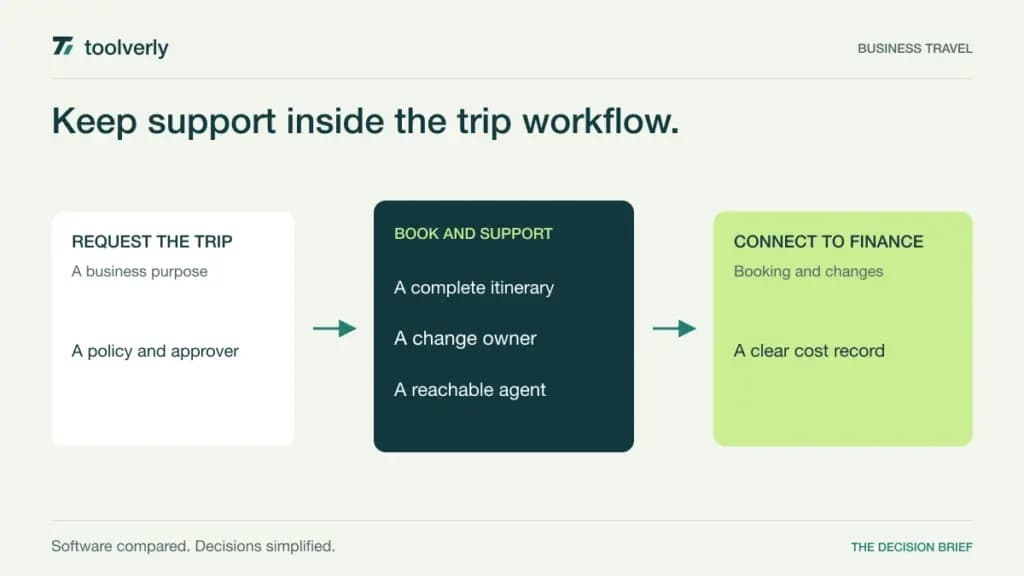
The cost of a business trip includes the work around it. An employee searches for a suitable flight, a manager approves an exception, and someone needs to help when the return journey changes. A useful travel platform connects those decisions with the booking and finance record, while making support responsibilities clear before anyone departs.
Perk, Navan, TravelBank, SAP Concur Travel, and Amex GBT Egencia represent five ways to organize that program. This comparison focuses on booking, policy, approvals, servicing and the accounting handoff. It does not compare holiday websites or promise that a platform will always find the cheapest fare.
Official sources were checked on October 8, 2026. Product descriptions and commercial terms below are documented information, with editorial judgments about fit; no bookings or support tests were performed. Expense submission is an adjacent workflow covered in our expense management comparison. The approval roles can also be clarified with your business process map.
Five business travel programs compared
| Product | Best fit | Main strength | Meaningful tradeoff |
|---|---|---|---|
| Perk | Teams choosing travel and spend modules | Policy tiers with explicit booking-fee structure | Travel-only and combined offers use different units |
| Navan | Eligible smaller firms and larger programs | Booking, approvals and traveler support | Expense users and enterprise scope change cost |
| TravelBank | Teams connecting travel with finance | Booking controls and round-the-clock agents | Current pricing requires a scoped conversation |
| SAP Concur Travel | Organizations with a structured travel ecosystem | Centralized booking and policy visibility | Agency, implementation and product scope need definition |
| Amex GBT Egencia | Teams wanting a managed travel program | Booking, servicing and expense-provider connections | Availability and service terms vary by program |
Perk
Perk, the current brand used by the former TravelPerk business, separates Travel from combined Travel and Spend offers. The distinction matters because a booking program and an expense-user subscription are different purchases. Its travel tiers provide policy and approval controls, reporting and increasing support for organizational complexity.
The checked USD Travel-only display lists Starter with no platform fee and a 5% booking fee, Premium at USD99 per month plus 3% per booking, and Pro at USD299 per month plus 3% per booking. The displayed booking fee has a USD2 minimum and USD30 maximum per booking. Currency and contract scope must be confirmed; the combined offer uses active expense users and should not be substituted into a Travel-only comparison.
Best fit: teams wanting to select travel scope before combining it with spend management. Limitation: policy counts, entities and reporting entitlements differ. Compare a realistic month with short trips and expensive trips so the fee minimum and cap are visible. Ask which changes, optional services and support events sit outside the displayed booking charge. Perk’s Travel and combined pricing.
Navan
Navan’s Business offer combines travel inventory, policy and approval workflows, self-service changes, traveler support and reporting. The official page describes free Travel access for companies with up to 300 employees, with no trip-count limit for that eligible population. Flights, hotels, cars and trains are part of the stated booking scope.
The free description does not mean the trip itself is free. Supplier fares, accommodation and applicable travel costs remain purchases. Expense access is a separate boundary: the first five monthly expensing users are free, followed by USD15 per user per month. The page defines an active expense user by submitting a transaction. Larger organizations are directed to an enterprise quote with implementation, program coverage and service requirements.
Best fit: eligible smaller businesses wanting booking controls without a Travel platform subscription, or larger teams evaluating an integrated program. Limitation: eligibility and expense activity must be modeled correctly. Ask the travel lead and finance administrator to distinguish travelers from expensing users in the proposed contract. Rehearse an out-of-policy selection and a changed itinerary, then identify who owns the record after a support agent becomes involved. Navan pricing and eligibility FAQ.
TravelBank
TravelBank brings travel management into a wider travel-and-expense operation. Its current official material describes flight, hotel and car booking with custom budgets and approvals, alongside agent support available around the clock. That combination can suit a finance team that wants a controlled booking process and a clearer handoff into spend records.
Its public pricing route now leads to a demonstration page with Travel, Expense and All-In-One options. It does not establish a current numerical subscription rate. Older per-user amounts should therefore not be treated as today’s offer. Obtain a scoped quote covering the chosen products, booking and service fees, implementation and any card or reporting requirements.
Best fit: teams that want travel decisions connected to finance administration. Limitation: commercial comparison requires a defined package rather than a historical headline rate. Ask for a demonstration of approval responsibility, a traveler change and the resulting finance record. Confirm what the support team can do without another internal approval. The vendor’s published customer savings are not forecasts for your trip mix, and should not replace a cost model using your own booking patterns. TravelBank’s current package and demonstration route.
SAP Concur Travel
SAP Concur Travel is an online booking platform within a broader travel-and-expense ecosystem. The current product page describes centralized flight, hotel, rail and rental-car booking, policy checks during selection, approvals, spending visibility and support for regional or global programs. That scope is relevant when travel is an established function with defined policies and partner relationships.
The purchase needs a system-level view. Concur Travel, Concur Expense, request management, agency services and third-party integrations should not be assumed to be one interchangeable subscription. Ask how the proposed booking implementation connects to your travel management company and which party owns fare changes or traveler assistance.
Pricing is by quote; the reviewed Travel page does not publish a universal per-traveler amount. Best fit: organizations needing centralized policy and a structured travel ecosystem. Limitation: product breadth and partner dependencies can increase implementation decisions. Use a real multi-entity trip example to inspect policy selection, approval routing and cost coding. Confirm market coverage and the selected configuration before relying on a feature shown in a global product demonstration. Concur Travel capabilities and quote route.
Amex GBT Egencia
Egencia combines booking, traveler servicing and a managed travel program under Amex GBT. Its current overview describes surfacing in-policy choices, flagging exceptions for approval, mobile bookings and approvals, reporting, and connections to expense providers. It also identifies global round-the-clock support through chat, phone and in-app messaging.
The expense-provider relationship deserves attention. Egencia’s current material describes Concur Expense integration, while also distinguishing Egencia from Amex GBT Complete. This means Concur Travel and Egencia are different program choices, even though a travel and expense ecosystem can contain commercial connections between them. Compare the proposed workflow and service ownership, not an assumed requirement to use an entirely independent stack.
Obtain pricing for the actual Egencia program, regions, servicing requirements and implementation; the reviewed overview does not establish a universal public seat rate. Best fit: teams wanting booking software backed by a managed travel service. Limitation: market availability and premium service levels require confirmation. Ask which itinerary changes travelers can complete themselves, which need an agent, and how approvals and finance records are preserved. Egencia’s current features and service guidance.
Evaluate a changed trip as well as a booking
Select a representative itinerary with the routes, hotels and traveler locations your business actually uses. Define the cabin, advance-booking and accommodation policy before looking at recommendations. Ask each candidate to distinguish an acceptable choice, a permitted exception and a choice that needs further approval. Compare the complete fare conditions and included services.
Then introduce a disruption as a demonstration scenario without buying a ticket. The important questions are who can change the trip, whether the traveler can reach support, which approval still applies and what the change costs. Ask how unused tickets, refunds and credits remain visible to the program owner. Make sure the finance handoff preserves the original booking and the later adjustment.
- Map traveler countries, billing entities and required inventory.
- Specify approvers and backup approvers for exceptions.
- Separate platform, booking, servicing and supplier charges.
- Confirm support channels and service scope in writing.
- Identify the expense and accounting system’s responsibilities.
Shortlist Perk for explicit modular scope, Navan for its eligible Business offer, TravelBank for a finance-connected operation, Concur Travel for a structured ecosystem, or Egencia for a managed program. The stronger choice keeps the traveler supported and the business record understandable when the itinerary changes.
Original illustration by Toolverly. Read about our publication or send a correction.