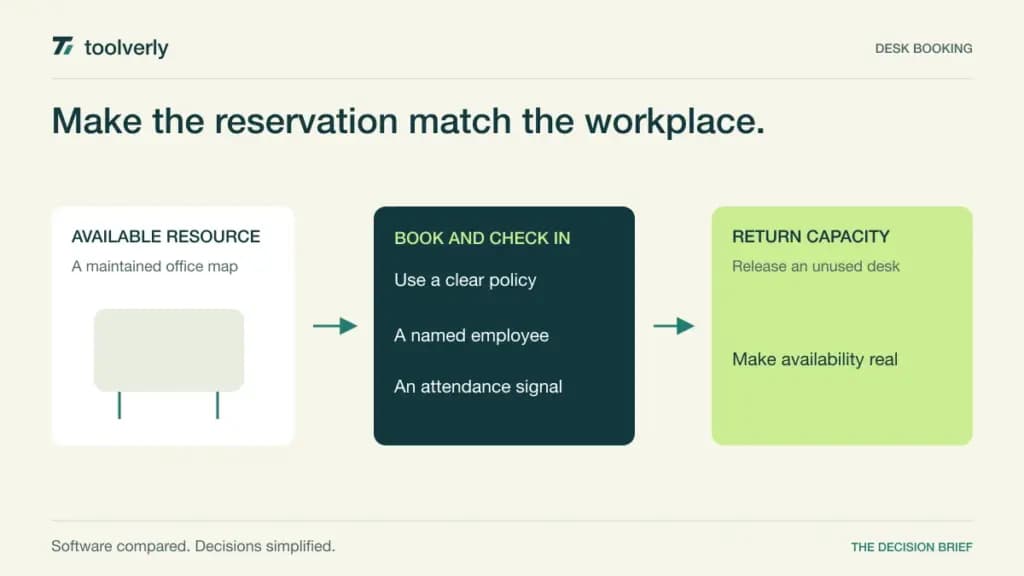
A hybrid office has two different capacity problems: finding a usable seat on a busy morning, and understanding why booked seats remain empty. Desk booking software connects a physical resource, an employee, a time window, and an attendance signal. A shared calendar can record a reservation, but it rarely explains equipment needs, neighborhood restrictions, or the policy for releasing an unused desk.
This comparison considers Skedda, Robin, Envoy Reservations, deskbird, and OfficeRnD Workplace. The decision is employee workspace allocation, rather than the guest arrival workflow covered in our visitor management comparison. Room resources also need a calendar integration; the meeting itself still depends on a video meeting platform.
Official product and pricing pages were checked on October 6, 2026. This is a documentation-based comparison, without claimed hands-on performance results. Pricing units differ substantially: spaces, active users, bookable resources, and configured workplace contracts should not be compared as interchangeable subscriptions.
Five desk booking options at a glance
| Product | Best fit | Main strength | Meaningful tradeoff | Pricing reference |
|---|---|---|---|---|
| Skedda | Policy-driven space allocation | Maps and booking rules | Regional packages and space allowances differ | Regional space-based plans |
| Robin | Larger workplace operations | Resources, neighborhoods, and planning together | Broad annual platform commitment | Configured annual quote |
| Envoy Reservations | Teams combining workplace modules | Desks, rooms, and parking in one reservation layer | Platform fee is additional | $5/resource/month, annual billing, plus platform |
| deskbird | Employee-oriented hybrid scheduling | Bookings and colleague coordination | Identity and room capabilities can require add-ons | Active-user plans; higher tiers quoted |
| OfficeRnD Workplace | Resource-based workplace management | Dedicated and shared resources with policies | Rooms and other resources have separate pricing treatment | Minimum commitments and resource rates |
Skedda
Skedda puts an interactive floor plan and a rules engine at the center of booking. Its desk product describes check-in through QR codes, email confirmation, or Wi-Fi detection, with unused reservations released for other people. The useful question is which attendance method matches the actual office environment. A reservation made the night before and a verified arrival should remain distinct operational signals.
Its strength is allocating scarce spaces under explicit policies. A facilities team can evaluate booking conditions, quotas, lead times, and departmental permissions instead of relying on informal messages. It suits offices where seats have different equipment or access conditions and administrators need a repeatable explanation for why a booking is allowed.
The limitation is package scope. The current pricing page separates US/Canada from EMEA/APAC. US/Canada Plus starts at $249/month with 35 spaces; Premier starts at $349/month with 45 spaces and annual billing. EMEA/APAC Starter starts at $99/month with 15 spaces, billed annually. Confirm the applicable region, additional-space price, rules tier, and attendance functionality in the quote. A published starting price does not establish the complete cost of your floor plan.
Robin
Robin combines desk, room, parking, and locker reservations with space management. Its official platform list includes shared assigned desks, automatic booking, priority booking, office neighborhoods, and booking policies. This makes it relevant when the workplace team wants to coordinate where people sit alongside moves and changing office layouts.
The main advantage is breadth around the resource decision. A desk reservation can sit inside a larger operating model with calendar synchronization, workplace usage reporting, and team coordination. Robin’s own pricing page positions the platform for companies with 500 or more employees and a substantial regular office population. That positioning is a useful shortlist signal rather than a universal eligibility rule.
The tradeoff is evaluating a whole platform when the immediate problem might be one floor of hot desks. Pricing is tailored through sales, subscriptions are billed annually, and hardware is sold separately. The page marks its analytics AI assistant and custom reports as optional add-ons. Ask for an itemized scope covering locations, attendance inputs, reporting, implementation, and hardware dependencies before comparing Robin with a smaller self-service option.
Envoy Reservations
Envoy’s current Reservations module handles desks, rooms, and parking. The pricing page lists hot desking, desk hoteling, permanently assigned desks, hourly and multi-day scheduling, mobile bookings, map availability, and automatic release after missed check-ins. Desk amenities provide context beyond a seat number, which matters when employees need a monitor, accessible location, or a particular work area.
Its strength is a coherent reservation module inside a broader workplace platform. Companies already considering Envoy’s other modules can inspect shared administration and identity rather than building separate employee directories. For selection, demonstrate one employee reserving a desk and another finding the space after a missed check-in releases it.
The current public rate is $5 per bookable resource per month, billed annually. It explicitly excludes the platform fee: every Envoy plan starts with the platform. Therefore, multiplying desks by $5 is only a module estimate. Ask which rooms and parking spaces count, how the platform fee is determined, and whether displays or other modules add cost. Visitor licensing should not be assumed to follow from employee reservations.
deskbird
deskbird emphasizes the employee experience around booking and hybrid schedules. Business includes desk, room, and parking reservations, mobile apps, check-ins, automatic releases, and Microsoft Teams integration. Colleague discovery and scheduling can help employees choose a useful office day, provided the organization has sensible visibility and privacy settings.
Its advantage is bringing workspace availability closer to the tools employees already use. It suits teams whose adoption problem is remembering a separate booking portal. Test the path from a colleague’s planned attendance to a compatible desk booking, including cancellations and changes, rather than judging only the appearance of the map.
Pricing is per active user per month, with currency and annual/monthly selectors. Higher Professional and Enterprise tiers use custom pricing. The page separates advanced booking rules, analytics, and workplace ticketing from basic booking, and lists User & Data Management Plus and Rooms Plus add-ons. Confirm the definition of an active user, selected billing term, identity provisioning, and display/service-request requirements. This comparison does not treat every feature listed anywhere on the page as part of Business.
OfficeRnD Workplace
OfficeRnD Workplace supports desk and room bookings, dedicated desks, an office map, team neighborhoods, and colleague seating visibility. Its resource documentation distinguishes hot desks from assigned desks and private office resources. That structure is useful when one workplace mixes permanent allocations with seats employees reserve for particular days.
Start includes basic bookings and utilization analytics; Professional adds advanced booking policies, provisioning, QR check-ins, and multi-location capabilities. This suits an operator who wants resource administration to remain visible as the office grows. Evaluate how a permanently assigned resource becomes available, who can change its status, and whether the published floor plan remains accurate.
Pricing uses bookable resources and meeting rooms with minimum commitments. The official page supports monthly and annual prepayment and separates room charges from other resources. Our regional browser showed Start from €99/month and Professional from €399/month; the official extracted USD version showed corresponding $99 and $399 starting amounts. These are regional starting displays, not currency conversions or complete quotes. Confirm term, resource totals, user limits, SSO tier, and Visitor Hub add-on costs.
Choose around the actual reservation policy
Start with a resource register: number each desk, record amenities, identify permanently assigned seats, and name the owner of floor-plan changes. Then write a short policy covering booking windows, neighborhood access, cancellations, and late arrival. Software selection becomes clearer when vendors demonstrate the same policy rather than their preferred showcase.
Compare three scenarios: a busy team day, a no-show, and an employee changing locations. Require the administrator to explain the audit trail and the employee to find the correct seat. For utilization decisions, separate reservation counts from verified presence; neither alone describes why people chose a particular workspace.
Skedda merits attention for rules around spaces; Robin for broader workplace planning; Envoy for modular reservations; deskbird for employee coordination; and OfficeRnD for mixed resource administration. Choose the smallest contracted scope that handles your real exceptions. Assign an ongoing floor-plan owner before rollout, because an accurate map is a maintained operational record.
Official sources
- Skedda pricing and desk booking
- Robin platform and annual pricing
- Envoy Reservations and platform pricing
- deskbird packages
- OfficeRnD Workplace pricing and resource definitions
Original illustration by Toolverly. Read about our publication or send a correction.