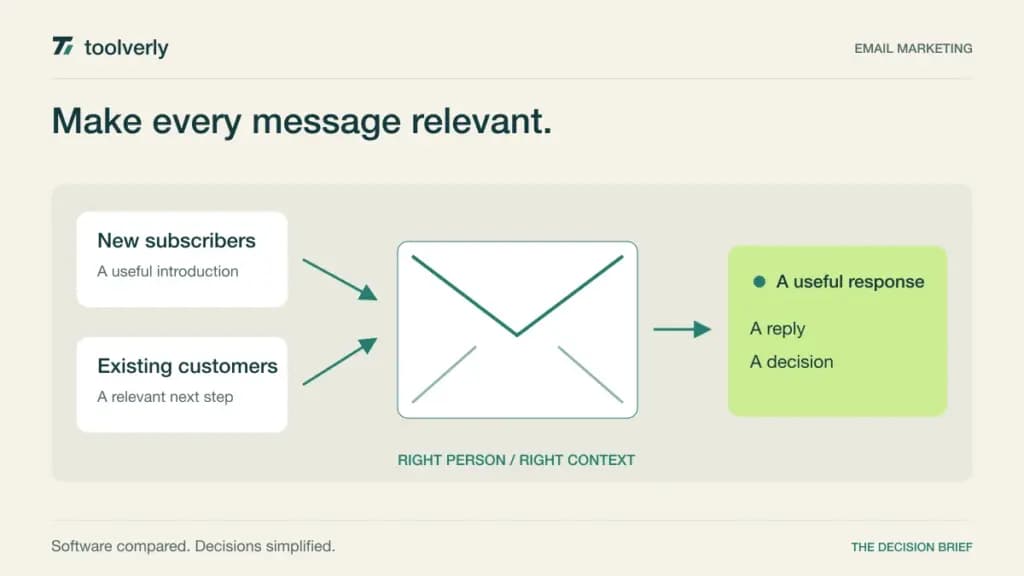
A growing mailing list creates two different problems: sending the next campaign and deciding which message each subscriber should receive. A newsletter publisher might mainly need a dependable writing and sending routine. A service business may need a welcome series, a product announcement, and follow-up that stops when somebody becomes a customer.
The right email platform makes those choices manageable at your current size. Buying elaborate automation before you have useful audience data can create more maintenance than value. Choosing only by the entry price can be equally misleading when the bill changes with contacts, sending volume, or required features.
We reviewed Mailchimp, Brevo, Kit, MailerLite, and ActiveCampaign using official sources checked on September 22, 2026. This is a comparison of documented capabilities and our assessment of fit, not a deliverability benchmark or a claim of hands-on testing. Pricing calculators vary by region, audience size, billing period, and plan; confirm those inputs before purchase.
Compare the campaign you need to run
Describe one ordinary newsletter and one automated journey. For the journey, write down what starts it, which information determines the next message, and what should stop it. A purchase, an unsubscribe, or a reply requiring human attention may all need different handling.
Then count both people and messages. A list of 5,000 subscribers receiving four broadcasts produces 20,000 sends before welcome emails or other sequences. This is a budgeting example, not a quoted allowance from any vendor. It makes the difference between contact-based and volume-based pricing easier to evaluate.
Five email platforms compared
| Product | Best fit | Main strength | Main tradeoff |
|---|---|---|---|
| Mailchimp | Teams combining campaigns and audience marketing | Campaign tools, integrations, and reporting | Contact and sending allowances both affect the purchase |
| Brevo | Businesses comparing email with other messaging channels | Campaign and transactional messaging options | Sending tiers also have contact-storage boundaries |
| Kit | Creators building a subscriber business | Forms, sequences, and creator commerce | Advanced automation requires paid packaging |
| MailerLite | A focused newsletter and signup workflow | Email, forms, landing pages, and automation | Free-plan and automation limits require attention |
| ActiveCampaign | Teams with several lifecycle journeys | Segmentation and marketing automation | Complex journeys need both data and ongoing maintenance |
Mailchimp
Mailchimp combines email campaigns with audience tools, integrations, and reporting. It is a relevant candidate when a marketing team wants to manage campaign creation and customer targeting in one established platform.
Our assessment is that it is most useful when the business has a defined campaign calendar and knows which systems must supply customer information. The integration list is a starting point; test the particular fields and events you need from your store, forms, or CRM.
The main purchasing caution is the relationship between contacts, monthly sends, and feature level. A promotion or trial can make the starting offer look different from the ongoing arrangement. Build the comparison around the audience and campaign frequency you expect to maintain.
Pricing context: Mailchimp lists Free, Essentials, Standard, and Premium options, with prices and sending allowances tied to the selected configuration. The reviewed page displayed regional pricing, so we have not substituted a dollar amount from an older comparison. Mailchimp marketing plans.
Brevo
Brevo brings email campaigns, transactional messaging, and other channels into one platform. That makes it worth considering for a business evaluating how marketing messages and operational communications will coexist, while keeping their purposes and audiences clear.
The pricing model needs a careful read. Choosing a sending-volume tier can also determine how many contacts the account may store. The current documentation gives the lower Starter tiers specific contact limits, so an assumption of unlimited contacts at every paid level would be misleading.
Our recommendation is to model a busy campaign day as well as the monthly total. The Free plan includes 300 email sends per day, and unused daily sends do not accumulate. That limit can matter more than the headline size of a stored list.
Pricing context: The official guide lists Starter from US$9 per month and Standard from US$18, with optional extras billed separately. Check the selected volume and contact tier together. Brevo plan and billing guide.
Kit
Kit is a natural candidate for creators whose email audience is central to the business. Its offering includes signup forms, landing pages, broadcasts, sequences, and tools for selling digital products or subscriptions.
Our assessment is that a writer, educator, or independent creator should evaluate Kit through one subscriber journey: joining through a specific form, receiving an appropriate introduction, and reaching the relevant product or newsletter. This is a more meaningful trial than simply designing a single broadcast.
Plan boundaries matter when the audience develops several interests. The paid Creator plan includes unlimited visual automations and email sequences. Check the exact Free-plan conditions, recommendation settings, branding, and commerce terms before treating a large subscriber allowance as a complete paid-business setup.
Pricing context: Kit currently advertises a Free plan for up to 10,000 subscribers. Paid Creator and Pro pricing varies with subscriber count and billing period. Evaluate the audience size you expect after growth, not only the starting slider position. Kit pricing and features.
MailerLite
MailerLite combines newsletters with signup forms, landing pages, and a visual automation builder. It deserves consideration when a small team wants one manageable place to collect subscribers and maintain a regular publishing routine.
The current public pricing page uses Free, Comfort, Power, and Enterprise packaging. Comfort lists features including up to 50 active automations and three user seats; Power expands limits and offers unlimited monthly emails. Those names and limits should be checked directly rather than taken from older plan comparisons.
Our assessment is that the central trial should be editorial: can one person draft a message and another review it without duplicating work? Then test the form and welcome sequence as a complete path.
Pricing context: Free currently includes up to 250 subscribers, 2,500 monthly emails, and three automations. Paid pricing depends on the selected configuration; higher tiers change sending, collaboration, and automation allowances. MailerLite current plans and limits.
ActiveCampaign
ActiveCampaign is worth shortlisting when the business has several meaningful customer journeys to coordinate. Its plans combine email marketing, segmentation, and automation, with more advanced targeting and reporting in higher editions.
Our view is that this is strongest when the team can already identify useful events: a requested demo, a completed purchase, an abandoned onboarding step, or a renewal approaching. Without dependable event data, a complex journey can confidently send the wrong message.
Review the plan against the actual journey. The current Starter package lists five actions per automation, while higher plans expand automation capability. User counts and integration levels also vary, so a solo trial may not reveal the cost of the working team.
Pricing context: Starter, Plus, Pro, and Enterprise use configurable pricing based on contacts and package selection. Obtain the price with your audience, channels, and required seats selected, and account for any optional products. ActiveCampaign pricing and feature matrix.
Make the trial reveal targeting mistakes
Use test subscribers with different characteristics. Include somebody who has already bought, somebody interested in a different product, and somebody who unsubscribes halfway through the journey. Write down what each person should receive before building the automation. This gives the trial a clear expected result.
Inspect the message on a phone, including the sender name, subject, links, and plain-text version where available. A beautiful desktop template can still be awkward to read when the main action is buried below several screens of content.
Ask how the team will measure a useful outcome. Replies, qualified inquiries, and completed purchases may tell you more than a large engagement percentage with no business context. Define the event you care about and confirm that the required information reaches the reporting view.
Plan the migration separately from the first campaign. Preserve subscription preferences, suppression information, and useful segmentation. A contact export that loses those distinctions is not a complete migration. Keep an example export and document which fields another system would need to interpret it.
- Budget for ordinary sends and a high-volume launch month.
- Confirm who can approve, schedule, and edit automations.
- Test the stopping conditions for every automated journey.
- Name an owner who will review old campaigns and segments.
Choose the workflow you can keep useful
Our starting shortlist is Mailchimp for broad campaign operations, Brevo for evaluating several messaging needs, Kit for a creator-led audience business, MailerLite for focused newsletter publishing, and ActiveCampaign for more developed lifecycle journeys. Choose the platform that fits the information you actually have and the campaigns your team can maintain. Additional automation becomes valuable when it improves relevance, not simply when it produces more messages.
Original illustration by Toolverly. Read about our publication or send a correction.
Plan the handoff beyond email
A qualified reply may belong in a CRM follow-up process. When information must move between the mailing platform and other applications, compare automation tools against the exact fields and subscription preferences the connection needs to preserve.