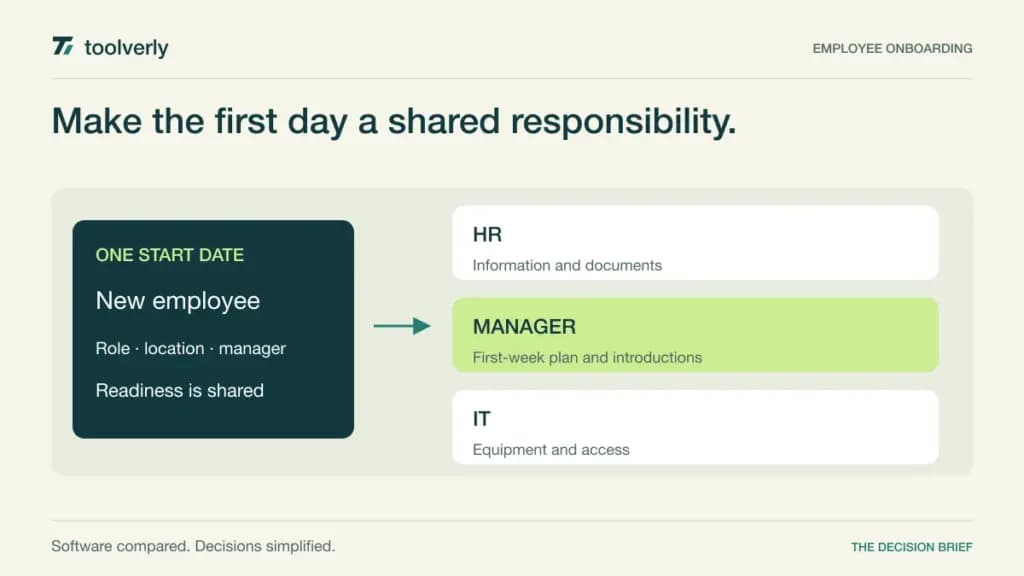
The offer is accepted, but the employee is not ready to start. HR needs information, the manager needs a first-week plan, and IT needs enough notice to arrange equipment and access. Employee onboarding software coordinates those responsibilities around one person and one start date.
This guide compares BambooHR, HiBob, Rippling, Personio, and Deel for the period between an accepted hire and a productive first few weeks. These are broader people platforms with onboarding capabilities, so the buying question is which platform should own the new employee record and the handoffs around it. Our guide to applicant tracking software addresses the preceding hiring process; IT asset management software covers the equipment record that continues after onboarding.
Research basis: Official product and pricing pages checked on October 3, 2026. We have not performed hands-on implementation tests. Published employee-month prices are reference points, not a complete onboarding project budget. Confirm minimums, contract terms, regional availability, selected modules, and implementation in the final proposal.
Compare the owner of the onboarding workflow
| Platform | Likely fit | Verified commercial reference | Question to resolve |
|---|---|---|---|
| BambooHR | HR teams consolidating employee data and checklists | Core listed at US$10/employee/month; confirm contract terms | Which connected services are separate add-ons? |
| HiBob | Role- and location-based employee workflows | Configured quote by company needs and modules | Who maintains exceptions and regional variations? |
| Rippling | Onboarding that crosses HR, IT, and connected systems | Configured platform and product quote | Which products and connections support each action? |
| Personio | Teams needing shared checklists and progress visibility | Core and Core Pro quoted; no fixed public amount | Which package covers the complete workflow? |
| Deel | Global workforce records and connected handoffs | HR Core listed at US$5/employee/month; confirm terms | Which HR, employment, payroll, and IT services are included? |
BambooHR
BambooHR brings employee records together with hiring and onboarding tools. Its current pricing page lists Core at US$10 per employee per month, Pro at US$17, and Elite at US$25. Onboarding checklists, new-hire packets, and electronic signatures appear in the product comparison, while services such as payroll and time tracking have separate add-on discussions.
Strengths: A centralized employee record is useful when HR currently re-enters information from forms into spreadsheets. Checklists can turn a remembered routine into a repeatable process with visible ownership. Evaluate whether the new hire can complete the necessary steps without navigating several unrelated systems.
Limitations: The employee-month figure does not settle minimum charges, implementation effort, or connected service costs. A checklist item saying “prepare laptop” also needs an accountable person and an external equipment process. Confirm what actually happens when that task is late.
Best fit: HR teams seeking a coherent record and a manageable onboarding routine. Demonstrate an ordinary office hire and someone starting remotely with a delayed document. Ask what HR sees, what the employee sees, and how the manager knows which steps remain incomplete. Review BambooHR’s current plans and onboarding feature comparison.
HiBob
HiBob’s Bob platform includes employee lifecycle workflows within Core. Its automation page describes onboarding triggered by lifecycle events, role- and location-based logic, cross-team task assignment, and tracking of completion and exceptions. It also describes document generation and signing within workflows. Pricing is tailored to company requirements and selected modules, without a fixed public rate.
Strengths: Role and location logic matters when the company has several genuine onboarding paths. A new manager, a remote specialist, and an office-based employee may need different tasks while sharing the same workforce record. Structured handoffs make it possible to examine that variation without creating a disconnected process for every department.
Limitations: Configurable workflows still need someone to keep them accurate. A change in office policy or a new department should have an owner, a review step, and a way to inspect existing hires. Ask which modules and integrations the proposed implementation requires.
Best fit: Organizations with several role or regional paths and a people operations owner. Show the vendor a start-date change after tasks have already been assigned. Check which deadlines update and how an unresolved exception stays visible. Consult Bob’s onboarding automation and HiBob’s pricing approach.
Rippling
Rippling’s workflow platform uses workforce attributes and connected business data to drive triggers and actions. Its current workflow page describes onboarding sequences, role and location context, and a review step before publishing workflow logic. Pricing is configured around the platform and selected products; there is no single public amount that prices the complete cross-department onboarding scenario.
Strengths: This approach is relevant when readiness depends on more than HR paperwork. The buyer can examine how employee information drives actions across the intended HR, IT, and other connected products. Reviewing the trigger and affected people before activation is especially relevant for a process that creates access or assigns equipment.
Limitations: Do not assume every action shown in a platform demo is included in the quoted product selection. Specify the required app connections, device-related services, workflow permissions, and administrative responsibilities. A connected process should also have a clear response when an external action fails.
Best fit: Teams willing to coordinate HR and IT around shared employee data. Bring a hire with a changed role or withdrawn start date, then inspect which downstream actions remain pending. Ask who can edit the logic and who receives the exception. Read Rippling’s workflow capabilities alongside its configured pricing process.
Personio
Personio’s onboarding page describes role-based templates and checklists, personalized messages, shared tasks for HR, IT, and managers, and a dashboard for progress. New employees can see their information and tasks in a central starting point. Core and Core Pro have configured pricing; the published page does not provide a fixed monthly amount.
Strengths: The shared checklist model makes ownership a practical part of the evaluation. Instead of asking whether the system can store a document, ask whether the right person knows that a document or equipment step is still missing. Templates can establish a consistent starting process while leaving room for genuine role differences.
Limitations: Package boundaries, active-user license counts, document allowances, and integration requirements need confirmation in the quote. A progress dashboard is only useful if the organization agrees what “complete” means. Completing an administrative task may not mean the employee has successfully used the resulting access.
Best fit: Teams prioritizing visible task coordination and a central employee record. During evaluation, reassign a manager’s task while keeping the employee’s start date unchanged. Check reminders, the ownership history, and the view available to HR. Compare Personio’s onboarding workflow with its current package details.
Deel
Deel’s HR platform links a worker profile with people operations and connected payroll or IT processes. Its pricing page’s Manage section lists HR Core at US$5 per employee per month, Advanced at US$19, and Elite at US$29. Those HR amounts are separate from the prices for employment, contractor management, payroll, or other services.
Strengths: Deel is relevant when the organization needs a coherent workforce record across different locations and worker arrangements. Its HR overview connects hiring to onboarding and describes handoffs to equipment and access processes. A buyer can use that connected model to examine what happens when one person’s details change.
Limitations: A broad platform should be purchased against a precise service list. The HR Core amount is not the price of employing a person through an employer-of-record service, nor proof that every IT action is included. Confirm the onboarding scope and contract terms for the selected worker populations.
Best fit: Teams managing a distributed workforce and seeking a shared record with explicit service boundaries. Demonstrate two relevant worker types and follow their information through the proposed onboarding process. Inspect what must be entered separately and who can correct it. Review Deel’s HR platform and the Manage tab of Deel’s current pricing.
Build the evaluation around readiness
Begin with the last three hires and identify every dependency before their first useful working day. Separate information collection, document completion, equipment, access, manager preparation, and introductions. Give each step an owner and a definition of completion. That becomes your evaluation script.
Test a normal hire, a moved start date, a missing document, and a manager who becomes unavailable. Check whether the system preserves the employee’s experience while making the exception visible to the responsible team. Also examine which data a new hire can access before starting and how that access changes later.
Normalize the commercial comparison around the same employee population and required products. Include implementation, integrations, administrator time, and the process for maintaining templates. Avoid buying an entire additional module solely because one attractive demo included it; establish the dependency first.
BambooHR fits a consolidated HR routine, HiBob offers lifecycle-based variation, Rippling deserves attention for cross-system actions, Personio emphasizes shared checklist coordination, and Deel suits a connected global workforce discussion. Choose the platform that makes an incomplete handoff understandable and assigns someone to resolve it.
Original illustration by Toolverly. Read about our publication or send a correction.