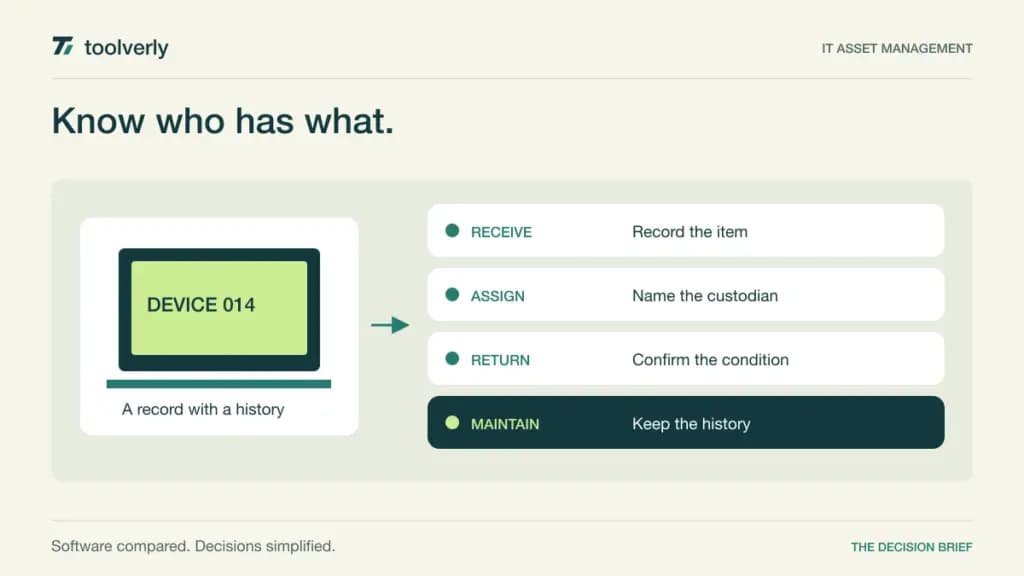
An equipment register becomes useful when it can answer a practical question: who has this laptop, what condition is it in, and what happens when it comes back? A purchase spreadsheet may record the original invoice while missing every handoff afterward. IT asset management software connects the item, its custodian, its location, and its history.
This comparison focuses on physical equipment custody and lifecycle work. Snipe-IT, AssetTiger, Reftab, Asset Panda, and Timly offer different routes from a labeled device to a reliable record. The buying decision is whether you need an economical register, connections to device-management systems, or configurable processes shared with facilities and operations.
We reviewed official product and pricing pages on September 27, 2026. Prices below use the vendors’ USD displays where available. This is a documentation-based comparison, not a hands-on benchmark. Subscription costs do not include the work of cleaning an existing register, attaching labels, and making people record equipment movements.
Compare the job each tool should own
Start with one complete lifecycle: receive a device, assign it, lend a replacement, arrange a repair, and retire the original. Decide which system owns each field. A device-management platform may know the operating system; your asset register should establish custody. Synchronizing both without field ownership can replace a correct human update with stale imported data.
| Product | Best fit | Main strength | Meaningful tradeoff |
|---|---|---|---|
| Snipe-IT | IT teams wanting control | Open-source custody register | Self-hosting adds operational responsibility |
| AssetTiger | Teams pricing by inventory size | Asset tiers with unlimited paid-plan users | Asset allowance determines the subscription |
| Reftab | IT teams connecting existing systems | Hardware workflows and integrations | Hardware and software licensing differ |
| Asset Panda | Organizations with custom processes | Configurable records and workflows | Quote and configuration work required |
| Timly | Mixed equipment operations | Custody, inventory, and service workflows | Starting rates need a scoped quote |
Snipe-IT
Snipe-IT suits an IT team that wants a clear equipment register and a choice of hosting arrangements. Its records connect assets with people and locations, retain checkout and maintenance history, and support custom fields. QR labels and barcode-reader compatibility help staff retrieve the correct record while handling a physical item.
The practical strength is a straightforward custody model. A laptop can move from stock to an employee and back without losing its history. Asset acceptance, auditing, and license-expiry alerts also make it useful beyond a list of serial numbers. These capabilities are described in the official Snipe-IT feature overview.
Snipe-IT pricing lists the self-hosted software as free, with unlimited users and assets. Basic managed hosting is $39.99 monthly or $399.99 for a year. Those are different payment choices, not the same monthly rate under an annual commitment.
The limitation is operational ownership. Free software still requires hosting, updates, backups, and someone accountable for recovery. Choose managed hosting if that work would distract the team. During evaluation, import a small equipment set and check whether the person receiving a device can understand the acceptance process without an administrator explaining every field.
AssetTiger
AssetTiger is a useful candidate when several departments need to update a modest inventory and charging for every participant would discourage adoption. Its paid plans include unlimited users; the subscription scales with the asset allowance instead. That model makes occasional participation by office managers or equipment custodians easier to budget.
The product combines barcode and QR tracking with mobile check-in and checkout, maintenance records, and contract tracking. The strength is bringing routine equipment handling into one register. It is a sensible fit for a team that wants staff to scan and update records rather than send an administrator a message after every move.
The current AssetTiger pricing page lists Basic at $20 per month or $220 per year for 500 assets. Core allows 2,500 assets at $40 monthly. Its trial lasts 30 days and supports 250 assets; that trial allowance should not be confused with an ongoing free plan.
The tradeoff is deciding what counts as a separately tracked asset. A laptop, dock, monitor, and loan kit can consume capacity differently depending on your record design. Before importing everything, agree which items need individual custody and which can be managed in groups. Test whether a department can complete an inventory check without exposing unnecessary employee information.
Reftab
Reftab deserves attention when the asset register needs to sit alongside an established IT stack. Its hardware offering includes integrations with systems such as Intune and Jamf, as well as assignment, reservations, audits, and maintenance workflows. This can reduce the distance between a device record and the person who is responsible for it.
Its strength is the connection between IT administration and everyday equipment lending. For example, an organization with shared laptops should evaluate both the integration that creates records and the checkout process used at the service desk. A successful integration is only half the job if returns still disappear into email.
Reftab’s current pricing displays Hardware Asset Management at $125 per month with unlimited users. The displayed card does not establish an unlimited asset allowance: confirm the inventory capacity and contract term in your quote. Software Asset Management is priced separately at $9 per tracked software user per year.
That separate licensing model is the main budgeting caution. Tracking the physical laptop and discovering its user’s software subscriptions are different commercial scopes. Ask which integrations belong to the hardware plan, which fields synchronize, and what happens when a user leaves. Reftab is a stronger fit when those connections solve a defined reconciliation problem, rather than merely adding more data.
Asset Panda
Asset Panda is worth considering when a standard IT register is too rigid for the organization. Its product overview describes configurable asset tracking, assignments, inspections, maintenance, and mobile barcode workflows. This flexibility is useful when equipment passes between IT, field teams, and facilities with different information requirements.
The benefit is the ability to shape the record around a real process. A returned laptop and a field instrument may need different inspection questions, statuses, and follow-up actions. Treat those differences as a design exercise: decide which fields genuinely change a decision and which only increase data-entry effort.
The official Asset Panda quote page does not publish a universal subscription amount. Pricing requires a scoped quote. Supply your asset count, participating users, workflows, and required integrations so that competing quotes describe comparable work.
Configuration is also the limitation. A flexible system can faithfully reproduce an unnecessarily complicated process. Require a demonstration using your receipt, assignment, repair, and retirement steps, including who may edit each stage. Asset Panda is a reasonable shortlist choice when those differences are important enough to justify deliberate setup and an owner who will maintain the configuration after launch.
Timly
Timly fits organizations whose equipment responsibility extends beyond employee computers. Its inventory approach covers assignment, return, transfer, stocktaking, and service-related work. The value is giving staff a common way to handle equipment even when different teams care about different parts of its history.
The Timly pricing page, viewed in USD, lists Essential+ from $229 per month with unlimited users. Professional starts at $569 per month and adds capabilities including a REST API and digital handover. Enterprise pricing is available on request. Other regional currency displays differ.
These are starting monthly rates; the page does not by itself establish a month-to-month contract or your final asset allowance. Ask for the billing commitment, equipment capacity, implementation scope, and any required add-ons in writing. Unlimited users should not be read as unlimited capacity across every other dimension.
The useful evaluation is a physical handoff: scan an item, transfer responsibility, flag damage, and find the record during a later stocktake. Timly becomes more compelling when that sequence crosses departmental boundaries. For a small IT team that only needs laptop assignments, compare the total implementation effort against a simpler register before paying for broader operational coverage.
Choose for reliable records after the first import
Snipe-IT is a natural starting point for control over the register and hosting. AssetTiger deserves a look when many people need access to a bounded inventory. Reftab fits integration-led IT administration, Asset Panda fits tailored processes, and Timly fits equipment workflows spanning multiple operating teams. These are fit judgments, not performance rankings.
Run a pilot with real exceptions: an unreturned loan, a missing label, a replacement device, and a departed employee. Measure whether staff can resolve each exception from the record, then export the data and confirm that custody history remains intelligible. Decide who checks stale assignments each month before expanding the rollout.
- Define the record owner, physical custodian, and source of each synchronized field.
- Quote the expected asset count and occasional users, not just today’s administrators.
- Confirm backups, exports, permission boundaries, and the process for correcting a mistaken handoff.
A device record should link to a support incident when repair work is needed; our helpdesk software comparison covers that separate case-management decision. Keep credentials out of equipment notes and use an appropriate business password manager for shared secrets. A useful asset register records accountability without becoming an uncontrolled repository for everything about an employee.
Original illustration by Toolverly. Read about our publication or send a correction.