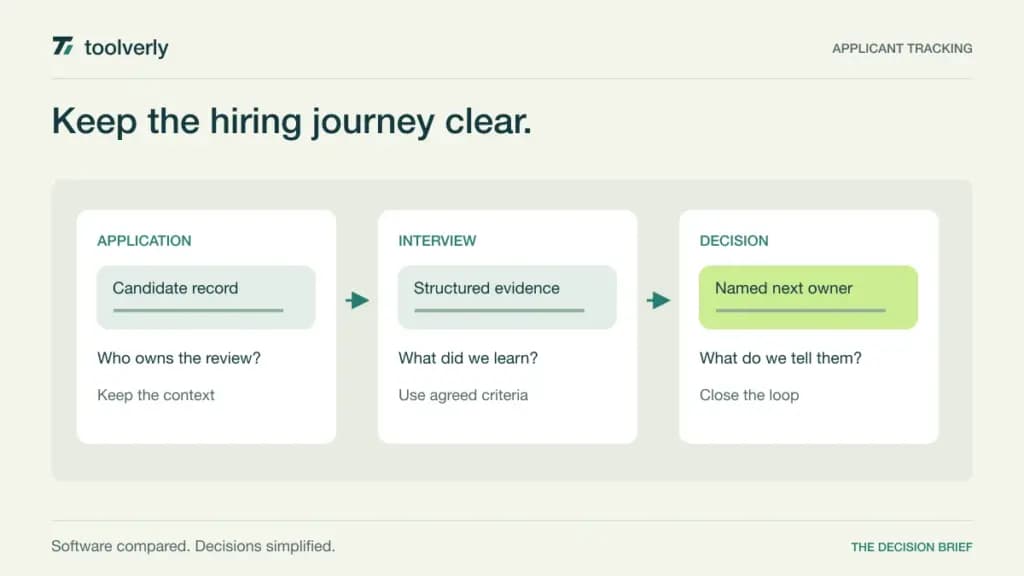
Hiring becomes difficult to coordinate before it becomes high volume. Applications arrive in several places, interview feedback sits in private messages, and nobody is certain who should contact the candidate next. An applicant tracking system should give each application a clear stage, a responsible person, and a record of the evidence behind the next decision.
Workable, Breezy HR, Tellent Recruitee, JazzHR, and Zoho Recruit offer different ways to organize that process. This comparison focuses on employers managing their own hiring, rather than agencies placing candidates for clients. Official product and pricing sources were checked on September 25, 2026. The recommendations are based on those sources and workflow analysis, not a hands-on hiring experiment. Dollar prices are USD; the Zoho example is explicitly in euros.
Describe a vacancy from approval to handoff
Start with the people involved: recruiter, hiring manager, interviewers, and the person approving an offer. Define which information each role needs and who is responsible for the next candidate communication. Then count simultaneous vacancies, recruiter licenses, and occasional reviewers. Different vendors charge around different units, so company headcount and recruiter count should not be confused.
An ATS may include interview booking, but the broader appointment scheduling decision is separate. Likewise, the interview can happen through a video meeting service while its evaluation belongs in the candidate record. Test those handoffs instead of assuming that an integration logo proves the entire sequence works as your team expects.
| Product | Best fit | Main strength | Key tradeoff |
|---|---|---|---|
| Workable | Employers building a broad recruiting process | Sourcing and applicant coordination | Employee bands and add-ons affect cost |
| Breezy HR | Teams using visual candidate stages | Pipeline actions and scheduling | Structured evaluation features require higher tiers |
| Tellent Recruitee | Collaborative hiring across departments | Shared workflows and career sites | Pricing requires a sales discussion |
| JazzHR | Small employers formalizing hiring | Tiered recruiting workflow | Posting and offer features vary by plan |
| Zoho Recruit | Teams budgeting by recruiter | Corporate hiring with configurable records | Hiring-manager access can be an add-on |
Workable
Workable combines candidate sourcing and applicant tracking, with features such as career pages, application forms, interview kits, scorecards, and scheduling. It also offers HR capabilities beyond recruitment. This makes it relevant when an employer wants a coherent recruiting process and may later connect it with onboarding or employee administration.
The pricing configurator displayed Standard Recruiting for the 1–20 employee band at US$299 per month on annual billing, or US$3,588 per year. The page offers separate Recruiting and HR selections; confirm the selected modules rather than assuming the example includes both. Active jobs are advertised as unlimited subject to fair-use limits. Texting, assessments, video interviews, and AI usage can introduce additional costs.
The breadth is useful if one owner will maintain the full process. It can be more than an occasional hiring team needs. Ask a hiring manager to review an application, complete feedback, and identify the next action without opening the recruiter’s private notes. Workable fits employers seeking a broad recruiting system. Model the next headcount band and the add-ons your process requires before treating the smallest company’s displayed price as a durable budget.
Breezy HR
Breezy HR organizes recruiting around candidate pipelines and actions associated with stages. Startup includes capabilities such as bulk candidate actions, questionnaires, calendar integration, and interview self-scheduling. That makes it a candidate for teams trying to replace scattered spreadsheets and reminders with an explicit sequence of candidate handling.
The official pricing page lists Startup at US$157 per month on annual billing or US$189 monthly. Growth is US$273 per month billed annually or US$329 monthly and adds features including customizable scorecards and interview guides. The free Bootstrap plan permits one active position or pool, and candidate access is limited to candidates added in the previous 30 days.
The free plan can demonstrate a pipeline, but its recent-candidate window is an important limitation for a lasting recruiting record. Also check which evaluation and approval capabilities are included in the tier being trialed. For a practical test, move a fictional applicant through two stages and inspect the messages and tasks triggered at each change. Breezy fits a team that wants visible candidate progress and repeatable actions, provided someone owns the stage definitions and checks that automation sends the intended communication.
Tellent Recruitee
Tellent Recruitee emphasizes collaborative hiring, combining candidate pipelines, team feedback, career sites, and recruiting integrations. Its Start plan includes five active job posts, while Advance expands the offering with unlimited job posts, workflow automation, structured evaluation forms, and candidate self-scheduling. That progression suits organizations where several departments contribute to hiring but the recruiting team needs a consistent process.
The current plan page presents Start, Advance, and Optimize through a demo or sales conversation without a public amount. Treat pricing as quote-based. It separately lists optional capabilities such as texting and, on some plans, SSO. Ask for a written configuration with the relevant job allowance, users, add-ons, implementation, and renewal terms.
The strength is making recruiting a shared workflow instead of a private recruiter inbox. The tradeoff is coordinating that shared participation. Ask an interviewer to find the evaluation form, submit evidence, and understand whether feedback is complete. Recruitee fits companies that want departmental collaboration and a more deliberate candidate journey. If you need structured evaluations, compare the appropriate plan directly; a trial containing advanced features may otherwise make the entry package look more capable than the eventual subscription.
JazzHR
JazzHR offers a tiered approach for employers moving into a more formal recruiting process. Hero covers a starting ATS workflow and job posting, while Plus adds structured interviewing, configurable task automation, and reporting. Pro includes offer and e-signature functionality and more advanced reporting. This gives small employers a way to match the package to the parts of hiring they actually manage inside the system.
The annual pricing page lists Hero at US$1,000 per year, Plus at US$3,480 per year, and Pro at US$5,508 per year, billed annually. Hero’s posting allowance starts at three per month. The vendor qualifies job posting and syndication with eligibility rules, partner restrictions, and usage limits; it should not be read as an unconditional guarantee of distribution.
The strength is a clear progression from collecting applications to managing interviews and offers. The limitation is that the lowest plan may omit the structured evaluation or closing step your process needs. Map each required step to a tier before comparing prices. JazzHR fits smaller employers seeking a defined recruiting workflow. Include premium listings and any offer-related additions in the budget, and make sure the team can export the records it needs when a vacancy closes.
Zoho Recruit
Zoho Recruit has a corporate hiring edition distinct from its staffing-agency offering. The corporate Standard plan includes candidate sourcing, resume management, a branded career site, referrals, assessments, and a hiring pipeline. Enterprise adds more configurable automation and record controls. This makes it relevant when the recruiting team wants a system organized around recruiter licenses and structured candidate information.
The rendered European corporate pricing page lists Standard at €25 per recruiter per month billed annually, with ten active jobs per recruiter license. Enterprise is €50 on that basis, with 20 active jobs per recruiter license. Free permits one active job per recruiter license. Hiring-manager or employee licenses are a separate add-on sold in packs of ten.
The recruiter-based model can be attractive when a small recruiting team coordinates many colleagues, but reviewer access needs explicit costing. Confirm which roles require an extra license and what those people can see. In a pilot, give a manager only the access intended for their vacancy and ask them to complete the review. Zoho Recruit fits an employer prepared to configure its records and permissions. Compare the corporate edition’s limits, not an agency price found elsewhere on the same vendor’s site.
Use a realistic candidate journey to evaluate the system
Create a fictional vacancy and a small set of fictional applicants. Include a referred candidate, a duplicate application, an interview reschedule, and a person who withdraws. Assign different colleagues the recruiter and hiring-manager roles. Check whether each person can identify the next action and whether the candidate communication remains consistent when the owner changes.
Have interviewers record evidence against agreed job criteria. Treat automated suggestions as inputs for human review, and make sure a reviewer can understand the underlying application. Check access to private notes, exports, and the process for removing records according to your organization’s retention rules. These are proposed evaluation tasks, not claims of legal compliance or measured vendor outcomes.
Build a cost model using your expected company size, open jobs, recruiter seats, reviewer access, and communication add-ons. Workable is worth considering for a broad recruiting operation; Breezy for explicit stage-based coordination; Recruitee for collaborative hiring; JazzHR for a defined small-employer workflow; and Zoho Recruit for a configurable recruiter-based setup. Prefer the product that keeps responsibilities and evidence clear throughout the hiring process, including the handoff after a candidate accepts.
Original illustration by Toolverly. Read about our publication or send a correction.