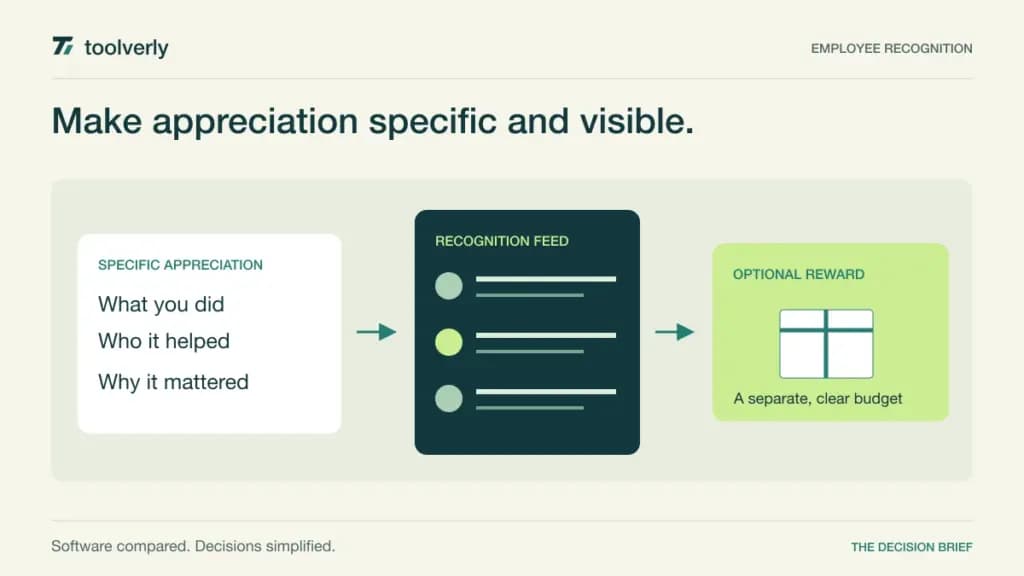
An employee recognition program starts with a specific thank-you: what someone did, who benefited, and why it mattered. Software can help people notice those contributions and distribute optional rewards. It cannot make an unclear program meaningful simply by adding points, badges, or a public feed.
We compared Bonusly, Nectar, Kudos, Guusto, and Achievers using official product and pricing information checked on September 30, 2026. Our recommendations are editorial judgments about program design and purchasing fit, not measured claims about retention, engagement, or productivity. Prices and quotes should distinguish the software subscription from the money used to fund rewards.
Recognition also serves a different purpose from formal evaluation. Our employee performance software guide covers goals and review cycles. Here, the decision is how employees and managers express appreciation, how people participate across working environments, and how administrators manage the program.
Compare participation before reward catalogs
| Platform | Useful starting point | Verified pricing model | Question to resolve |
|---|---|---|---|
| Bonusly | Peer recognition in everyday team work | Team with Bizy: $50/user/year | Which package and reward funding are needed? |
| Nectar | Recognition within a broader employee program | Custom quote by selected bundle | Which modules and participation channels are included? |
| Kudos | Recognition, milestones, and program campaigns | Request a proposal; no fixed amount on the reviewed product page | Which program features belong to the quote? |
| Guusto | Different sender and recipient populations | Essential: $4/sender plus $0.70/recipient monthly, billed annually | $200 monthly minimum and reward budget |
| Achievers | Broad recognition and reward administration | Custom quote | Population, countries, and implementation scope |
These are different commercial models. Count who can send recognition, who can receive it, who administers the platform, and who receives funded rewards. Ask the vendor to apply those roles to a realistic employee roster; the total headcount alone may not describe the program.
Bonusly
Bonusly’s current pricing includes a free option for up to eight users, with peer recognition, Slack and Microsoft Teams integrations, and mobile access. Its Team package with Bizy is $50 per user annually. The pricing FAQ also lists Team without Bizy at $30 per user annually. Organization pricing is quoted, with broader administration and company-wide capabilities. Reward funding is separate from the software subscription.
Strength: a small group can evaluate the recognition habit inside familiar team communication. The useful question is whether people write specific appreciation and notice colleagues’ contributions, rather than whether they can send a generic badge.
Limitation: package names and the Bizy option change the price, so an older per-seat figure may describe a different offer. Confirm the relevant new-customer terms and required administration. Best fit: a team seeking a straightforward peer-recognition program with a clear owner. During evaluation, include colleagues from different functions and shifts, then ask whether the feed represents the work they actually see. Check Bonusly’s pricing and package FAQ.
Nectar
Nectar now presents bundles such as Recognize, Engage, Comms, Flows, and Nectar One, with pricing supplied through a quote. Recognize includes peer and manager recognition, points budgets, rewards, company values, milestones, and reporting. Nectar also describes Slack and Teams integrations and options for reaching frontline workers through channels such as mobile and SMS, depending on the selected solution.
Strength: it is worth considering when recognition needs to sit alongside other employee communication or engagement work. The bundle discussion can make responsibilities explicit across HR, internal communications, and team managers.
Limitation: a broad platform demonstration can show more than the package being purchased. Ask the proposal to name the modules, delivery channels, integrations, and support included; do not assume that every advertised workforce feature belongs to Recognize alone. Best fit: an organization that wants to coordinate several employee programs and can define their boundaries. Have a frontline employee complete the proposed recognition journey using the device and access they actually have. Consult Nectar’s current bundle and quote page rather than relying on historical public prices.
Kudos
Kudos describes peer-to-peer and manager recognition, milestones, nominations, rewards, and program reporting. Its platform also supports recognition campaigns and integrates with Slack and Microsoft Teams. The official product page reviewed for this comparison does not publish a fixed subscription amount, so a buyer should request a proposal for the required population and program scope.
Strength: the combination of ongoing recognition and structured occasions gives an administrator several ways to organize the program. It is a relevant candidate when appreciation needs to cover both everyday contributions and planned milestones.
Limitation: feature breadth does not identify which activities employees will find useful. Too many simultaneous campaigns can make the program harder to explain and administer. Best fit: an organization with a program owner who can define a small number of meaningful recognition practices. Ask for a demonstration of creating a campaign, changing its audience, and reviewing participation without treating a leaderboard as an employee performance score. Confirm the selected reporting and reward options in writing. See Kudos’ recognition platform overview.
Guusto
Guusto separates senders from recipients in its pricing. Essential lists $4 per sender and $0.70 per recipient monthly, with a $200 monthly minimum and annual billing. Premium lists $5 per sender and $1 per recipient, with a $500 minimum. The platform describes email, SMS, mobile, and offline options such as printed or QR-based delivery. Reward value is separate from the subscription; payment funding methods can have their own fees.
Strength: the role distinction is useful when a relatively small manager group funds recognition for a much larger workforce. It encourages the buyer to model the program’s actual participation structure.
Limitation: recipients are not universally free under the current pricing, and minimums can outweigh a simple per-person calculation. Confirm which recipient activities and offline delivery options the chosen plan supports. Best fit: a business with a defined sender population and employees who may not spend their day in a collaboration app. Test how a person without regular computer access receives and redeems a reward. Review Guusto’s current sender, recipient, and minimum charges.
Achievers
Achievers uses custom pricing for its recognition and rewards offering. The reviewed page describes monetary and nonmonetary recognition, service anniversaries, nominations, a global rewards marketplace, and integrations including Workday. It also describes a branded mobile and desktop experience, a recognition feed, administrative reporting, and member support. A separate years-of-service solution is available through its own quote discussion.
Strength: the scope is relevant to an organization coordinating recognition across a broad employee population. Administration, integrations, support, and reward delivery can be considered as one implementation rather than separate purchases.
Limitation: a global marketplace description does not confirm every reward choice or fulfillment condition in each employee’s country. Require a location-specific demonstration and a clear statement of implementation work. Best fit: an organization with the resources to define a formal program and maintain its employee data connections. Ask who handles a failed redemption and how the employee finds help without navigating internal departments. Use Achievers’ pricing and solution scope to frame the proposal.
Design a program people can actually use
Write a short recognition example before choosing a platform. It should describe a contribution and its effect in ordinary language. Then define who can recognize whom, whether recognition can be private, and when a funded reward is appropriate. A clear example helps employees understand the purpose more effectively than a complicated points chart.
Map access across office staff, remote colleagues, shift workers, and employees without a company email address. Test the actual invitation and redemption journey for each group. A program can appear widely available while making participation cumbersome for the people least likely to use a desktop application.
Keep the budget visible. Separate software fees, funded rewards, payment charges, implementation, and administrative time. Ask what happens to unused rewards, departing employees, and incorrectly issued recognition. Have the organization’s own payroll or benefits specialists review any relevant treatment; the platform comparison does not determine it.
Finally, define a modest review routine: participation across teams, examples of useful appreciation, access problems, and unresolved support requests. A team chat integration can make the program easier to encounter, but it should not overwhelm everyday communication. Choose the platform that supports your intended behavior and employee access, then improve the program from observed participation rather than promising a particular business outcome.
Original illustration by Toolverly. Read about our publication or send a correction.