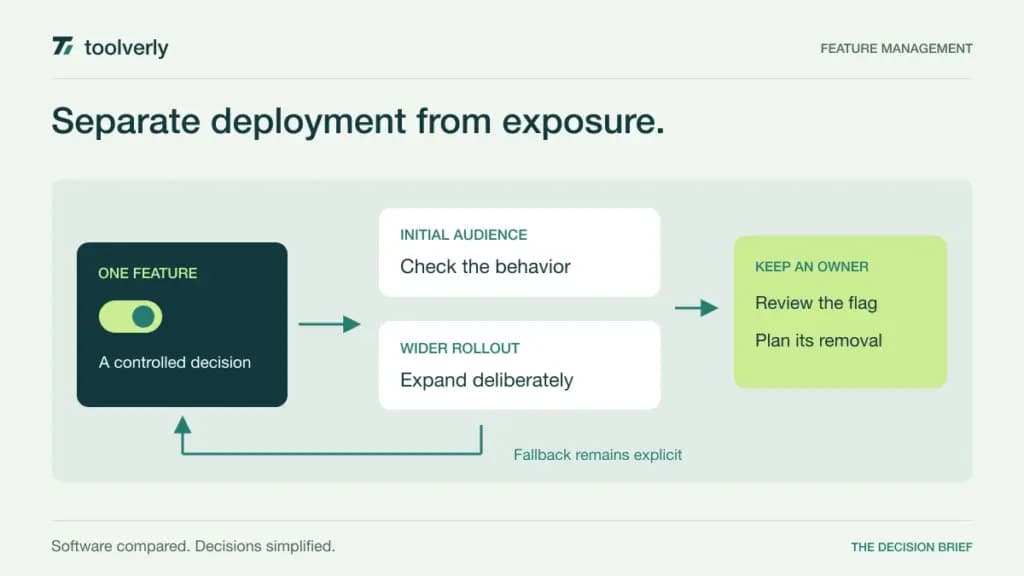
Deploying code and exposing a feature to customers do not have to be the same event. Feature flags let a team decide who receives a capability, change that decision without another code deployment, and keep a fallback available while the rollout develops. The platform matters most when more than one engineer needs to understand and control that decision.
LaunchDarkly, ConfigCat, Unleash, Flagsmith, and DevCycle all support feature management, but their commercial models describe different kinds of scale. Some emphasize service connections or active users; others count seats, configuration downloads, or API traffic. A comparison based only on the number of flags will miss much of the operating cost.
We reviewed official pricing and feature information on September 27, 2026. Prices are in USD unless specified otherwise. This is a documentation-based comparison, not a latency test or an endorsement of a particular production architecture. Treat a vendor’s service commitments as contract terms to review, not as evidence that your application cannot fail.
Define the release workflow before counting flags
Start with one rollout that has a named owner, a target audience, a success measure, and a removal date. Document the behavior when the SDK cannot obtain fresh configuration. Then decide who can change production targeting and who can approve that change. Those answers determine whether a low-cost configuration service is sufficient or stronger governance is necessary.
| Product | Best fit | Main strength | Meaningful tradeoff |
|---|---|---|---|
| LaunchDarkly | Teams growing a release platform | Usage-based foundation with enterprise controls | Several usage and add-on dimensions |
| ConfigCat | Teams wanting broad developer access | Unlimited seats and local flag reads | Configuration delivery still has limits |
| Unleash | Teams considering hosting flexibility | Cloud and self-hosted enterprise options | Seat fees and cloud traffic allowances |
| Flagsmith | Teams buying governance in stages | Clear hosted tiers and deployment options | Member and request limits both matter |
| DevCycle | Teams managing ongoing flag lifecycle work | Business controls and stale-flag visibility | Multiple traffic counters affect cost |
LaunchDarkly
LaunchDarkly is a reasonable candidate when feature delivery is becoming a shared organizational process. Its free Developer tier includes unlimited seats and flags, with five service connections and 1,000 client-side monthly active users. That is a useful starting point for understanding the product, but its capacity and environment boundaries still need to match the pilot.
The official LaunchDarkly pricing page presents Foundation as pay-as-you-go with no platform or seat fees. Its monthly-rate view shows $12 per service connection and $10 per 1,000 client-side monthly active users; the yearly-billing view shows $10 and $8.33 respectively. Five service connections are included.
The strength is a path into a wider release platform. Custom roles, workflows, and approvals appear in the quoted Enterprise offering. Automatic pause or rollback is associated with the paid Guardian add-on, so it should not be assumed to be part of basic flag delivery.
The limitation is forecasting usage correctly. Ask how your runtime architecture, especially short-lived processes or serverless execution, maps to service connections. Price the desired governance and monitoring scope separately. LaunchDarkly is a stronger fit when someone can own that model and connect the release controls to a clear production decision process.
ConfigCat
ConfigCat deserves a look when many developers need access and the team prefers to avoid seat or active-user charges. Its plans advertise unlimited seats, service connections, monthly active users, and flag reads. The commercial limits instead include delivered configuration files, network traffic, flag counts, and environments.
On the monthly USD view of ConfigCat pricing, Forever Free includes ten flags, two environments, five million configuration JSON downloads per month, and 20 GB of traffic. Pro costs $110 per month and increases capacity to 100 flags, three environments, 25 million downloads, and 100 GB. Annual billing is a separate choice.
The appeal is that frequent application-side evaluations do not necessarily mean one billable request for every decision. However, unlimited reads should not be confused with unlimited configuration delivery. A large client fleet, polling settings, and configuration size still matter to the paid capacity calculation.
This makes ConfigCat a useful candidate for a team willing to understand its SDK delivery pattern. During evaluation, estimate configuration refreshes across browsers, services, and environments, then compare that estimate with observed usage in the pilot. Also check history retention and the exact permissions needed by non-engineering users; a broad free feature set does not mean every plan has identical operational limits.
Unleash
Unleash fits teams that want to consider managed cloud alongside a self-hosted enterprise deployment. The current enterprise offering includes unlimited flags, projects, environments, client-side monthly active users, and service connections. Targeting strategies, segmentation, and stickiness support controlled exposure across different audiences.
The official Unleash pricing page lists Enterprise Pay-As-You-Go at $75 per seat per month, paid by credit card. Cloud includes 53 million API requests monthly, with $5 per additional million. The page explicitly states a five-seat minimum for self-hosted Pay-As-You-Go; do not automatically apply that condition to the cloud option.
The strength is being able to discuss deployment ownership and feature management together. A quoted Custom Enterprise option supports cloud, self-hosted, or hybrid arrangements under an annual contract. That gives organizations with specific infrastructure requirements a different procurement route from a standard hosted subscription.
The limitation is that hosting choice changes the work your team owns. Self-hosting calls for capacity planning, backups, upgrades, and recovery procedures; it is not simply a privacy switch. During evaluation, test a realistic targeting change and a recovery scenario. Unleash is most compelling when deployment requirements are concrete and someone can maintain the chosen operating model over time.
Flagsmith
Flagsmith is a practical candidate when a team wants to move from a small hosted setup into more formal release controls. Its free tier supports one member and 50,000 requests per month. Unlimited flags and environments are subject to fair usage, so the generous item counts still sit within a bounded service.
Flagsmith pricing lists Start-Up at $45 monthly, or $40 per month when paid annually, for three members and one million requests. Scale-Up is $300 monthly or $250 at the annual rate, with five members and five million requests. Scale-Up adds controls including SAML, roles and permissions, change requests, and audit records.
The strength is a visible upgrade path when more people begin changing production flags. The tradeoff is that member count and API volume can independently force a plan decision. Additional API capacity has its own pricing, so a five-person team is not necessarily a low-usage team.
Flagsmith also offers quoted enterprise deployment options. Choose the hosted tier according to the workflow you can actually enforce: have one person propose a change and another review it, then inspect the recorded result. Check required capabilities against current availability labels; a feature marked as forthcoming should not become a dependency in your rollout plan.
DevCycle
DevCycle is worth considering when the team wants to manage flags as ongoing engineering work rather than temporary switches that are forgotten after launch. Its Business offering includes role controls, audit visibility, and stale-flag detection. These capabilities can help create a routine for reviewing who changed a flag and whether the code still needs it.
The current DevCycle pricing page lists Business at $500 per month billed annually, with a $625 monthly-billing rate. The plan includes 100,000 client-side monthly active users, 500,000 events, one million cloud configuration requests, and ten million server requests. Each allowance measures a different part of usage.
The strength is pairing rollout work with lifecycle visibility. The limitation is estimating several counters instead of treating the subscription as one unlimited traffic pool. The free plan can support a smaller pilot, while enterprise approval and identity requirements may require a separate quote.
Use an evaluation to follow a flag from creation through full release and removal. Confirm who receives the cleanup task, how long audit evidence remains accessible, and which events your implementation sends. DevCycle is a more attractive fit when the team can connect that lifecycle to normal engineering ownership and model expected usage before a broad client rollout.
Choose an operating model you can sustain
LaunchDarkly is a sensible shortlist option for a broader release platform; ConfigCat for wide team access with delivery-based limits; Unleash for deployment flexibility; Flagsmith for staged governance; and DevCycle for ongoing flag lifecycle work. These recommendations describe fit, not measured speed or reliability.
For each candidate, implement the same small scenario: enable a feature for staff, extend it to a limited audience, change the rule, and return to the safe behavior. Record what happens when configuration is unavailable. Keep sensitive authorization decisions separate from client-visible targeting rules, and confirm which values are exposed to a browser.
- Map the application’s SDKs and refresh behavior to the vendor’s billable units.
- Define production change permissions, approval responsibility, and an emergency fallback.
- Assign every long-lived flag an owner and a review or removal date.
Flags should complement release evidence, not replace it; our test management comparison covers organizing that evidence. Likewise, use appropriate uptime monitoring to observe availability after release. The useful end state is a team that can explain what is enabled, for whom, why, and how to change it safely.
Original illustration by Toolverly. Read about our publication or send a correction.