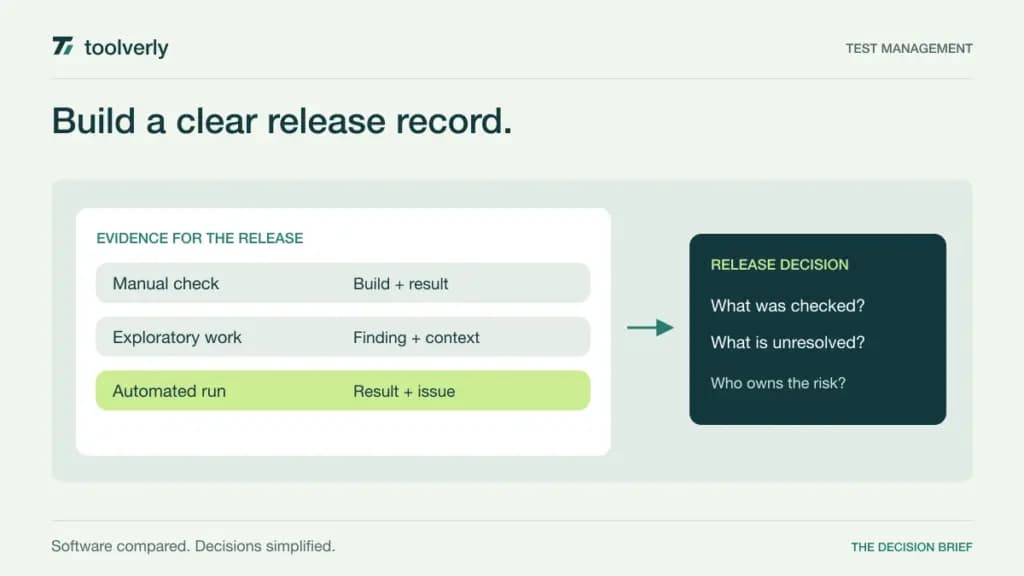
A passing build does not tell a release manager everything they need to know. Some checks are manual, exploratory work may uncover risks outside a scripted suite, and a failed automated run may refer to an obsolete test. Test management software helps connect those pieces so a team can explain what was checked, against which version, and what remains uncertain.
TestRail, Testmo, Qase, PractiTest, and Testiny all organize testing work, but their commercial models and governance boundaries differ. This guide focuses on coordinating test cases, runs, results, and evidence. Your project management software can still own delivery commitments; the testing system should provide the evidence behind a release decision.
We checked official pricing and product descriptions on September 26, 2026. This is a documentation-based comparison, not a benchmark of execution speed or defect detection. Dollar amounts below are the vendors’ displayed US-dollar prices, with billing periods, seat conditions, and relevant limits called out. Proposed trial exercises are recommendations for buyers, not tests Toolverly claims to have performed.
Compare evidence quality before counting features
Start with one release question: can the team show which important requirements were checked and whether any failures remain unresolved? A long case library is less useful if results cannot be traced to a build or if an old pass is mistaken for current evidence. Decide how manual tests, exploratory notes, and automated results should fit together.
Next, separate people who create and run tests from people who only read the outcome. Seat models can make that distinction expensive. Check history retention, exports, project access, and review controls on the actual plan being considered. A team chat tool can distribute release updates, but the durable result and its supporting context should remain easy to find in the testing record.
| Product | Best fit | Main strength | Important tradeoff |
|---|---|---|---|
| TestRail | Teams building a structured test-case practice | Cases, plans, runs, and a governance upgrade path | Entry tier has a five-user ceiling |
| Testmo | Teams combining manual, exploratory, and automated work | Multiple testing styles in one cloud workflow | Advanced controls move to larger packages |
| Qase | Teams linking results to requirements and release reviews | Traceability and collaboration options | Minimum full-seat count and history limits matter |
| PractiTest | QA groups emphasizing coverage and cross-record reporting | Connected requirements, tests, runs, and issues | Team packs require a realistic staffing budget |
| Testiny | Small teams wanting a clear entry and growth path | Accessible test management with explicit tier boundaries | Automation and stronger permissions require upgrades |
TestRail
TestRail is a suitable starting point for teams that want a reusable test-case library connected to plans and runs. Its current offer includes integrations with issue trackers and automation tools, so manual evidence does not have to sit apart from the engineering workflow. The practical appeal is a structured record that can outlive a single sprint.
Essentials is US$22 per user per month billed annually, cloud only, and available for up to five users. Professional is US$38 per user per month annually; Enterprise is US$78. Enterprise adds controls including test-case versioning, reviews and approvals, audit logs, and SSO. On-premise deployment is offered for Professional and Enterprise with at least ten seats and a 12-month minimum contract. See TestRail’s current licensing details.
The strength is an explicit progression from basic structure to more controlled testing. The limitation is that the smallest advertised plan cannot simply grow beyond its user ceiling, and formal review requirements may move a team directly to Enterprise. During a trial, revise a test after a run has completed and inspect the historical evidence. Ask whether the team can explain the original result without reconstructing what the case looked like at the time.
Testmo
Testmo is a strong candidate when the team treats exploratory sessions and automated results as first-class testing work alongside manual cases. Its product description brings those activities into a shared cloud system, with milestones and reporting to connect them. This can help a release discussion include useful findings that do not originate from a scripted case.
Team starts at US$59 per month with five users included. Business starts at US$249 per month with 15 users and adds a reporting center, customizable role-based access, and project administrators. Enterprise starts at US$599 per month with 25 users and adds capabilities such as SSO, two-factor enforcement, and a user audit log. These are monthly package prices, not per-seat figures. See Testmo’s pricing and plan boundaries.
The advantage is a broad testing workflow without requiring every useful observation to become a formal case first. The limitation is the package jump when advanced permissions or identity controls become mandatory. Testmo also describes itself as a cloud application rather than an on-premise product. For an evaluation, collect one exploratory session and one automated run under the same milestone, then have a release owner identify remaining risk without opening several separate reporting systems.
Qase
Qase is relevant when the team wants test results linked to requirements and visible to colleagues outside QA. Its current plan structure distinguishes full testing seats from collaborators who follow runs, reports, and dashboards. That can support a clearer conversation about who needs to perform work and who needs to understand its outcome.
Teams is US$35 per user per month billed annually, or US$42 monthly, with a minimum of five full seats in the comparison table. It lists requirements traceability, test-case review, SAML SSO, and two years of test history. View-and-comment collaborator seats are US$10 per user per month. Enterprise is custom priced and includes unlimited retention and additional administration controls. The free offering is positioned for students, hobbyists, educators, and nonprofits. See Qase’s official pricing matrix.
The strength is connecting test evidence to a wider release conversation. The limitation is that an apparently inexpensive per-user figure still has a minimum team size, and retained history differs between plans. Build a sample trace from requirement to case, run, and defect, then inspect it as a collaborator. Confirm that stakeholders can answer their questions with the permissions they will actually buy, rather than using a trial administrator account.
PractiTest
PractiTest deserves a close look when coverage and reporting across related QA records are central requirements. Its Team offer brings together requirements, a test library, test sets and runs, and issue management. Filtering, custom fields, dashboards, and traceability reporting give a QA lead ways to organize evidence around the dimensions that matter to a release.
The checked Team configuration showed US$47 per user per month on annual billing, with a ten-tester pack totaling US$5,640 for 12 months. It also includes five comment users per tester license. Corporate is quote-based, billed yearly, and requires at least ten licenses; it adds stronger security and administration options. Use PractiTest’s plan comparison to confirm the pack and integration requirements for your organization.
The benefit is a model that can connect execution evidence with coverage and issue follow-up. The tradeoff is administration: rich fields and filters only help if people apply them consistently. Establish a small required vocabulary for product area, release, and risk before importing a large spreadsheet. In a demonstration, ask for a report of important requirements without current passing evidence. The result should be explainable by the QA team, not dependent on an elaborate configuration only the vendor understands.
Testiny
Testiny is attractive for teams that want to start with structured cases and runs while keeping the initial scope small. Its free plan supports up to three users, with a combined limit of 1,000 test cases, plans, runs, and executions. That is a practical evaluation boundary, but it is not an unlimited production history allowance.
On the monthly US-dollar view, Starter was US$18.50 per user per month for up to 25 users. Business started at US$20.50 per user per month with at least five users and adds automation, milestones, and SSO. Enterprise starts at US$30 per user per month, sold in five-seat packages, and adds project-level roles, custom roles, permission groups, and an audit log. Prices exclude tax; yearly payment offers two months free. See Testiny’s current pricing.
The strength is a readable progression from a small team’s manual process to broader automation and control. The limitation is that requirements such as automation or project-specific permissions change the appropriate tier. Count the number of people who genuinely need edit access before comparing costs. For a pilot, import representative cases, record a failed step, attach useful evidence, and export the result. Check that the exported record remains understandable to someone without access to the live workspace.
Make the trial answer a release question
Shortlist TestRail for a structured case practice and a clear governance path. Consider Testmo when exploratory and automated work need equal visibility, Qase when traceability and stakeholder participation are priorities, and PractiTest when QA reporting depends on connected requirements and issues. Testiny is worth considering for a smaller team that wants an explicit route from simple runs to stronger controls.
Evaluate with an imperfect release, not a tidy demonstration. Include one outdated case, one flaky automated test, one blocked manual check, and one issue that has been accepted for later work. Ask the release owner to explain the remaining risk using only the candidate system’s records. A dashboard that simply displays a green percentage is insufficient if those distinctions disappear.
Agree on the minimum evidence for a result, the owner of stale tests, and the retention period before buying. The goal is a trustworthy release conversation. The number of stored cases is useful only when those cases describe current behavior and their results remain interpretable.
Original illustration by Toolverly. Read about our publication or send a correction.