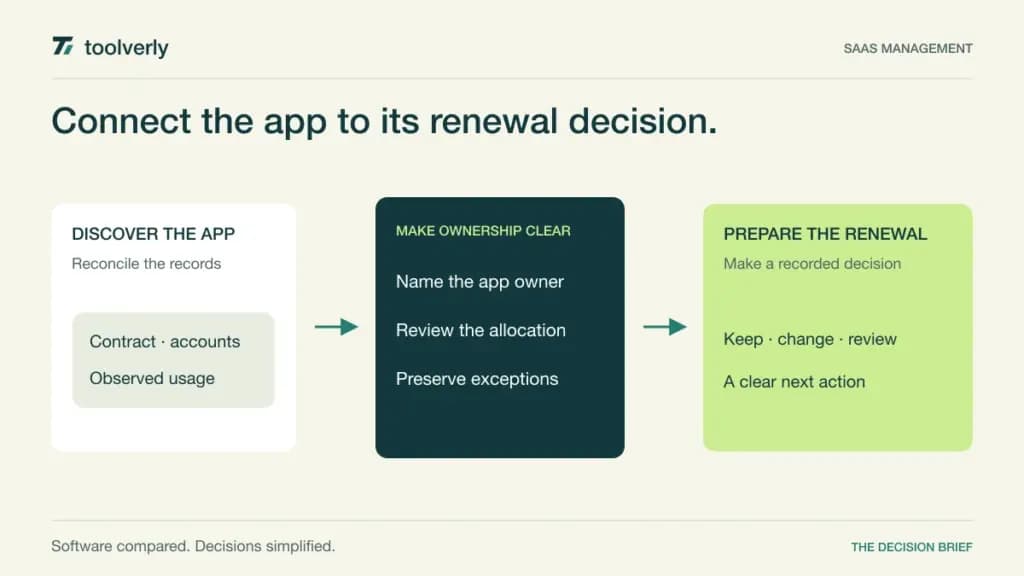
A SaaS renewal becomes difficult when finance has the invoice, IT has the user list, and the business owner has the reason for buying. A management platform should connect those records well enough to support a decision: keep the application, change its allocation, consolidate it, or prepare a different contract. A longer application inventory is useful only when someone can act on it.
Zylo, Torii, BetterCloud, Zluri, and CloudEagle.ai approach that decision through different combinations of discovery, license information, contracts, and automation. The right shortlist depends on your existing identity systems, purchasing data, and ownership practices. Start with the renewal questions your team cannot answer today, then ask which platform can answer them using data you are permitted to connect.
How this comparison was prepared
This is a research-based comparison of current official packages, checked October 5, 2026. We did not run hands-on trials or measure savings. The selection criteria are discovery coverage, ownership reconciliation, evidence behind license recommendations, renewal coordination, and the boundaries between SaaS management and adjacent identity or procurement modules. Our recommended evaluation exercises are buyer checks, not reported product test results.
| Product | Best fit | Main strength | Meaningful tradeoff | Pricing reference |
|---|---|---|---|---|
| Zylo | Portfolio and renewal oversight | Spend and usage context | Automation scope varies by tier | Sales quote |
| Torii | IT-led application workflows | Discovery and license coordination | Adjacent modules need scoping | Sales quote |
| BetterCloud | Operations plus spend management | Selectable automation modules | Full platform differs from free preview | Configured quote |
| Zluri | App and license reconciliation | Discovery with renewal context | Data coverage needs validation | Contact sales |
| CloudEagle.ai | IT and purchasing coordination | Application and contract workflows | Procurement is a distinct scope | Sales quote |
Zylo
Zylo’s current packages combine application discovery, spend visibility, usage connections, and reporting. Premium adds capabilities such as pricing benchmarks, identity actions, IT service management automation, and cost allocation; Enterprise extends the organizational scope. The pricing page requires a sales conversation rather than publishing a fixed subscription amount.
Best fit: A company that wants finance and application owners to work from a common portfolio view. Strength: The package structure connects license information with the commercial context of a renewal. Limitation: Finding an opportunity and executing a change are different jobs, and the relevant integration or automation may require a higher package.
For a buyer evaluation, choose one application with a central contract and another purchased separately by several teams. Ask how the vendor would reconcile the records, identify a responsible owner, and explain which usage signal informs a recommendation. The useful output is an auditable decision with exceptions, not a dashboard number presented as guaranteed savings. Request a quote for that workflow and your organizational structure.
Torii
Torii’s SaaS management offering lists application discovery, license and renewal workflows, contract and expense integrations, and optimization context. Identity governance and AI management appear as distinct offerings. Its pricing page does not provide a fixed public amount for the SaaS management module.
Best fit: An IT team that wants to coordinate application actions as well as maintain a register. Strength: The published scope brings discovery and operational workflows into the same discussion. Limitation: Do not assume an adjacent identity review capability is included merely because it appears elsewhere in the vendor’s portfolio.
Have the vendor walk through an employee changing departments while retaining access to an application used in both roles. Ask where the business owner approves the allocation, what happens when an integration cannot observe usage, and how a manual exception remains visible. This scenario tests your requirements without equating inactivity with lack of business value. Include the necessary connectors and workflow volume in the commercial proposal.
BetterCloud
BetterCloud separates User Automation, Spend Optimization, and Workspace Management for Google. The spend offering covers applications, contracts, utilization, and license reclamation; automation is separately scoped. Pricing depends on factors including licenses, connected applications, selected modules, and add-ons. A zero-dollar Basic spend option is a limited entry offering, not evidence that the complete platform is free.
Best fit: Organizations buying application operations and spend oversight together. Strength: Buyers can discuss individual modules instead of assuming one universal package. Limitation: A low-cost entry point may not represent the workflow your operations team needs.
Prepare two requirements lists: the information needed for a renewal decision and the actions needed after approval. Ask which module supplies each item and whether it introduces another administrator or integration dependency. A departmental pilot should include an app outside the dominant workspace suite. That helps you assess whether the proposed configuration matches your actual estate rather than only the easiest systems to connect.
Zluri
Zluri’s SaaS management product describes application discovery and classification, usage and license information, contract records, and renewal alerts. Its public pricing route leads to a demo request rather than a published subscription amount. Broader identity governance capabilities should be treated as a separate scope question.
Best fit: Teams trying to reconcile a fragmented application list with license and contract ownership. Strength: Discovery is paired with information needed to prepare a renewal. Limitation: Useful coverage depends on the actual sources your organization connects and the permissions it grants.
Bring a deliberately awkward example: an application paid on a card, an owner who has left, and several users whose accounts are absent from the central directory. Ask how conflicting records would be resolved and how confidence or missing evidence would be communicated. A buyer should be able to distinguish a discovered application, a purchased seat, and an observed active user. Request the required integration scope and implementation effort alongside the subscription quote.
CloudEagle.ai
CloudEagle.ai’s pricing page separates SaaS management, SaaS procurement, identity governance, and AI governance. Application rationalization, license management, and contract management form part of its SaaS management presentation; renewal and purchasing coordination have their own commercial scope. The page asks buyers to discuss pricing rather than publishing a fixed SaaS management rate.
Best fit: A business where IT and purchasing need a shared view of application ownership. Strength: The portfolio covers both application information and adjacent commercial workflows. Limitation: That breadth makes it necessary to identify exactly which modules are being purchased.
Map a renewal from the first reminder to a signed decision. Specify who checks utilization, who owns the business justification, and who can negotiate or approve a contract. Ask the vendor to identify the module responsible at each stage. This makes a proposal easier to compare with a portfolio-only alternative and prevents a broad platform presentation from obscuring the actual starting workload.
Choose the workflow before the platform
Discovery coverage should be judged against your applications, not a vendor’s connector count. A finance feed may reveal spend without proving access; an identity feed may reveal accounts without proving an application is useful. Request a clear explanation of each signal and the reconciliation process. Decide how your team will maintain owners when roles change.
Separate recommendation from execution. Reclaiming a license, removing an account, and ending a contract can have different consequences and approvers. Define exception handling for seasonal workers, service accounts, and infrequently used critical tools. Where purchasing approval is the main bottleneck, our procurement software comparison addresses that decision. Infrastructure consumption is a different cost problem covered in cloud cost management software.
A practical buying checklist
- Choose a sample containing centrally purchased, card-paid, and department-owned applications.
- Document which identity, finance, expense, and usage sources can be connected with acceptable permissions.
- Require an explanation of conflicting records and missing information before accepting optimization recommendations.
- Name the person who approves each renewal and each license action; preserve justified exceptions.
- Request pricing for the actual modules, connectors, organizational units, support, and implementation work.
- Confirm how application records, ownership history, and contracts can be exported when the agreement ends.
The strongest shortlist is the one that can turn your imperfect records into a defensible renewal decision. Compare the completeness of that decision, the effort to maintain it, and the full configured cost. A convincing portfolio view should make uncertainty visible enough for an owner to resolve it.
Sources and verification date
Official product information checked October 5, 2026. Prices are published reference points, not binding offers; confirm tax, currency, region, contract term, and package scope before buying.
- Zylo pricing
- Torii pricing
- BetterCloud packages
- Zluri SaaS management
- Zluri sales contact
- CloudEagle.ai pricing
Original illustration by Toolverly. Read about our publication or send a correction.