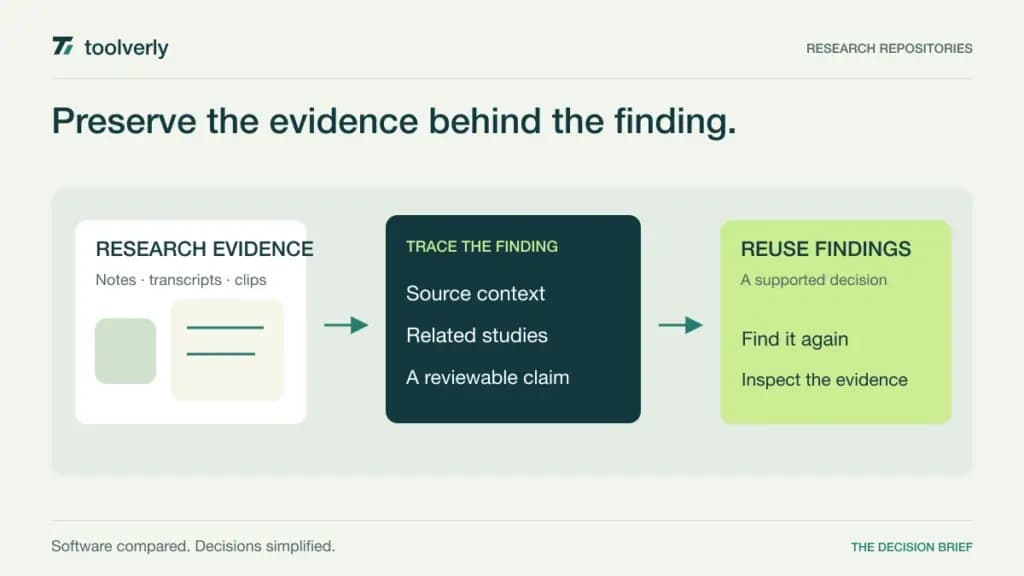
A research report can answer today’s design question and still become difficult to find next month. When recordings, notes, themes, and decisions live in different places, the team repeats questions it has already investigated. A user research repository keeps findings connected to the evidence behind them and makes that knowledge reusable.
This comparison covers Dovetail, Condens, Aurelius, Looppanel, and Marvin. The decision is how your organization analyzes, preserves, and retrieves qualitative evidence across studies. Our guide to usability testing platforms covers running participant studies; product feedback software addresses collecting and prioritizing requests. A repository’s central task is helping people find and interpret what the evidence supports.
Research basis: Official pricing and feature pages checked on October 3, 2026. We have not performed hands-on analysis tests or measured transcription accuracy. Prices, editor roles, stakeholder access, and cross-project capabilities are described separately because a cheap single-project workspace may not serve an organization-wide repository.
Compare analysis and access boundaries
| Platform | Likely fit | Verified pricing reference | Repository boundary |
|---|---|---|---|
| Dovetail | Organizations connecting projects and shared insight access | Free with 1 project and 1 channel; Enterprise by quote | Multi-project capacity and governance |
| Condens | Research analysis with a dedicated stakeholder experience | Lite from €15/month; Business €500/month equivalent, billed €6,000 yearly | Contributor roles and organization-wide repositories |
| Aurelius | Teams organizing notes, insights, and recommendations | Professional US$49/month and Premium US$199/month, both billed yearly | Cross-project functions and advanced permissions |
| Looppanel | Interview-heavy teams building a searchable archive | Monthly selection: Solo US$49/month; Pro US$395/month | Project-only versus global search |
| Marvin | Teams centralizing evidence from several research inputs | Free with 5 file uploads/month; paid tiers by quote | Repository-wide analysis and permission scope |
Dovetail
Dovetail’s current pricing distinguishes a Free tier with one project and one channel from a quoted Enterprise option with unlimited projects and channels. The feature comparison includes transcripts, clips, summaries, search, and shared organizational structures. Enterprise adds controls and cross-project organization that matter to a continuing research practice.
Strengths: Connecting research material with reusable highlights and searchable findings helps a team revisit the context behind an insight. A structured shared workspace is relevant when several researchers need consistent fields and tags rather than private systems of labels.
Limitations: One free project can support a contained evaluation, but it is not an organization-wide historical repository. Establish the cost and permissions needed for the real number of studies and stakeholders. Also inspect how generated summaries point back to original material; a concise answer needs an evidence trail.
Best fit: Organizations that can invest in a shared research structure and need governed access. Bring two studies discussing the same issue with different participant groups. Ask a stakeholder to find the relevant evidence, identify its context, and distinguish one study’s conclusion from the other’s. Review Dovetail’s current Free and Enterprise options.
Condens
Condens Lite starts at €15 per month for one contributor, with a €165 yearly option. Business is €500 per month equivalent, paid yearly at €6,000, including five contributors and unlimited viewers. Business adds customizable insight repositories, while Enterprise extends repository count, permissions, and anonymization options. Lite’s analysis workspace and Business’s stakeholder repository serve different scopes.
Strengths: The separation between contributors and viewers makes stakeholder access a concrete buying decision. Analysis features include tagging, clips, and collaborative work; the dedicated stakeholder presentation is relevant when findings need to reach colleagues who will not perform research themselves.
Limitations: Compare the package that supports your repository use case, not merely the lowest analysis price. Business lists three customizable repositories, and some controls or connections are add-ons. Unlimited transcription or projects should not be confused with unlimited contributor seats.
Best fit: Teams that want a deliberate path from raw research to findings that others can consume. During evaluation, publish a finding with supporting clips and ask a viewer to retrieve it without editing the original study. Then inspect how sensitive evidence is shared differently from its summary. Consult Condens’s current contributor, viewer, and repository allowances.
Aurelius
Aurelius lists Professional at US$49 per month billed yearly and Premium at US$199 per month billed yearly. All tiers advertise unlimited users, projects, and storage. Its workflow includes notes, tags, key insights, reports, transcriptions, and clips. Premium adds capabilities such as universal search and collections; Enterprise introduces advanced permissions and other organizational controls.
Strengths: The notes-to-insights model is useful for teams that want to preserve the reasoning between observation and recommendation. A broad user allowance also changes the commercial discussion: the buyer can focus on required functions and governance instead of counting every colleague who may participate.
Limitations: Unlimited capacity does not mean every cross-project or permission function is included in the lowest tier. A solo project’s analysis needs differ from an archive shared across departments. Annual prices are paid on a yearly basis, so compare the full commitment with monthly alternatives.
Best fit: Research teams that value a clear distinction between notes, insights, and recommendations. Bring one finding that changed after a follow-up study. Check whether a colleague can understand the earlier evidence and the reason for the revised conclusion. Ask which tier supports the required access boundaries. Read Aurelius’s pricing and capability comparison.
Looppanel
With monthly billing selected, Looppanel displays Solo at US$49 per month for one editor and Pro at US$395 per month with five editors and unlimited viewers. Solo includes project-level search and analysis, while Pro adds global search and a team workspace. Enterprise is quoted and adds controls such as granular access, redaction, and data deletion policies.
Strengths: Interview-oriented notes, clips, and analysis are relevant when the archive grows mainly from recorded conversations. Moving from project search to global search is a meaningful transition: the team can investigate a question across earlier work instead of opening each study separately.
Limitations: The editor and viewer roles matter more than the headline amount alone. The published plans also specify different automated analysis run allowances per project. Confirm which package provides the stakeholder repository experience and permission granularity your organization needs.
Best fit: Interview-heavy teams seeking a reusable evidence archive. Evaluate a recording with two overlapping themes and a participant whose wording needs context. Ask how a researcher corrects notes and how a stakeholder gets from a summary to the original clip. Use the Looppanel pricing page to compare the chosen billing cycle and roles.
Marvin
Marvin’s Free tier lists five file uploads per month, project-wide AI questions, insight reports, clips, and playlists. Starter moves to unlimited data ingestion and repository-wide questions, with sales-led pricing. Higher tiers add integrations and analysis functions, while Enterprise adds organizational controls. The current page does not publish a fixed paid subscription amount.
Strengths: Marvin is relevant when the team wants a knowledge hub spanning several research inputs. The difference between asking within one project and across the repository gives the buyer a clear test for whether earlier evidence can inform a new question.
Limitations: A five-upload free allowance is a small evaluation footprint, not proof of sufficient production capacity. Ask for the proposed seat roles, data limits, integrations, and access controls in writing. Some privacy and identity features have specific tier or add-on packaging.
Best fit: Teams seeking consolidated research knowledge with an explicit migration and access plan. Import two kinds of material from related studies, then ask a question that requires both. Inspect references and conflicting evidence rather than accepting the generated answer on its own. Review Marvin’s current Free and quoted paid tiers.
Choose for retrieval, context, and responsible reuse
Inventory the evidence your team already has: recordings, notes, transcripts, screenshots, and reports. Decide what belongs in the repository, who can see it, and what should happen when retention expires. The goal is a useful research memory, not an indiscriminate folder of everything a participant has ever said.
Build a trial around two completed studies and one new question. Ask someone who did not conduct the studies to find relevant findings, trace a claim to its evidence, and identify the participant context. Measure the steps they need to take and note where terminology or permissions creates confusion.
Evaluate generated answers against contradictory examples. A summary may be fluent while omitting a minority observation or blending different populations. The product should help a reviewer inspect the source and retain uncertainty. Establish a lightweight taxonomy with owners instead of allowing every project to create incompatible tags.
Finally, compare researcher seats, viewer access, cross-project search, redaction, retention, migration, and export in the package you would buy. Dovetail suits shared project structures, Condens emphasizes stakeholder presentation, Aurelius organizes insights and recommendations, Looppanel supports interview-centered reuse, and Marvin centralizes several inputs. Choose the repository that helps a colleague make a supported decision and return to the evidence when the question changes.
Original illustration by Toolverly. Read about our publication or send a correction.