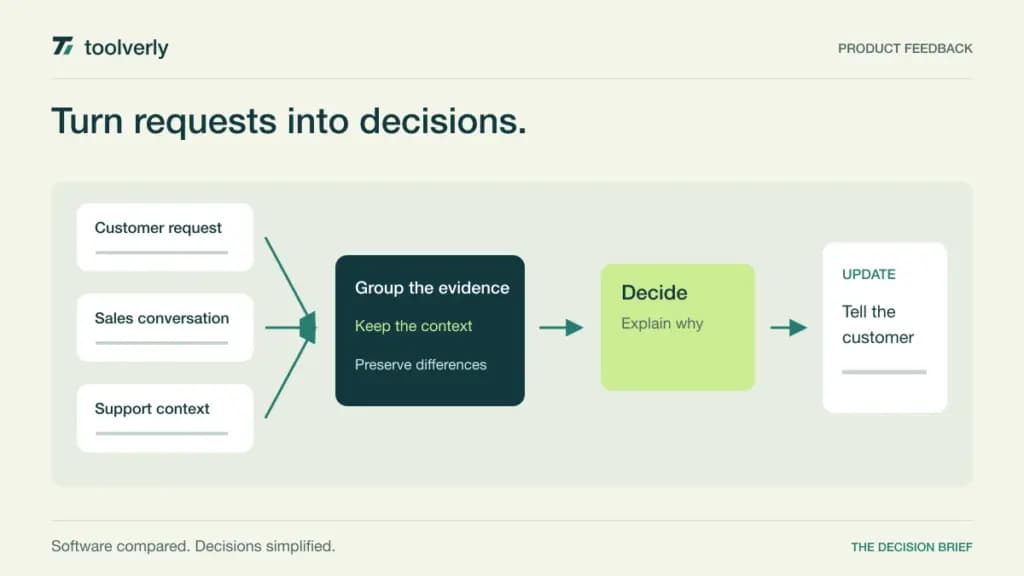
A feature request can appear in a support conversation, a sales call, or a message from a long-standing customer. Collecting those requests is only the first step. A product team also needs to recognize duplicates, understand the underlying problem, decide what deserves attention, and tell customers what happened to their input.
Canny, Productboard, UserVoice, Featurebase, and Frill offer different ways to manage that loop. This guide compares the buying decisions behind product feedback and roadmap communication, using official sources checked on September 24, 2026. It is not a hands-on benchmark of AI classification or a claim that any tool will identify the correct roadmap automatically. Prices are USD unless stated otherwise; annual monthly equivalents require the specified annual commitment.
Decide what a feedback record must preserve
Start with the customer problem, the source conversation, and the person or organization affected. A request for a dashboard could mean faster reporting, more confidence in data, or access for a different role. Merging those requests too aggressively can erase the differences that a product manager needs to understand.
This category is separate from a general form builder, which structures a submission. It is also separate from a customer help desk, which owns the immediate service response. A feedback system should preserve evidence across requests and support a considered product decision even after the original conversation is closed.
| Product | Best fit | Main strength | Meaningful tradeoff |
|---|---|---|---|
| Canny | Teams connecting customer conversations to feature requests | Feedback capture, deduplication, and a customer portal | Tracked users drive pricing as participation grows |
| Productboard | Product teams linking evidence to prioritization | Feedback notes, roadmaps, and maker workflows | Maker seats, plan limits, and AI credits need budgeting |
| UserVoice | Organizations coordinating product and revenue teams | Segmentation and a managed feedback program | Pricing requires a scope-specific sales quote |
| Featurebase | Teams wanting feedback close to customer support | Feedback and help desk modules in one subscription | Seat charges and optional AI usage affect the total |
| Frill | Teams wanting a focused feedback and update destination | Ideas, roadmap communication, and announcements | Idea allowances and privacy options distinguish plans |
Canny
Canny is a practical candidate when requests arrive through several customer-facing channels. Its Autopilot offering captures and organizes feedback from conversations, while the portal gives customers a place to contribute and follow changes. The useful question is whether this reduces lost evidence without removing the context behind a request.
Canny’s current pricing includes a free plan with twenty-five tracked users. Pro starts at $79 per month billed yearly for a tier starting at one hundred tracked users. A tracked user is associated with feedback, including activity captured on their behalf. Business is custom priced. Canny provides an optional spend limit; without one, exceeding the allowance can trigger a tier upgrade.
The strength is gathering scattered input into a continuing record. The limitation is that wider participation changes the cost even if the product team stays the same size. During evaluation, inspect several automatically grouped requests and their original wording. Canny fits teams that want broad capture and can forecast the number of people whose feedback they will track.
Productboard
Productboard is worth considering when feedback is one input to a larger product planning process. A team may need to connect customer evidence, segments, and priorities before deciding what to communicate externally. That makes the product manager’s working environment more important than the appearance of a public voting board.
The official pricing page now lists Free, Plus, Business, and Enterprise. Plus costs $19 per maker per month billed annually, or $25 monthly. Business is $59 per maker per month billed annually, with a two-maker minimum, and includes unlimited feedback notes and teamspaces. The plans also allocate AI credits. Enterprise uses custom pricing and a five-maker minimum.
The strength is connecting evidence to prioritization and roadmap work. The limitation is that makers, contributors, feedback allowances, and AI usage represent different dimensions of the subscription. Map actual responsibilities to those roles before estimating cost. Productboard fits teams with an explicit product decision process and a willingness to maintain links between evidence, assumptions, and proposed outcomes.
UserVoice
UserVoice is relevant when feedback management crosses several departments. Sales may need to explain a prospect’s requirement, customer success may know the affected accounts, and product may need a broader view of demand. The buying decision becomes how those groups share context without turning every request into an immediate promise.
UserVoice’s pricing page says subscriptions depend on feedback volume, capabilities, and connected integrations rather than seats. It does not publish a standard entry price; request a scoped quote. The offering includes a feedback portal, capture tools, segmentation, filtering, and communication. Guided onboarding and trial arrangements are part of the sales-led evaluation.
The strength is treating feedback as an organizational program with multiple participants. The tradeoff is a less self-service purchasing process and the need to define the scope before comparing cost. Bring representative requests from each department to the demonstration and ask how the same customer is recognized across them. UserVoice fits companies prepared to assign an owner, standardize incoming context, and maintain a regular review rhythm.
Featurebase
Featurebase is attractive when support conversations and product feedback frequently refer to the same problem. Its combined subscription can reduce the distance between the person responding to a customer and the team considering a product change. The important evaluation is whether each responsibility stays clear as the conversation moves between them.
The pricing page lists Growth at $29 per seat per month billed yearly and Professional at $59 on the same basis. Help desk and feedback modules share one subscription. Optional Fibi AI resolutions are listed at $0.49 each. Its feedback product provides a dedicated collection workflow alongside the broader support offering.
The strength is bringing related customer workflows together. The limitation is that a team buying only a feedback board must still assess the seat model and the surrounding suite. Price the roles you actually need, and keep AI resolution usage separate from the subscription estimate. Featurebase fits teams that want support and product feedback connected and can agree on when an issue becomes a product request.
Frill
Frill deserves consideration when the goal is a focused place for ideas, roadmap communication, and announcements. A smaller product team may value a manageable public loop more than an elaborate planning system. Success still depends on maintaining the board and explaining decisions in language customers understand.
Frill’s published monthly plans start with Startup at $25 for fifty active ideas. Business is $49 with unlimited ideas. Paid tiers include unlimited administrators and tracked users; privacy, surveys, and white labeling appear as additional options or included capabilities on higher tiers. Growth is $149 monthly and includes those expanded options.
The strength is a pricing model that does not charge for every additional participant in the feedback loop. The limitation is that an entry plan’s idea allowance or privacy requirements can matter sooner than user volume. Demonstrate how your team will merge a duplicate, change a status, and publish an update. Frill fits a team seeking a maintained feedback destination with a clear editorial owner and a modest set of operating rules.
Evaluate a decision, not a popularity contest
Create a small sample containing repeated requests, conflicting requests, and a widely requested feature that does not fit your strategy. Include one detailed account conversation and one short anonymous suggestion. The purpose is to observe whether the system preserves evidence quality while making related material easier to find.
Trace one request from capture to decision. Can a colleague find the original words, distinguish the problem from the suggested implementation, and identify the affected customer group? If an AI summary is available, compare it with the original material. A useful summary should save reading time while preserving disagreement and uncertainty. It should not silently turn a tentative request into a commitment.
Then close the loop with a sample update. Explain what changed, what remains undecided, and whether the user needs to do anything. Decide who reviews public language and how internal planning dates differ from public expectations. A roadmap is more useful when its status labels have an agreed meaning than when it contains the largest number of planned items.
Match the cost model to participation
Estimate three quantities separately: internal decision-makers, people whose feedback will be represented, and the number of active ideas or notes. Add connected systems and optional AI usage. A tool that is inexpensive for a small private pilot may have a different cost once feedback collection becomes part of every customer conversation.
- Define which source details must survive import and duplicate merging.
- Assign an owner for triage, prioritization, and customer updates.
- Test internal versus public visibility with realistic examples.
- Confirm exports include the context you would need to leave the service.
- Review spend caps, seat roles, and annual commitments before expanding the program.
Shortlist Canny for broad conversation capture, Productboard for evidence-led product planning, and UserVoice for a coordinated program across departments. Compare Featurebase when support and feedback should share an environment, and Frill when a focused board and update loop meet the need. Choose the system that helps the team explain a decision, including a decision not to build something.
Original illustration by Toolverly. Read about our publication or send a correction.