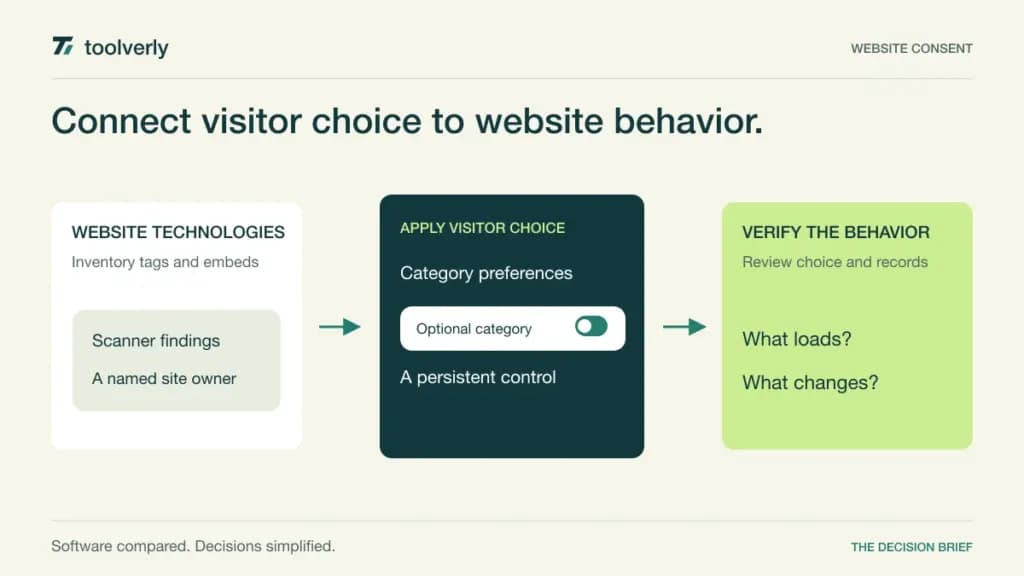
A website consent banner is only the visible part of a technical process. The site also needs to recognize relevant technologies, apply the visitor’s choice, make preferences available again, and preserve an appropriate record. A consent management platform helps operate that process, but the website owner still has to define its policy and verify what the site actually does.
This guide compares CookieYes, Cookiebot, iubenda, Osano, and Termly for website consent operations. It focuses on banners, preference handling, scanning, tag behavior, and records. Our guides to website analytics software and online form builders cover adjacent tools whose behavior and data collection should be included in that review. A website cookie preference is also different from permission collected through a newsletter signup.
Official sources were checked on October 4, 2026. This is a technical purchasing comparison without hands-on testing or a determination of legal requirements. Buying a platform does not establish compliance by itself; your organization’s policy owner must define the required behavior, and the implementation must be checked against it. Regional currency displays and billing selections are preserved below.
Compare domains, traffic, and scanning scope
| Product | Pricing reference | Published sizing unit | Boundary to review |
|---|---|---|---|
| CookieYes | Basic: USD 10/domain/month on monthly billing | 100,000 pageviews and 600 pages per scan | Traffic overage and higher-tier targeting |
| Cookiebot | Premium Lite: EUR 7/domain/month | Up to 50 subpages; no traffic limit | Domain count and automatic size-tier changes |
| iubenda | Essentials: EUR 4.99/site/month, billed yearly | 25,000 pageviews | Traffic overage and separate form-consent products |
| Osano | Configured quote on the checked pricing page | Request a scope for sites, usage, and modules | Cookie Consent versus the broader privacy suite |
| Termly | Starter: EUR 9.50/website/month, billed annually | 50,000 banner views | Banner-view allowance and region/language features |
CookieYes
CookieYes provides a configurable banner, category preferences, consent logs, scanning, automatic blocking, and tag-manager support. With monthly billing selected, Basic was USD 10 per domain per month for 100,000 pageviews and 600 pages per scan. Pro was USD 25 with 300,000 pageviews. Basic and Pro charge USD 0.30 per additional 1,000 pageviews, with taxes extra. Scheduling and geographic targeting vary by tier; its free plan has a much smaller traffic allowance.
Strength: the published pageview and scan allowances give a small website a concrete sizing discussion. Include both visitor traffic and the number of pages that must be checked.
Limitation: a quiet site’s current traffic may be a poor estimate for a campaign month. Overage and higher-tier targeting should be part of the budget.
Best fit: a business operating a defined number of websites with known traffic. Ask the implementation owner to demonstrate a visitor’s rejection, later preference change, and the resulting tag behavior.
Cookiebot
Cookiebot prices its core plans by domain and subpage count rather than traffic. Premium Lite is EUR 7 per domain per month for up to 50 subpages, with prices excluding VAT. Larger sites move into higher size tiers, and the vendor describes automatic upgrades as the page count grows. Its Free offering is limited to one domain with up to 50 subpages and an initial scan. Premium provides broader scanning, consent records, reports, and configuration capabilities.
Strength: subpage-based pricing offers a different budgeting model for a small site with substantial traffic. The commercial question becomes the maintained site’s size and domain structure.
Limitation: expanding a content library or adding another domain can affect costs even when traffic stays steady. Clarify how redirects, localized pages, and subdomains are treated.
Best fit: organizations that can inventory their domains and pages reliably. Ask how scan results are reviewed and how newly introduced technologies trigger an implementation check.
iubenda
iubenda combines consent tooling with additional policy and privacy-related products. The checked annual euro display showed Essentials at EUR 4.99 per site per month, billed yearly, with 25,000 pageviews. Additional traffic is EUR 0.05 per 1,000 pageviews, with taxes extra. Essentials has one language, while broader language and geographic configuration sits in higher packages. Its form-consent database is separately priced and should not be assumed to come with website cookie consent.
Strength: it gives a buyer a place to scope several related website requirements. Keep each requirement explicit so the organization knows which component handles a preference and which handles a form submission.
Limitation: a combined suite can obscure product boundaries. A generated policy or an additional module does not replace a review of the website’s actual behavior.
Best fit: teams coordinating several website policy and consent tasks under a defined internal owner. Compare the required languages, scan frequency, traffic estimate, and separate consent-record needs.
Osano
Osano’s pricing page presents Cookie Consent within a broader privacy platform and directs buyers to configured pricing; it also links to self-service options. The checked page does not establish a single published subscription amount. Its consent capabilities include technology discovery, category preferences, blocking, consent records, and integrations such as Google Consent Mode. Ask for a quote that identifies the sites, usage assumptions, administration needs, and modules rather than treating the entire suite as one cookie banner subscription.
Strength: it is a candidate when website consent sits within a larger organizational privacy operation. Review how the people maintaining site tags communicate changes to the people responsible for policy.
Limitation: wider platform scope introduces commercial and operational questions beyond the banner. Purchase only the modules with a defined owner and use.
Best fit: organizations coordinating several sites and a broader privacy program. Ask to trace a scan finding through classification, approval, deployment, and a reviewable consent record.
Termly
Termly offers a consent banner, preferences, blocking tools, scanning, and tag-manager support alongside policy-generation products. The checked euro display with annual billing selected listed Starter at EUR 9.50 per website per month for 50,000 banner views. Pro+ was EUR 13.50 per month billed annually, with unlimited banner views and broader language and regional configuration. Scan frequency varies by plan. A displayed promotional code is separate from these listed rates and has not been applied in this comparison.
Strength: the banner-view allowance creates a clear question for a smaller website: how many visitors encounter the banner and what configuration does the site need?
Limitation: banner views are not automatically interchangeable with pageviews. Confirm the counting rules before comparing this allowance with a traffic-based competitor.
Best fit: smaller organizations wanting a bounded website consent setup. Inspect the proposed tier’s languages, regional behavior, branding, records, and scanning schedule rather than assuming the free or entry plan covers all requirements.
Verify behavior with a visitor journey
Start by inventorying the website’s domains, pages, tags, embeds, and forms. Name the person who decides the required consent behavior and the person who implements it. Keep that inventory current when marketing adds a new script or a developer changes an embedded service. The platform’s scan is an input to this process, not a substitute for knowing how your own site is assembled.
Prepare a repeatable visitor journey for a proposed implementation. Open a fresh session, record what loads before a choice, reject optional categories, and inspect what loads afterward. Then change the preference through the site’s persistent control. Repeat with an accepted choice and with the relevant languages or regional configurations. A banner that looks correct can still be disconnected from scripts that load elsewhere in the page.
Include ordinary website changes in the evaluation. Add an embedded video or a new marketing tag to a test environment and ask how the operator discovers it, classifies it, and verifies the required behavior before release. Examine what a stored record contains, how it is retrieved, and who can access it. Avoid collecting or retaining extra information merely because a platform supports it; follow the organization’s defined requirements.
Build the commercial comparison from the same website inventory. CookieYes and iubenda expose traffic allowances, Cookiebot uses subpage size, and Termly uses banner views. These units describe different things. Model your current site and an expected campaign period for each, then include domain growth, overage, taxes, languages, and optional modules. For Osano, have those assumptions written into the quote.
- Confirm the expected behavior with the organization’s policy owner.
- Check tag behavior before choice, after rejection, after acceptance, and after a preference change.
- Assign responsibility for new scripts, scan findings, and release checks.
- Separate website cookie preferences from consent collected through forms.
- Keep billing units, scan limits, taxes, and additional modules explicit.
Choose around an implementation your team can explain and maintain. A small site may value transparent traffic or page-count pricing, while a larger organization may need more coordination across sites and policy owners. The decisive evidence is whether the selected setup applies the intended visitor choice reliably through the website’s real technical paths.
Official sources and verification date
Checked October 4, 2026: CookieYes pricing, Cookiebot pricing, iubenda pricing, Osano pricing, and Termly pricing. Reconfirm the regional display, billing selection, and required configuration before purchase.
Original illustration by Toolverly. Read about our publication or send a correction.