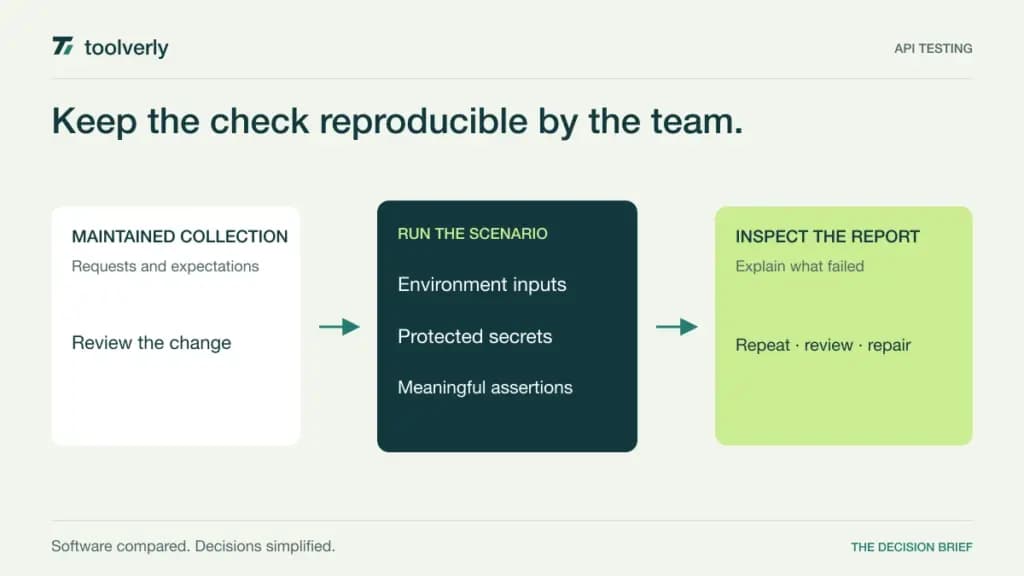
A saved API request can demonstrate that an endpoint responded once. A maintained API test explains what should happen across environments, what the response must contain, and how another person can reproduce a failure. Teams selecting API testing software need to consider collections, assertions, test data, secrets, and automation together. Otherwise, a useful personal request folder becomes a fragile release dependency.
This comparison covers Postman, Insomnia, Bruno, Hoppscotch, and ReadyAPI. The decision is executing requests and repeatable checks. It differs from publishing a reference in our API documentation comparison and organizing release evidence in our test management comparison.
Official sources were checked on October 6, 2026. No throughput benchmarks, vendor trials, or security results are claimed. A successful assertion is evidence about that check and environment; it is not a guarantee that the whole API is correct. The buying question is how the team maintains useful checks as the service changes.
Five API testing workflows compared
| Product | Best fit | Main strength | Meaningful tradeoff | Pricing reference |
|---|---|---|---|---|
| Postman | Teams wanting a broad API workspace | Collections, runners, mocks, and collaboration | Automation and governance require scope review | Free; Solo $9/month and Team $19/user/month, annual billing |
| Insomnia | Client testing with storage choices | Local, Git, and cloud projects plus Inso CLI | Git collaboration and mock allowances vary by plan | Free Essentials; paid user plans |
| Bruno | Teams reviewing collections in Git | Local plain-text collections beside code | Repository and secret discipline remain team responsibilities | Free; Pro $6 and Ultimate $11/user/month, annual billing |
| Hoppscotch | Accessible client and shared workspace use | Requests, scripts, and collection runs | Cloud and self-hosted scope should be priced separately | Free; cloud Business $6 and Enterprise $11/user/month, annual billing |
| ReadyAPI | QA-led multi-protocol testing | Functional tests with performance and virtualization options | Modules and execution licensing need a configured proposal | Request current package pricing |
Postman
Postman brings an API client, collections, environments, runners, and mocks into a wider platform. The current Free plan lists core tools and collection-runner and performance-testing runs. Solo adds data-driven testing with exports and expanded monitoring; Team adds collaboration and basic role-based access controls. This breadth is useful when several roles need to work from the same API artifacts.
The strength is keeping requests and supporting workflows together. It suits teams that want a shared workspace rather than each engineer maintaining an isolated folder. During evaluation, ask a colleague to run a collection with a different environment and explain the failure without copying a secret into a request description.
Current annual-billing prices are $9/month for Solo and $19 per user/month for Team, with Enterprise quoted. These are current package names rather than historical Basic or Professional assumptions. AI credits, monitoring allowances, private runners, and security add-ons have their own boundaries. The tradeoff is platform scope: confirm automated execution, private workspace, and governance needs before assuming the paid seat price covers every operation your pipeline will perform.
Insomnia
Insomnia offers a multi-protocol client, testing, and local, Git, or cloud storage choices. Its current Essentials plan includes Inso CLI for CI/CD automation, unlimited collection runs and environments, and Git Sync projects for up to three users. That makes it relevant to a small team wanting repeatable checks without adopting every part of a large API platform.
The strength is choosing how project artifacts are maintained while retaining a client-oriented workflow. It suits a team that wants to inspect requests interactively and run related checks automatically. Compare a local project and a Git-synchronized project using the actual repository permissions and secret injection method the company expects to keep.
Essentials is free. The pricing page presents paid Pro and Enterprise user rates alongside a monthly/annual selector; obtain the selected-term price before budgeting. Pro expands Git collaboration and role controls, while Enterprise adds SSO, provisioning, storage-policy enforcement, and vault integrations. Mock request allowances are explicitly limited on lower plans, with overage packages listed. The meaningful limitation is assuming unlimited collection runs mean unlimited hosted mocks or unrestricted organizational governance.
Bruno
Bruno describes itself as a Git-native client with collections stored as plain-text files on the local filesystem. Those artifacts can live beside the application code and follow normal branch, review, and merge procedures. Its current site describes OpenCollection YAML; teams should review the format supported by their chosen version rather than relying on an old migration guide.
The strength is making API collections reviewable through an existing developer workflow. It suits engineering teams that want changes to requests and assertions discussed with related service changes. This model places responsibility on the repository: define where examples, environment configuration, and secret references belong so private values do not become permanent commit history.
The Open Source edition is free. Pro is $6 per user/month and Ultimate $11 per user/month, both billed annually on the reviewed page. Paid tiers add deeper Git integration, administration, and support; enterprise integrations should be checked against the matrix. The limitation is expecting local files alone to supply shared operational governance. Assign code owners and a CI maintainer, and verify that the required runner and reporting workflow is covered by the edition you select.
Hoppscotch
Hoppscotch’s Free plan includes REST, GraphQL, and real-time API testing, collections, environments, pre-request scripts, tests, and a collection runner. Its paid cloud Business plan adds team workspaces, shared collections, real-time collaboration, API documentation publishing, and mocking. This makes it useful when people need a convenient shared request workflow as well as individual exploration.
The advantage is a relatively clear progression from personal requests to team collaboration. It suits teams that want colleagues to inspect and reuse an API scenario without making a full platform contract the first step. Demonstrate the actual network path to a private development service and decide how browser or desktop access will work in your environment.
The reviewed cloud annual plans list Business at $6 and Enterprise at $11 per user/month. Enterprise adds identity controls, role-based access, SAML/OIDC, SCIM, and audit logs. The page also has cloud/self-host selectors, so these cloud figures should not be transferred to a self-hosted deployment. Infrastructure and ongoing operation belong in that estimate. The tradeoff is selecting the appropriate hosting and access model before treating a lightweight client experience as a complete team deployment.
ReadyAPI
ReadyAPI targets testers managing functional API checks with limited scripting and scripting where needed. Its current product page describes REST, SOAP, Kafka, JDBC, and JMS validation, creating tests from API definitions or traffic, and CI/CD integrations. The broader offering also presents performance testing, service virtualization, and TestEngine execution as distinct capabilities.
The strength is a QA-oriented suite for scenarios that extend beyond one HTTP request. It suits organizations with multi-step service checks, unavailable dependencies, or several protocols in a single test program. Ask the vendor to show how assertions, test data, and environment configuration are maintained together and what changes when those tests run unattended.
The reviewed public pricing page offers API Test packages and contact routes without a sufficiently detailed current rate or entitlement table to support a complete numerical comparison. Request a proposal naming functional testing, performance, virtualization, execution workers, concurrent use, and renewal terms. Do not assume the purchase of a functional authoring tool includes every load or virtual-service capability. The limitation is a larger commercial and operational evaluation than a free client requires.
Evaluate maintenance as well as execution
Use one non-production service and a small set of authorized scenarios: a successful response, a validation error, an authentication failure, and a sequence requiring data from an earlier request. Check that failures identify the broken expectation rather than merely returning a red status. Preserve sanitized examples that another teammate can understand.
Next, change a field in the service contract. Inspect the collection diff, update the assertion, run it in CI, and locate the report. Review how tokens are injected and refreshed, who can edit shared environments, and which outputs might contain private response data. A repeatable process matters more than the number of sample requests a demo includes.
Postman fits broader API collaboration; Insomnia storage choices and client automation; Bruno repository-centered maintenance; Hoppscotch accessible shared requests; and ReadyAPI QA-led service testing. Select around the protocols, artifact ownership, and unattended execution your team needs. Keep a named owner for test data and stale checks so a passing suite continues to represent meaningful evidence.
Official sources
- Postman current plans
- Insomnia storage and execution packages
- Bruno collection workflow and edition pricing
- Hoppscotch cloud and self-host plan selector
- ReadyAPI capabilities and package pricing route
Original illustration by Toolverly. Read about our publication or send a correction.